Short-Term Government Bonds Needed for Won Stablecoin Reserves
Kim Pilkyu: "Sufficient Demand Expected If Issued"
An analysis has found that improvements to the short-term government bond issuance system are necessary for the introduction of a Korean won stablecoin. In Korea, the absence of short-term government bonds may pose limitations in establishing requirements for reserve assets when introducing a won-denominated stablecoin.
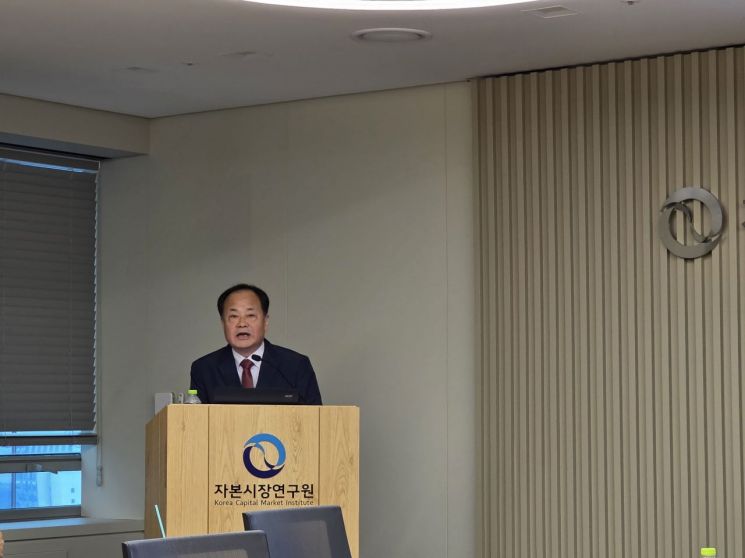
Kim Pilkyu, Senior Research Fellow at the Korea Capital Market Institute, stated at the KCMI Issue Briefing "Stablecoins and Short-Term Government Bonds," held at the Financial Investment Center Building in Yeouido, Seoul on August 11, that "amid the enactment of the U.S. GENIUS Act and the surge in the issuance of dollar stablecoins, discussions on introducing a won stablecoin are also active domestically." He added, "However, the absence of short-term government bonds could become an obstacle to securing reserve assets."
Reserve assets, which are central to stablecoins, guarantee price stability and the ability to meet redemption requests. In the United States and the European Union, relevant laws mandate the use of highly liquid, risk-free assets such as short-term government bonds as reserve assets. Major stablecoins such as Tether (USDT) and USD Coin (USDC) also mostly hold short-term government bonds.
However, Kim pointed out that Korea does not issue short-term government bonds, which may create limitations when establishing requirements for reserve assets in the introduction of a won stablecoin. Under the National Finance Act, Korea does not issue short-term government bonds due to National Assembly approval regulations based on the total issuance amount.
In addition, ultra-short-term matured government bonds account for only 1.8% of the total, and fiscal securities are unsuitable as reserve assets because they must be fully redeemed by year-end. Monetary stabilization bonds are also becoming less frequently issued, with a declining proportion of short-term issues, making sufficient supply difficult and presenting liquidity constraints.
Kim emphasized, "Despite Korea's developed government bond market, it is the only country that does not issue short-term government bonds with maturities of less than one year." He pointed out that while matured government bonds, fiscal securities, and monetary stabilization bonds could be alternatives, they are limited in terms of supply volume and liquidity.
Therefore, he explained that when considering the introduction of a won stablecoin, it is necessary to establish available reserve assets by introducing short-term government bonds. He also expected that short-term government bonds would play a significant role in fiscal funding and as short-term investment instruments.
Kim stated, "Short-term government bonds contribute to the government's flexible funding, and government bond investors have different motivations depending on the maturity. While medium- and long-term government bonds are used as materials for risk-free investment products for various investors, short-term government bonds are mainly used as underlying assets for short-term financial products or for managing temporary surplus funds."
However, he suggested that since the issuance of short-term government bonds could lead to an apparent increase in national debt through more frequent refinancing, it is necessary to revise the National Finance Act to change the government bond issuance limit standard from 'total issuance amount' to 'net increase' or 'outstanding balance.'
Regarding product structure design, he proposed first introducing one-year maturity short-term government bonds, and then gradually expanding to various maturities such as three and six months in the long term. He also emphasized the need to adopt a discount bond structure to facilitate the introduction of a spot rate and to refine the yield curve, as well as to establish an issuance strategy that reflects the demand of major investor groups.
He said, "To enhance the stability and liquidity of stablecoins, it is necessary to establish requirements for appropriate reserve assets in consideration of domestic market conditions, and efforts to improve market conditions must also follow." He added, "It is necessary to improve the systems that restrict the introduction of short-term government bonds and to establish measures for their efficient introduction."
Kim predicted that if short-term government bonds are introduced in Korea, there would be sufficient demand. He explained, "Recently, as the issuance volume of monetary stabilization bonds has decreased and issuance has focused on longer maturities, funds centered on short-term investments such as money market funds (MMFs) have no products to manage. National Pension Service and institutions also hold temporary surplus funds in the form of cash equivalents."
He further emphasized, "The key point for foreign investors is whether they can sell in the market when needed. Ultimately, it is about bond liquidity, and from that perspective, there would also be demand for short-term government bonds from foreign investors."
© The Asia Business Daily(www.asiae.co.kr). All rights reserved.

















