As the United States considers restricting imports of polysilicon?a key material for solar power and semiconductors?Korean companies investing in the U.S. have requested exemptions. Hanwha Q Cells and OCI, among others, have submitted statements to the U.S. Department of Commerce, urging the government to block unfair trade practices involving Chinese products but to ease tariffs and import restrictions for other companies.
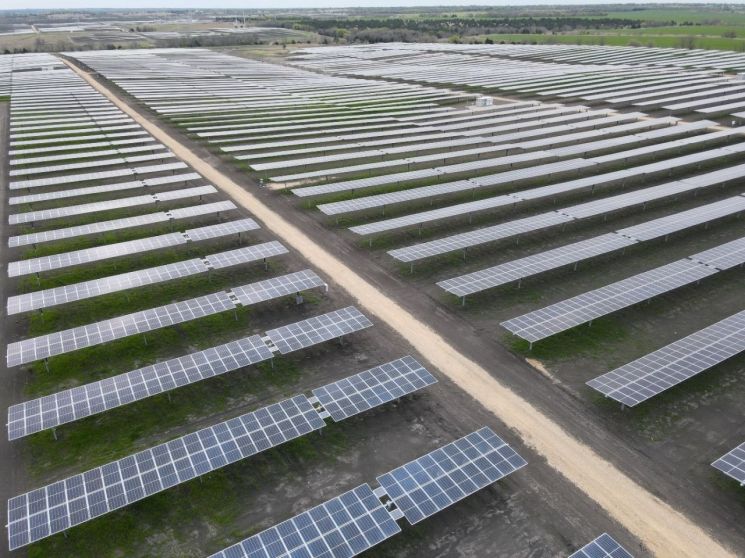 Hanwha Q Cells' 168-megawatt (MW) solar power plant under construction and operation in Texas, USA. Hanwha Solutions
According to industry sources on August 11, Hanwha Q Cells, in its statement to the U.S. Department of Commerce, proposed imposing a tariff of $10 per kilogram (approximately 13,900 KRW) on imported polysilicon. However, it recommended establishing a tariff rate quota (TRQ) for solar-grade polysilicon imported from Germany and Malaysia, allowing duty-free imports of up to 20,000 tons per country annually. The company also suggested allocating TRQ volumes for solar ingots, wafers, and cells made from polysilicon produced in the U.S., Germany, or Malaysia, but proposed imposing a flat tariff of 20 cents per watt on all solar modules, regardless of their country of origin.
The administration of Donald Trump is currently conducting a Section 232 investigation under the Trade Expansion Act to determine whether measures such as tariffs are needed to restrict polysilicon imports, given its importance to national security.
OCI, which produces polysilicon for semiconductors, emphasized that it has completely excluded forced labor and foreign entities of concern (FEOC) from its supply chain. The company requested that semiconductor-grade polysilicon not manufactured by FEOC and produced under fair trade practices be excluded from the investigation. Since 2023, OCI has sourced its raw material, metallurgical-grade silicon, not from China but from Brazil, France, and Africa.
© The Asia Business Daily(www.asiae.co.kr). All rights reserved.
![Clutching a Stolen Dior Bag, Saying "I Hate Being Poor but Real"... The Grotesque Con of a "Human Knockoff" [Slate]](https://cwcontent.asiae.co.kr/asiaresize/183/2026021902243444107_1771435474.jpg)















