88% of Squamous Cell Laryngeal Cancer and 86% of Squamous Cell Lung Cancer Attributable to Smoking, Says Health Insurance Research Institute
A study has found that smokers who have smoked for over 30 years, or who have smoked a pack a day for more than 20 years (20 pack-years), are 55 times more likely to develop small cell lung cancer and 21 times more likely to develop squamous cell lung cancer compared to non-smokers.
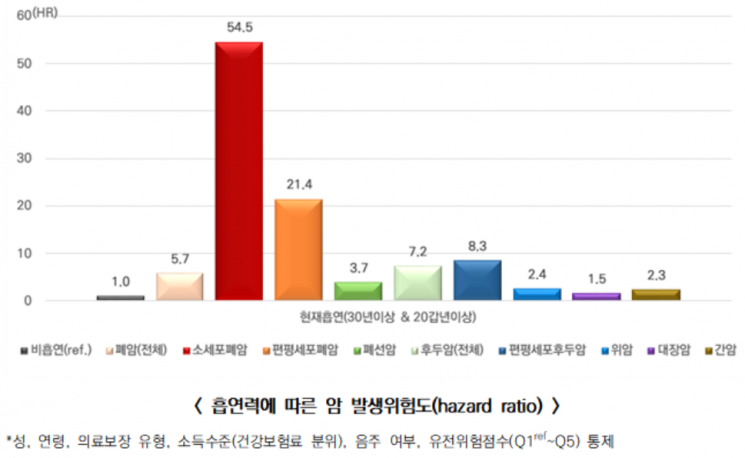
On August 11, the Health Insurance Research Institute of the National Health Insurance Service announced the results of a comparative analysis of the cancer risk and attributable risk due to smoking by cancer type, targeting major cancers with high incidence rates in Korea. The analysis was conducted among people with the same lifestyle and Polygenic Risk Score (PRS) levels.
The results showed that current smokers who have smoked for more than 30 years and more than 20 pack-years have a 54.5 times higher risk of developing small cell lung cancer compared to non-smokers. This is significantly higher than the risk for colorectal cancer (1.5 times), liver cancer (2.3 times), and stomach cancer (2.4 times). The degree to which smoking contributes to the development of small cell lung cancer was also extremely high at 98.2%, compared to 28.6% for colorectal cancer, 50.8% for stomach cancer, and 57.2% for liver cancer.
This study was conducted by the Health Insurance Research Institute and the Graduate School of Public Health at Yonsei University (Professor Ji Sunha's research team). The researchers tracked and analyzed health checkup data, Polygenic Risk Score (PRS) data, national cancer registry data, and health insurance eligibility data for 136,965 individuals who underwent health screenings at 18 private screening centers nationwide between 2004 and 2013, following them up until 2020.
The analysis of cancer risk showed that, even when general characteristics, lifestyle, and PRS levels were the same, the risk of developing small cell lung cancer, squamous cell lung cancer, and squamous cell laryngeal cancer due to smoking was higher than for other cancer types. Among current smokers with more than 30 years and 20 pack-years of smoking, the risk of developing small cell lung cancer was 54.5 times higher, squamous cell lung cancer 21.4 times higher, and squamous cell laryngeal cancer 8.3 times higher than for non-smokers. In contrast, the risk was 2.4 times higher for stomach cancer, 2.3 times higher for liver cancer, and 1.5 times higher for colorectal cancer.
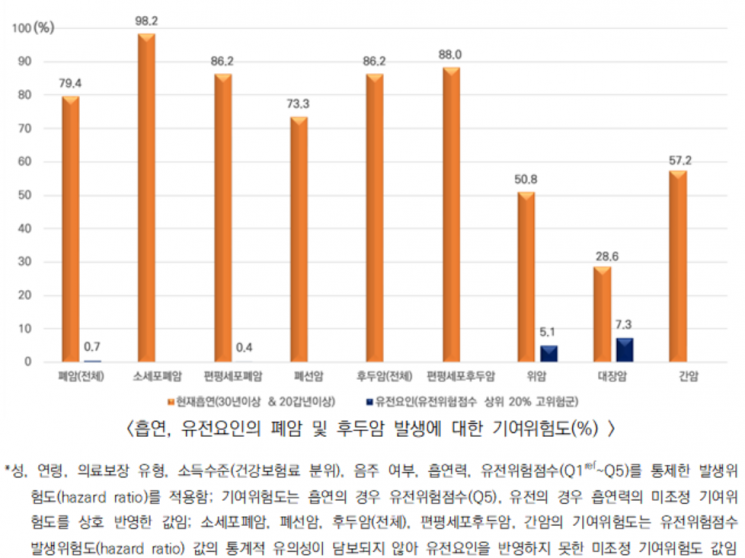
In the analysis of attributable risk, smoking accounted for 98.2% of small cell lung cancer cases among current smokers with more than 30 years and 20 pack-years of smoking, representing the vast majority. Smoking was also responsible for 88.0% of squamous cell laryngeal cancer cases and 86.2% of squamous cell lung cancer cases, confirming that smoking is the primary cause of these cancers, which have been the subject of tobacco litigation. In contrast, the contribution of smoking to colorectal cancer was 28.6%, to stomach cancer 50.8%, and to liver cancer 57.2%, which are significantly lower than for the litigated cancers, indicating that many other factors besides smoking have a substantial impact, according to the research team.
Additionally, the contribution of genetic factors to the development of squamous cell lung cancer was extremely low at 0.4%. In comparison, genetic factors contributed 7.3% to colorectal cancer and 5.1% to stomach cancer, making the impact of genetics 18.3 times and 12.8 times higher, respectively, than for squamous cell lung cancer.
Lee Sunmi, head of the Health Insurance Policy Research Office at the Health Insurance Research Institute, stated, "This study analyzed the contribution of smoking and genetic factors to cancer development by utilizing polygenic risk scores for the largest number of cancer types in Korea." She emphasized, "For lung and laryngeal cancers, the contribution of smoking to cancer development is overwhelmingly higher than for other cancers, while the impact of genetic factors is extremely low, making the causal relationship between smoking and the development of lung and laryngeal cancers even clearer."
© The Asia Business Daily(www.asiae.co.kr). All rights reserved.
![Clutching a Stolen Dior Bag, Saying "I Hate Being Poor but Real"... The Grotesque Con of a "Human Knockoff" [Slate]](https://cwcontent.asiae.co.kr/asiaresize/183/2026021902243444107_1771435474.jpg)
















