Four Key Areas: Economy, Employment, Environment and Health, and Resident Support
"Restarting the Gwangju Plant and Building the New Hampyeong Plant"
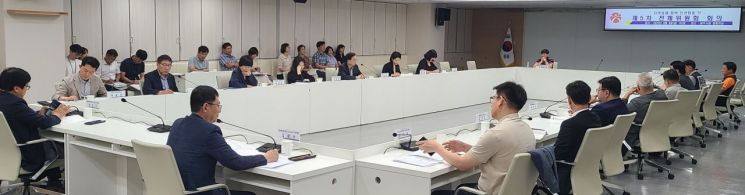 Kwangwan Ko, Deputy Mayor of Gwangju, attended the 5th General Meeting of the Public-Private Joint Special Task Force (TF) for Responding to the Kumho Tire Fire Damage held on the 8th at the city hall's medium conference room, sharing key achievements and seeking future response measures. Photo by Gwangju City
The "Public-Private Joint Special Task Force (TF) for Regional Economic Crisis Response," which was established to minimize the economic shock to the local economy caused by the Kumho Tire Gwangju Plant fire and to develop practical response measures, has concluded its regular meetings. The task force will continue to address current issues and unresolved tasks through its subcommittees.
On August 8, Gwangju City held the 5th General Committee Meeting of the Public-Private Joint Special Task Force for Responding to the Kumho Tire Fire Damage in the medium conference room at city hall, officially concluding the regular general meetings.
During the meeting, the task force shared key achievements and, together with the local community, discussed the restart of Gwangju Plant 1 and the relocation plan to the new Hampyeong plant, both of which were agreed upon between labor and management on July 30. The participants also explored future response measures.
The special task force, which was launched immediately after the Kumho Tire fire, established a response system centered on four subcommittees: economy, employment, environment and health, and resident support. The task force has been implementing practical measures in cooperation with district offices, related organizations, experts from various fields, and citizen representatives.
In the economic sector, efforts to revitalize local businesses and promote consumption included: concentrated hosting of festivals such as the 1913 Songjeong Station Market Beer Festa and the Gwangsan Songjeong Win-Win Festival; and a campaign encouraging all Gwangju City departments and public institutions to use nearby traditional markets and small businesses at least once a month.
To support small business owners and partner companies, the city implemented various financial and administrative measures, including: extension of maturity and repayment deferment for companies receiving policy funds such as management stabilization funds from Gwangju City; provision of special guarantees for small businesses worth 50 billion KRW in the second half of 2025; extension of maturity and provision of emergency management stabilization funds through cooperation with related agencies such as the Korea Credit Guarantee Fund; and guidance on applying for local tax payment deadline extensions and collection deferment systems.
In the employment sector, the city pursued multifaceted employment stabilization measures, including: applying for designation as an employment crisis area and a preemptive response employment crisis area; providing free labor consultations and empathy programs; operating employment support programs for employees on leave at partner companies; and offering information on support policies for affected workers and residents through the Gwangju City website.
In particular, the city prioritized employment stability for Kumho Tire workers and local economic recovery following the fire. Gwangju City actively supported the negotiation process by holding a total of five meetings with Kumho Tire labor and management (two with labor and three with management). As a result, the Gwangju plant will resume operations in October, and the phased relocation to the new Hampyeong plant will proceed.
In the environment and health sector, the city implemented response measures including: disclosing test results for hazardous chemicals in air and soil; installing cutoff walls and strengthening water quality monitoring in nearby streams; securing drone footage of the fire site to support future investigations and utilization; and holding resident briefings and preparing safety measures to prevent secondary damage before building demolition work.
In the resident support sector, the city handled more than 20,000 fire damage reports and processed over 8,000 compensation claims (by Kumho Tire); provided health and medical services through mobile health clinics; and worked to expand resident participation and alleviate community anxiety.
Kwangwan Ko, Deputy Mayor for Administrative Affairs, stated, "Although the regular general meetings of the Public-Private Joint Special Task Force have concluded, unresolved issues will continue to be discussed and monitored through the subcommittees." He added, "Gwangju City will take the resumption of operations at the Kumho Tire Gwangju plant and the construction of the new Hampyeong plant as opportunities to revitalize the local economy."
© The Asia Business Daily(www.asiae.co.kr). All rights reserved.

















