Return of Manrihwa and Podocarpus Macrophyllus
in the Form of Cuttings
Plants native to the Korean Peninsula, including Manrihwa and Podocarpus macrophyllus, have returned to Korea after 100 years. These plants were taken to the United States during the Japanese colonial period.
According to Yonhap News Agency on August 10, citing the Korea National Arboretum under the Korea Forest Service, the recently reintroduced Manrihwa is an individual collected from Mount Geumgang in 1917 by E.H. Wilson, a plant explorer from Harvard University's Arnold Arboretum, who then brought it to his home country. Both Manrihwa and Podocarpus macrophyllus have returned in the form of cuttings taken from the individuals that were exported at that time.
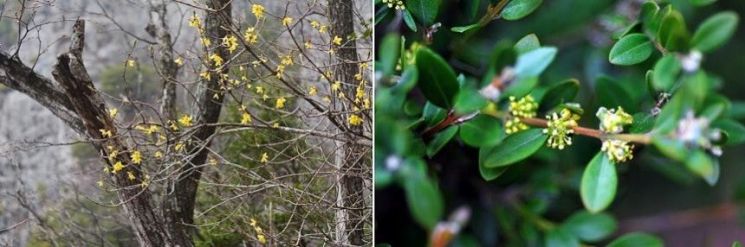
The Korea National Arboretum stated that while Manrihwa is an endemic plant of the Korean Peninsula and grows naturally in many places throughout the country, there are no known individuals from Mount Geumgang. Podocarpus macrophyllus is widely used as a hedge or ornamental plant in Korea, and its scientific name is 'Buxus microphylla var. koreana Rehder.'
Plant names are generally categorized into three types: scientific names, English names, and Korean names. Among these, the scientific name, as per international convention, often includes the location of discovery and the name of the discoverer or the person who named it. The Podocarpus macrophyllus that has returned to Korea this time is the specimen that served as the standard when an American botanist first described it as a new species. It is presumed that a Japanese botanist working in Korea in 1919 exported it during exchanges with the Arnold Arboretum.
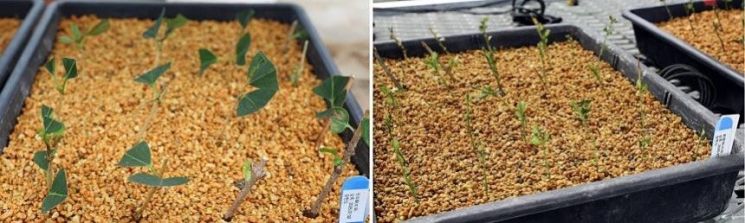
The Arnold Arboretum signed a Letter of Intent (LOI) for cooperation with the Korea National Arboretum during the World Botanic Garden Education Congress held at COEX in Seoul in June. As part of this, it provided 15 plant species, including Manrihwa and Podocarpus macrophyllus, in the form of cuttings, seedlings, and seeds.
Among these, Symplocos coreana and Spiraea longifolia, which were brought in as seeds, are species found only in North Korea and have not been confirmed to occur naturally in South Korea. However, in South Korea, the general public refers to ornamental Spiraea varieties with long leaves as Spiraea longifolia.
In connection with this, the Forest Museum is exhibiting photographs of plants and forest landscapes taken by Wilson during the Japanese colonial period, and the reintroduced plants will be open to the public only until August 17.
Additionally, the Korea National Arboretum is holding a photo contest titled "In Search of the Lost Records of Our Plants." The contest invites citizens to photograph the current appearance of seven locations (Ulleungdo, Pocheon, Jeju, Jirisan, Danyang, Cheonggyesan, and Seoul) where the Wilson expedition took photos, and compare them with images from 100 years ago.
© The Asia Business Daily(www.asiae.co.kr). All rights reserved.
![Clutching a Stolen Dior Bag, Saying "I Hate Being Poor but Real"... The Grotesque Con of a "Human Knockoff" [Slate]](https://cwcontent.asiae.co.kr/asiaresize/183/2026021902243444107_1771435474.jpg)
















