Deposit Protection Limit to Be Raised from 50 Million Won to 100 Million Won Starting in September
Funds Expected to Flow into Savings Banks
Concerns Over Polarization as Funds May Concentrate in Large Savings Banks
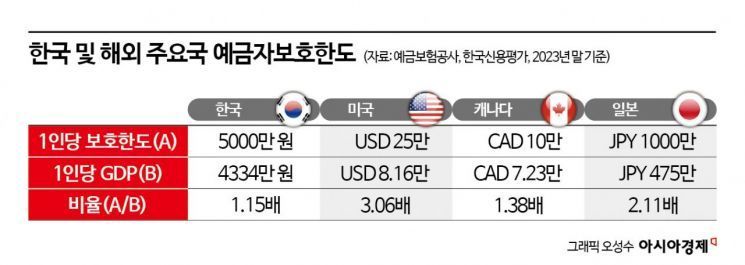
With the deposit protection limit set to rise to 100 million won starting next month, there are expectations that funds will increasingly move from major banks to secondary financial institutions such as savings banks and mutual finance companies. However, there are also concerns that customers are more likely to turn to large savings banks, which could deepen the polarization between large and small-to-medium-sized savings banks.
Deposit Protection Limit Raised for the First Time in 24 Years
According to the financial sector on August 11, the government will raise the deposit protection limit from the current 50 million won to 100 million won starting September 1. The increased limit will apply not only to banks, savings banks, and insurance companies protected by the Korea Deposit Insurance Corporation, but also to mutual finance institutions such as credit unions and agricultural cooperatives, whose deposits are protected by their respective central organizations. This is the first revision of the system in 24 years, since the limit was raised from 20 million won to 50 million won in 2001.
Both the government and the market believe that the higher deposit protection limit will likely lead to an inflow of funds into savings banks, which offer higher deposit rates compared to commercial banks. Savings banks are highly dependent on deposits, with deposits accounting for 85% of their total assets. Analysts point out that about 90% of all deposits at savings banks are within the protection limit, so the impact of the policy change will be significant and depositors are likely to respond quickly.
According to a report submitted to the National Assembly by the Financial Services Commission and the Korea Deposit Insurance Corporation, raising the deposit protection limit to 100 million won could increase savings banks’ deposits by 16-25%. Based on the 100 trillion won in deposits held by savings banks as of the end of March 2025, this could amount to as much as 25 trillion won.
However, there are concerns that the movement of funds may become concentrated in large savings banks, exacerbating polarization. According to Korea Ratings, among the 79 savings banks nationwide, the 30 banks with more than 1 trillion won in total assets accounted for 84% of all deposits as of the end of March 2025, while the five banks with more than 5 trillion won in assets accounted for 30%, indicating a strong concentration among large institutions.
If the deposit protection limit is raised to 100 million won, funds from customers who previously distributed large sums across multiple banks may become concentrated in top-tier savings banks. This could prompt small and medium-sized savings banks to raise their deposit rates competitively in an effort to prevent capital outflows.
 As market interest rates fall, banks are consecutively lowering savings and installment savings rates, causing funds to flow into secondary financial institutions such as savings banks. An interest rate notice is posted at a savings bank branch in Seoul. Photo by Jo Yongjun
Concerns Over Polarization as Funds May Flow to Large Savings Banks
If the concentration of funds in top-tier savings banks intensifies, small and medium-sized savings banks could experience capital outflows. For example, a customer who previously distributed 5 billion won across ten savings banks in 500 million won increments may now choose to deposit 1 billion won each in five savings banks with higher name recognition, increasing the likelihood that funds will shift from lesser-known small and medium-sized banks to well-known large ones.
Kwak Suyeon, senior researcher at Korea Ratings, analyzed, "Polarization among savings banks could undermine the deposit stability of small and medium-sized institutions and lead to a vicious cycle of further interest rate hikes."
As the deposit protection limit is raised, competition for deposit rates is expected to intensify, which could drive up funding costs and reduce the net interest margin (NIM) across the savings bank sector. Since the maturity of many savings bank deposits falls in the second half of the year and funding costs are already rising, the increase in the deposit protection limit starting in September could further accelerate competition for funding.

In particular, there are projections that small and medium-sized savings banks, which are left out in the competition for funds, will raise their deposit rates competitively, causing deposit rates to rise across the sector. In fact, some savings banks have recently been launching high-interest special products in a bid to attract deposit customers.
Senior researcher Kwak emphasized, "The increase in the deposit protection limit is expected to intensify the concentration of funds in large savings banks. If small and medium-sized savings banks raise deposit rates to prevent capital outflows, their funding costs will rise. In an effort to offset these costs, they may turn to high-risk, high-return loans such as real estate lending, which could increase management risks and should be carefully monitored."
© The Asia Business Daily(www.asiae.co.kr). All rights reserved.
![Clutching a Stolen Dior Bag, Saying "I Hate Being Poor but Real"... The Grotesque Con of a "Human Knockoff" [Slate]](https://cwcontent.asiae.co.kr/asiaresize/183/2026021902243444107_1771435474.jpg)

















