Office Workers Fear "Lack of AI Skills May Undermine Competitiveness and Lead to Undervaluation"
Employers Say "Employees with AI Proficiency Could See 18% Salary Increase"
Education Industry Expands Practical Training to Meet Growing Demand
"I feel pathetic just nodding my head whenever artificial intelligence (AI) comes up in meetings." This is a recent post on the anonymous workplace community 'Blind.' The author, who introduced herself as a fourth-year marketing professional, confessed, "I can barely use Excel, but my juniors automate tasks with Python and draft reports with ChatGPT. I feel anxious, as if I'm the only one falling behind." She added that although she knows she should learn AI and coding, she has no idea where to start and was seeking advice.
With the arrival of the AI era, the importance of AI utilization skills is growing in South Korea as well. In particular, among office workers, AI technology is increasingly recognized as a core element of job competitiveness, and there is a growing sense of crisis that those who fail to acquire these skills may be left behind.
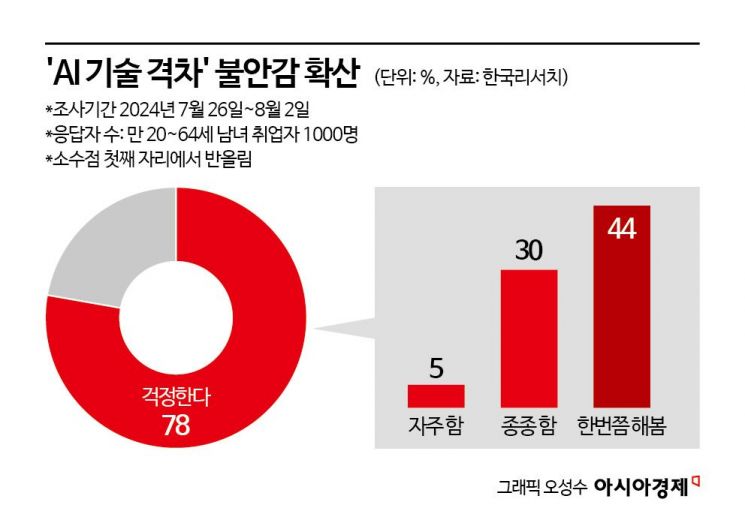
According to a survey conducted last year by Amazon Web Services (AWS), 85% of Korean employers expected their companies to transition into AI-based organizations by 2028, and they expressed willingness to offer at least an 18% salary increase to employees equipped with AI skills and literacy. Among employees, 87% believed that AI capabilities would have a positive impact on salary increases and career advancement, but 72% said they were not confident about which roles would allow them to make practical use of these skills. A survey by Korea Research also found that 78% of employed people felt anxious that their competitiveness would decline or be undervalued due to a lack of AI skills.
In response, the education industry has recently launched a series of practical AI training programs to address the growing anxiety among office workers. On August 8, Eduwill officially launched its 'AI Class,' offering courses designed to build practical skills. In particular, the 'ChatGPT Prompt All-in-One Class' is a comprehensive program that covers everything from introductory to practical applications for office workers. There is also a preparatory course for the nationally accredited AI certification, AICE Associate. An Eduwill representative stated, "This class will provide practical help for office workers to acquire AI skills that can be immediately applied in the workplace."
From August 12, Chunjae Education will begin the fall semester courses of the 'Chunjae IT Education Center.' The newly revamped curriculum reflects the rapidly changing technological environment and practical workplace demands, and is designed so that even those without a technical background can become practical talent. Park Geonye, head of the Digital Learning Division, said, "This curriculum overhaul is Chunjae Education's strategic investment to nurture practical talent in the AI era." The goal is to strengthen practical skills by focusing on three pillars: reflecting the latest trends, on-the-job mentoring, and project-based learning.
Tools to assess AI utilization and literacy levels have also emerged. On July 14, Ablearn released its 'AI Literacy Competency Assessment Tool.' The assessment items were developed with reference to the global AI literacy standards set by UNESCO and research from University Hospital Bonn in Germany, with a focus on attitudes and ways of utilizing AI rather than technical proficiency. CEO Park Jina said, "This assessment tool is both a standard and a starting point for realizing AI education," and added, "We will create learning experiences that lead to real change in the field going forward."
© The Asia Business Daily(www.asiae.co.kr). All rights reserved.


















