Shipbuilders and Steelmakers Enter Q3 Price Talks
Losses Mount Amid Low-Priced Chinese Competition
POSCO Reports Over 100 Billion Won Deficit Last Year
Industry Demands Price Normalization to 2023 Levels
Shipbuilders Express Concerns Over Rising Costs
Negotiations Seen as Turning Point for Pricing and Transaction Structure
The domestic steel industry, currently mired in severe stagnation, has begun demanding a normalization of plate prices to as much as 1 million won per ton in negotiations with the shipbuilding sector. The industry has determined that it can no longer bear the repeated losses incurred from shipbuilding orders. With the added burden of high U.S. tariffs, this round of negotiations is expected to mark a turning point for both the pricing system and the transaction structure, going beyond the usual quarterly procedures.
According to the steel industry on August 8, POSCO and Hyundai Steel are currently negotiating third-quarter plate prices with shipbuilders such as HD Korea Shipbuilding & Offshore Engineering, Hanwha Ocean, and Samsung Heavy Industries. Plates, which are steel sheets at least 6mm thick, are a key material used in shipbuilding. Steelmakers and shipbuilders have adjusted plate prices on a quarterly basis, and it is reported that the unit price was set at about 800,000 won per ton in negotiations for the first half of this year.
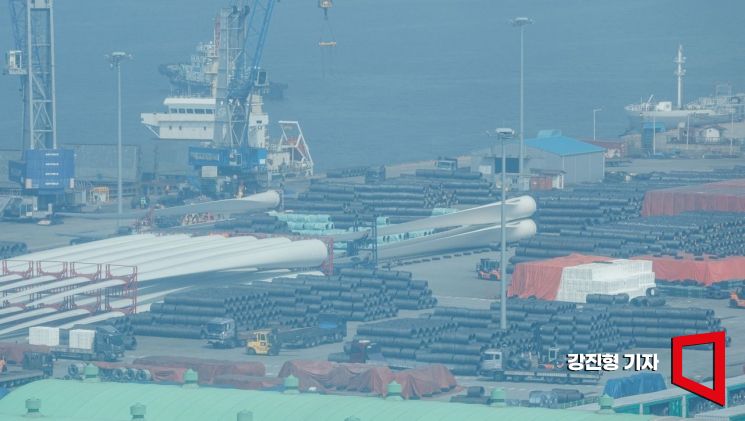
In the current negotiations, the steel industry is highlighting the structural deficit problem of shipbuilding plates. About half of all plate production is used for shipbuilding, but last year, a large influx of low-priced Chinese products meant that steelmakers could not receive fair prices and had to absorb losses. According to industry estimates, POSCO's share of shipbuilding plates exceeds 50%, while Hyundai Steel's share is around 40%. POSCO posted a deficit of over 100 billion won in its plate division last year, and Hyundai Steel also failed to avoid losses. A steel industry official stated, "The accumulated deficit from shipbuilding plates has reached an unsustainable level."
The steel industry is reportedly demanding a recovery of unit prices to the mid-900,000 won range per ton, up to a maximum of 1 million won. This matches the price level before the full-scale influx of Chinese plates in 2023. The industry emphasizes that this demand is closer to a 'normalization' aimed at restoring market price order to pre-disruption levels. An industry official commented, "Domestic plate prices are currently in a transitional phase toward regaining appropriate levels."
The steel industry believes that the government's imposition of anti-dumping duties on Chinese plates will have a positive effect on price recovery. This year, the government imposed anti-dumping duties of up to 38.02% on low-priced Chinese plates, leading to a sharp decline in ultra-low-priced imports. In April, when the anti-dumping duties were imposed, imports of Chinese medium and heavy plates dropped by 67% compared to the same period last year. As a result, the price of Chinese plates rose to the low to mid-800,000 won range. In addition, many analysts believe that the Chinese government's policy of production cuts will have a positive impact on the stability of steel supply and demand going forward.
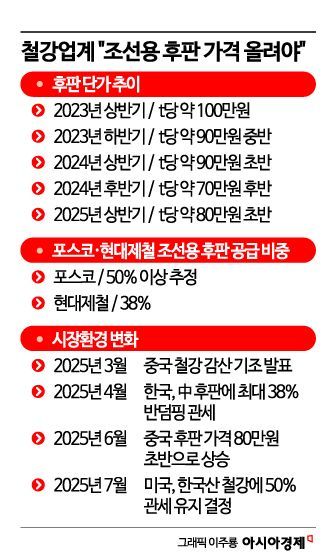
Recently, the U.S.-Korea tariff agreement is also expected to impact price negotiations with shipbuilders. With the United States maintaining a 50% tariff on Korean steel, sales to the U.S.?which had previously provided stable profits?are now inevitably affected. As a result, the industry believes it must at least reduce losses from shipbuilding plates, where deficits have been accumulating.
On the other hand, the shipbuilding industry argues that a plate price increase would significantly raise shipbuilding costs, and therefore insists on maintaining the first-half price level of around 800,000 won per ton. Shipbuilders are negotiating with the goal of freezing prices and are also planning to pursue cost reduction measures. A shipbuilding industry official said, "Plate prices are linked to international market prices," adding, "We are focusing on minimizing cost burdens."
© The Asia Business Daily(www.asiae.co.kr). All rights reserved.
![Clutching a Stolen Dior Bag, Saying "I Hate Being Poor but Real"... The Grotesque Con of a "Human Knockoff" [Slate]](https://cwcontent.asiae.co.kr/asiaresize/183/2026021902243444107_1771435474.jpg)
















