Goyang Records Lowest Fine Dust Levels in Eight Years
143 Tons of Fine Dust Reduced... Ultrafine Dust Down 35%, 53 New Green Spaces
Environmental Innovation from Old Diesel Vehicle Reduction to Urban Forests and ESS
Three Pillars: Transportation, Green Spaces, and Energy for a "Fine Dust-Free City"
Goyang Special City in Gyeonggi Province, led by Mayor Lee Donghwan, is showing tangible results in its challenge to become a city free of fine dust. In 2024, the concentration of fine dust in Goyang reached its lowest level in the past eight years, proving the effectiveness of various air quality policies promoted during the eighth popularly elected administration.
According to the Gyeonggi-do Air Pollution Information Center on August 8, the annual average concentration of fine dust (PM-10) in Goyang City last year was 34 ㎍/㎥, and the concentration of ultrafine dust (PM-2.5) was 18 ㎍/㎥. These figures represent decreases of 38% and 35%, respectively, compared to 2017. Notably, the city reduced approximately 143.74 tons of fine dust over the past three years, which is equivalent to the annual emissions of about 13,000 old diesel vehicles (Ministry of Environment, 2019).
Goyang Special City focused on the transportation sector, which is a major cause of air pollution. As of 2022, the transportation sector accounted for 48% of Goyang's ultrafine dust emissions (National Fine Dust Information Center, air pollutant emissions statistics). In response, the city has strengthened reduction measures across the entire transportation sector, including early scrapping of old diesel vehicles, replacement of construction machinery engines, and electrification retrofits.
From 2022 through the first half of this year, the city invested 16.6 billion KRW (including national and provincial funds) to support the early scrapping of 5,208 old diesel vehicles. It also actively subsidized 90% of the cost for emission reduction devices, engine replacements for construction machinery, and electrification retrofits for cargo trucks and forklifts.
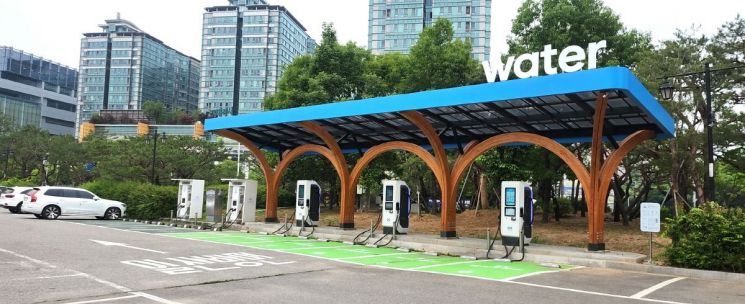
The expansion of eco-friendly vehicles is also accelerating. Over the past three years, Goyang City has supported the purchase of a total of 9,442 electric and hydrogen vehicles, and an additional 3,480 vehicles are scheduled for support in the second half of the year. Charging infrastructure has also expanded. Last year, the city secured 10 billion KRW through a Ministry of Environment grant and installed 167 chargers at city hall, KINTEX, Lake Park, and other locations. In total, 10,547 electric vehicle chargers have been established, including 1,086 rapid chargers.
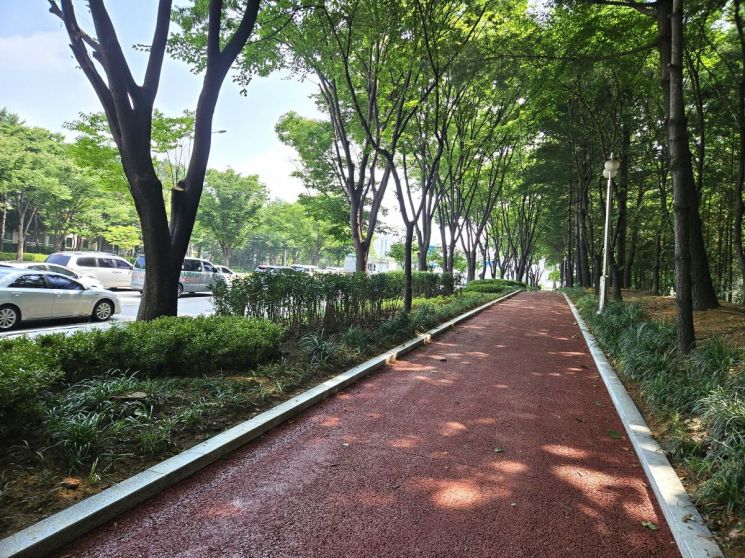
The city has also focused on expanding green spaces to reduce fine dust. From 2022 through the first half of this year, Goyang created 53 urban and pocket forests, securing 455,679 square meters of green space. This achievement surpasses the original target of 51 sites by 2026 by about one year.
In the second half of the year, the city plans to add 230,057 square meters of green space at 10 additional locations, including the Johyeon High School forest and the Soman Elementary School roadside flower beds. This is expected to help mitigate the urban heat island effect and expand recreational spaces for citizens.
Last year, the city supported the installation of fine dust-proof windows at 43 private and home-based daycare centers (with a 10% self-payment excluded). This year, the city plans to install them at 29 senior centers near power plants and 13 other facilities used by vulnerable groups. From last year to the present, a total of 586 daycare centers, senior centers, and facilities for people with disabilities have been equipped with air purifiers, and a free indoor air quality measurement service has also been provided to protect citizens' health rights.
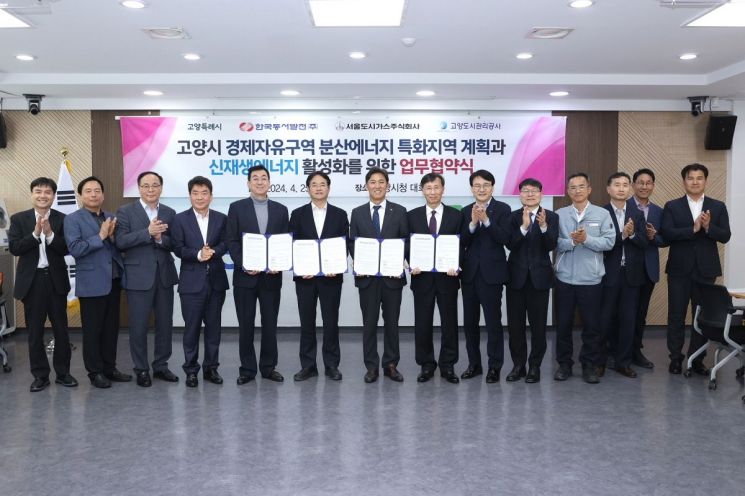 Goyang City-Korea East-West Power New Renewable Energy Activation Business Agreement Ceremony. Provided by Goyang Special City
The expansion of renewable energy is also a key pillar of Goyang City's "fine dust-free" strategy. From 2022 to 2024, the city invested a total of 14.3 billion KRW to support the installation of renewable energy facilities, including solar, solar thermal, and geothermal systems. Solar power facilities have also been installed and are in operation on public land, such as the slopes along Jayu-ro and Second Jayu-ro, and at Janghang Baseball Stadium.
In particular, in April last year, the city signed a business agreement with Korea East-West Power to promote renewable energy activation and is currently developing a strategy for a distributed energy-specialized zone in the JDS district, to be completed by October this year. If selected for the Ministry of Trade, Industry and Energy's competition next year, the city expects to transition to an eco-friendly, energy-independent city where energy production and consumption occur simultaneously.
Additionally, last month, for the first time in the country, the city signed an agreement with Gyeonggi Province, Korea Electric Power Corporation, and LS Electric for a "Shared ESS Demonstration Project." This project will install energy storage systems with capacities of 1 MW and 4 MW at Eoullimnuri and idle land in Jiyeong-dong, respectively, with a total investment of 3.2 billion KRW.
The shared ESS is a system that stores electricity during periods of low demand and supplies it during peak hours. Through this project, the city aims to achieve multiple effects, including stabilizing the power grid, preventing blackouts, and reducing electricity costs.
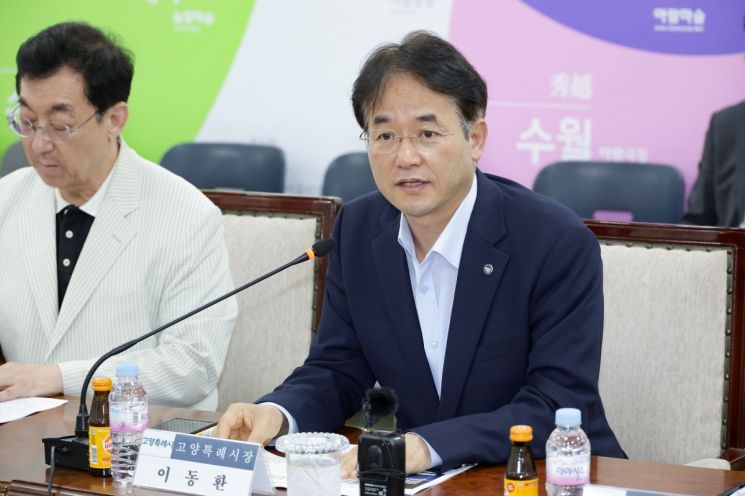 Lee Donghwan, mayor of Goyang Special City, is giving a greeting at the "Shared ESS (Energy Storage System) Demonstration Project Agreement Ceremony." Provided by Goyang Special City
Goyang City's air quality improvement policies are functioning as a sustainable strategy that enhances the city's value. Citizen-centered policies and future-oriented energy transitions are organically interconnected, establishing Goyang as a standard model for a "city with clean air."
Mayor Lee Donghwan stated, "Clean air is an urban resource closely linked to citizens' daily lives and quality of life," adding, "Because clear air can only be achieved through sustained, long-term efforts, we will continue our efforts to provide a pleasant atmospheric environment for our children in the future."
© The Asia Business Daily(www.asiae.co.kr). All rights reserved.



















