Enhanced ECG Monitoring and Cardiovascular Health Measurement
Sleep Management Possible with Bedtime Guide
"Helping Users Develop Healthy Habits... Leading the Future of Healthcare"
Acquisition of US Healthcare Company Xealth Signals Upcoming Collaboration
Samsung Electronics is targeting the healthcare market with the Galaxy Watch8, which features advanced sensor technology. The device calculates and notifies users of their optimal bedtime, and measures various physical indicators such as antioxidant levels, cardiovascular health, and electrocardiogram (ECG) data to help users develop healthy habits and practice preventive care. Based on the biometric data collected, Samsung also aims to build a digital healthcare ecosystem that connects users to medical services.
At a media briefing held on the morning of the 7th at the Samsung Electronics Press Room in Jung-gu, Seoul, Sung Min Choi, Senior Vice President of the Health Hardware Development Group at Samsung Electronics Mobile Experience (MX) Division, said, "The current healthcare system is focused on treatment, but I believe it should shift to prevention." He added, "Through the sensor technology of the Galaxy Watch, we want to help users detect abnormal signs early so they can prevent potential health issues."
 Choi Jongmin, Executive Vice President of Health Hardware Development Group at Samsung Electronics Mobile Experience (MX) Division, is presenting at a briefing held on the morning of the 7th at the Samsung Electronics Press Room in Jung-gu, Seoul. Photo by Samsung Electronics
During the event, Choi focused on introducing the sensor features embedded in the Galaxy Watch series. The sensors in the Galaxy Watch measure health indicators such as heart rate and sleep stress. By analyzing the data collected through these sensors, the device helps users develop healthy habits and also enables early detection and prevention of physical risk signals.
Samsung Electronics has been reducing the size of the Galaxy Watch sensors while increasing their precision. In 2021, the Galaxy Watch4 series was equipped with the '3-in-1 BioActive Sensor,' which integrates three existing sensors?an optical heart rate sensor (PPG), an electrical heart rate sensor (ECG), and a bioelectrical impedance analysis sensor (BIA)?into a single chip. To achieve this integration, Samsung redesigned the sensor layout.
In 2022, the company introduced non-contact, infrared-based skin temperature sensing technology. Last year, new LED colors (blue, yellow, purple, and ultraviolet) were added, enabling the monitoring of health indicators such as advanced glycation end products. The Galaxy Watch8 series, released this year, has improved wearing comfort to enhance detection accuracy.
The latest Galaxy Watch8 series incorporates all of these sensor technologies. The bedtime guide feature uses the 'Two-Process' sleep model, which calculates the optimal bedtime based on analysis of the user's biological rhythm (body clock) and sleep drive (fatigue), helping users develop better sleep habits. The algorithm was co-developed with a research team from the Korea Advanced Institute of Science and Technology (KAIST) and clinically validated through Samsung Medical Center.
The device is also the first in the world to feature an antioxidant index measurement function. Using the BioActive Sensor, it measures the level of carotenoids?an antioxidant in the body?in just five seconds, indicating whether the level is insufficient or adequate. Skin carotenoids serve as an indicator of fruit and vegetable intake and can also be used as a marker for cancer and chronic disease prevention.
Cardiovascular health measurement capabilities have also been enhanced. Vascular stress is assessed by measuring photoplethysmogram (PPG) signals, which are optical signals related to blood flow during sleep, to evaluate the health of the vascular system. The device measures blood volume and vascular stiffness, providing information on changes in vascular stress.
The ECG monitoring function has also been improved to detect ectopic beats. Ectopic beats are irregular heartbeats that are difficult to detect even during regular checkups, and if frequent, can lead to atrial fibrillation, increasing the risk of stroke and heart failure. The Watch8 detects ectopic heartbeats and provides analysis results on irregular heart rhythms.
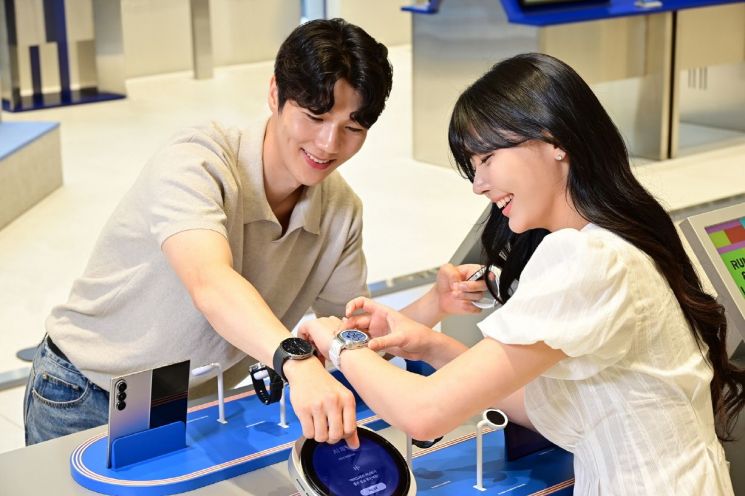 Models are experiencing the Galaxy Watch8 and Galaxy Watch8 Classic at the Samsung Store Hongdae 'Galaxy Studio'. Provided by Samsung Electronics
In addition to sensor technology, Samsung Electronics is working to build a healthcare ecosystem. The recent acquisition of the U.S. healthcare company Xealth earlier this month is part of these efforts. Xealth provides various digital healthcare solutions on a single platform, enabling medical professionals to assess patient conditions and prescribe or recommend digital healthcare solutions. The platform also allows real-time monitoring of patients' health status.
Samsung Electronics plans to use the Xealth platform to offer connected care services that link users' biometric data collected from wearable devices to professional medical services. Regarding collaboration with Xealth, Choi said, "The information obtained through the sensor technology of the Galaxy Watch can be valuable when connected to hospitals," and added, "We are currently finalizing the acquisition of Xealth, and once specific (collaboration) plans are established, we will be able to provide further details."
During the Q&A session, differences from competing products were discussed. When asked about the advantages of the Galaxy Watch compared to competitors such as the Apple Watch, Choi said, "Last year, we were the first to receive FDA approval for the early detection of sleep apnea, and competitors followed suit afterward. We are focusing on what new features we can add to the Galaxy Watch to benefit consumers."
Regarding the increasing market share of Chinese companies such as Xiaomi in the wearable device market, Choi explained, "Chinese products tend to use low-power chips, resulting in longer usage times but lower performance. It appears that the demand for longer battery life is driving the market share of Chinese products." He added, "The Galaxy Watch is being developed with the goal of providing users with high-level information, including advanced sensor technology."
© The Asia Business Daily(www.asiae.co.kr). All rights reserved.
![Clutching a Stolen Dior Bag, Saying "I Hate Being Poor but Real"... The Grotesque Con of a "Human Knockoff" [Slate]](https://cwcontent.asiae.co.kr/asiaresize/183/2026021902243444107_1771435474.jpg)
















