26 Consecutive Months of Surplus
Goods Account Surplus Reaches $13.16 Billion
Exports and Imports Both Rise... Semiconductor Exports Lead the Way
In June, South Korea recorded a current account surplus of $14.27 billion, breaking the previous all-time record. The expansion of the goods account surplus, driven by improvements in semiconductor exports, as well as an increase in the primary income account, including dividend income, compared to the previous month, contributed to this result.
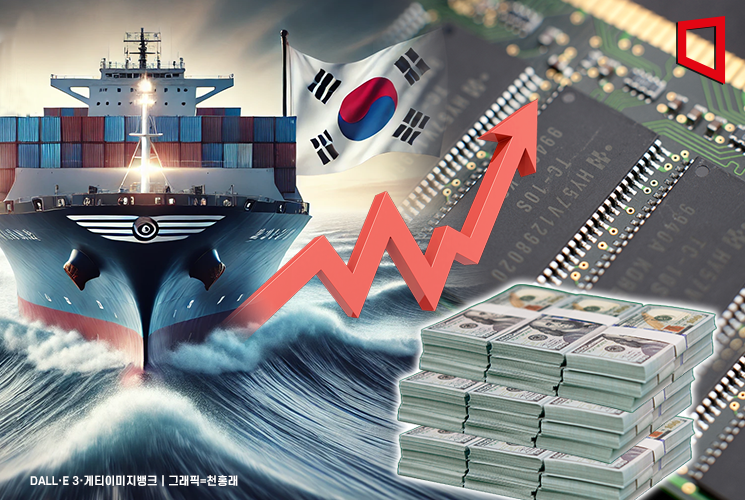
According to the "June 2025 Balance of Payments (Preliminary)" released by the Bank of Korea on August 7, South Korea's current account surplus in June was $14.27 billion. This marks the 26th consecutive month of surplus since May 2023, and the largest surplus ever recorded. The surplus widened compared to $10.14 billion in the previous month and $13.1 billion in the same month last year.
The goods account, which constitutes the largest portion of the current account, posted a surplus of $13.16 billion. The surplus increased compared to the previous month ($10.66 billion) and the same month last year ($12.13 billion). While the previous month saw a "recession-type surplus" with both exports and imports declining, this month both exports and imports turned to growth.
Exports amounted to $60.37 billion, up 2.3% from the same month last year. The continued strong performance of IT items such as semiconductors and computer peripherals, along with increases in non-IT items such as pharmaceuticals, led to a return to growth within one month. According to customs clearance data, semiconductor exports in June were $15.16 billion, up 11.3% year-on-year. Pharmaceutical exports increased by 51.8%. Ship exports also rose 64.8% to $2.33 billion. In contrast, exports of steel products and passenger cars decreased by 2.8% and 0.3%, respectively.
Imports reached $47.21 billion, a 0.7% increase from the same month last year. Imports of capital goods and consumer goods saw larger increases, while the decline in raw materials imports narrowed, resulting in a return to growth after three months. In June, raw material imports according to customs clearance data were $22.42 billion, down 6.4%. Imports of petroleum products (-33.1%), coal (-25.9%), and crude oil (-15.2%) decreased, while chemical products increased by 0.6%. Capital goods imports rose 14.8% to $19.81 billion, with increases in semiconductor manufacturing equipment (38.8%), semiconductors (22.7%), and transportation equipment (8.2%). Consumer goods imports also increased by 7.6% to $8.49 billion. Direct consumer goods imports rose by 10.9%, and passenger car imports increased by 7.3%.
The services account, which includes the travel account, posted a deficit of $2.53 billion, widening from the previous month's deficit of $2.28 billion. The travel account deficit expanded to $1.01 billion as the number of inbound travelers decreased due to the end of the May holiday effect.
The primary income account recorded a surplus of $4.16 billion, mainly due to dividend income. The surplus widened compared to the previous month's $2.15 billion. This was due to an increase in dividend income, as well as a decrease in dividend payments resulting from the base effect of the previous month.
Net external assets in the financial account, which subtracts liabilities from assets, increased by $17.29 billion. In direct investment, overseas investment by domestic residents increased by $3.92 billion, while foreign investment in South Korea increased by $740 million. In securities investment, overseas investment by domestic residents increased by $9.84 billion, mainly in stocks, while foreign investment in South Korea increased by $5.41 billion, mainly in bonds. Derivatives decreased by $1.23 billion. In other investments, assets increased by $6.89 billion, mainly in loans, while liabilities decreased by $1.01 billion, mainly in borrowings. Reserve assets increased by $3 billion.
© The Asia Business Daily(www.asiae.co.kr). All rights reserved.
![Clutching a Stolen Dior Bag, Saying "I Hate Being Poor but Real"... The Grotesque Con of a "Human Knockoff" [Slate]](https://cwcontent.asiae.co.kr/asiaresize/183/2026021902243444107_1771435474.jpg)
















