Tariff Exemption for Companies Manufacturing or Investing in the U.S.
Apple Announces $600 Billion Investment in the United States
Despite 'Most-Favored-Nation Treatment' in Korea-U.S. Trade Deal, Actual Tariff Rates May Still Cause Damage
On August 6 (local time), U.S. President Donald Trump announced plans to impose approximately 100% item-specific tariffs on semiconductors. This move is interpreted as a strategy to promote domestic semiconductor manufacturing within the United States and to strengthen control over the semiconductor supply chain. Semiconductors are the second-largest Korean export to the United States after automobiles, so the actual tariff rate applied is expected to have a significant impact on exports.
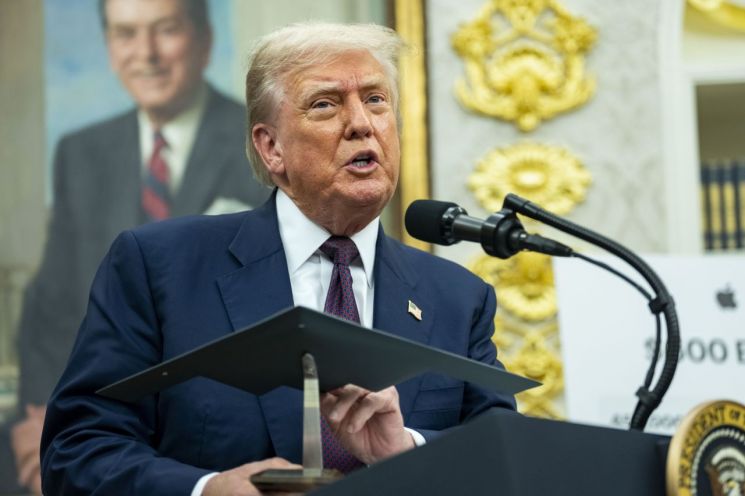
President Trump made the announcement at a White House event where Apple unveiled its U.S. facility investment plans. He stated, "We will impose roughly 100% item-specific tariffs on all integrated circuits (chips) and semiconductors produced outside the United States." He emphasized, "However, if a company commits to manufacturing in the United States, there will be no tariffs at all," adding, "This is a very big statement."
He reiterated, "In other words, we will not impose tariffs on companies that either manufacture in the United States or have pledged to invest, regardless of their employment or production scale." He also warned, "If for any reason a company claims to be under construction but later changes its mind, we will charge the cumulative amount," adding, "That money must be paid."
The specific timing for the semiconductor tariffs was not mentioned. President Trump stated in a CNBC interview the previous day that he plans to announce additional item-specific tariffs, including on semiconductors and pharmaceuticals, "next week or so," raising the possibility that an announcement could be made as early as next week.
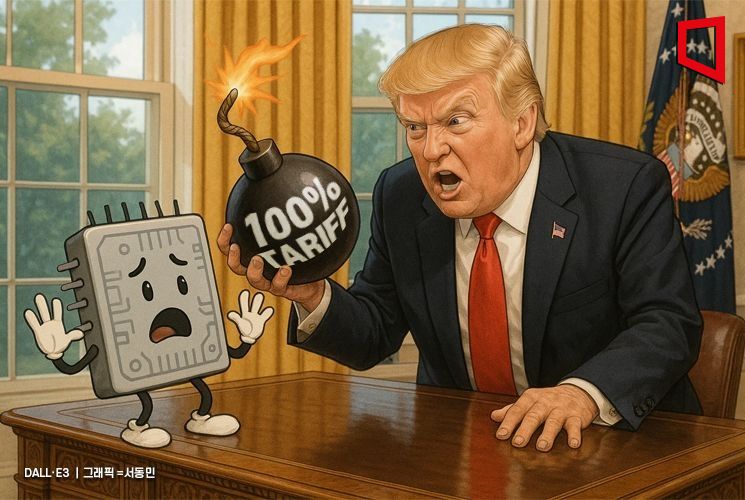
The U.S. media outlet Axios analyzed that, given semiconductors are foundational technology for automobiles, electronics, and medical devices, President Trump's move is seen as a strategic effort to bring global semiconductor supply chain leadership to the United States. Reuters also interpreted President Trump's announcement of a 100% tariff on semiconductors as a shift from the Biden administration's subsidy-focused policy to a more coercive approach, using economic sanctions to strengthen the domestic semiconductor industry.
President Trump's tariff policy aligns with the broader push to expand domestic manufacturing in the United States. Apple's commitment to invest $100 billion in U.S. manufacturing is seen in the same context. At the event, President Trump stated, "Apple will invest $600 billion in the United States over the next four years," noting that "this is $100 billion more than originally planned."
Semiconductors are the second-largest Korean export to the United States after automobiles, so this measure is expected to have a considerable impact on Korea as well. According to the Korea International Trade Association (KITA), Korea's semiconductor exports to the United States last year amounted to $10.6 billion (approximately 14.7 trillion won). In nominal terms, the share of U.S.-bound exports was 7.5%, lower than China (32.8%), Hong Kong (18.4%), Taiwan (15.2%), and Vietnam (12.7%). However, since a significant portion of semiconductors produced in Korea are assembled or processed in third countries like Taiwan before being exported to the United States, the actual U.S. market dependency is considered higher. A report by the Bank of Korea analyzed that if a 10% tariff is applied to imported semiconductors, semiconductor exports could decrease by 0.2%.
The Korean government stated that it secured "most-favored-nation treatment" regarding semiconductor tariffs in the Korea-U.S. trade agreement concluded on July 30. However, depending on the actual tariff rate applied, significant damage to exports may be unavoidable.
Some have pointed out that tariffs alone are unlikely to significantly increase domestic manufacturing in the United States, citing structural limitations such as process and cost burdens and the relocation of production overseas. The Financial Times (FT) of the United Kingdom reported that high tariffs alone have limited effectiveness and that targeted tariffs on key components, combined with industrial policy and infrastructure investment, may be more effective.
Meanwhile, Apple announced in a press release that it is developing innovative next-generation chip manufacturing technology in collaboration with Samsung at Samsung's semiconductor plant in Austin, Texas. This is interpreted as part of Apple's plan to rebuild its global supply chain around the United States and to strengthen advanced manufacturing capabilities in the U.S. through technical collaboration with Samsung.
Separately, President Trump was asked whether, as with India?which was subjected to a 25% "secondary tariff" due to imports of Russian oil?he would impose a secondary tariff on China, another major importer of Russian energy. He responded, "That could happen."
© The Asia Business Daily(www.asiae.co.kr). All rights reserved.
![Clutching a Stolen Dior Bag, Saying "I Hate Being Poor but Real"... The Grotesque Con of a "Human Knockoff" [Slate]](https://cwcontent.asiae.co.kr/asiaresize/183/2026021902243444107_1771435474.jpg)

















