Court Administration and Ministry of Justice Express Mixed Views
on Mandatory Cumulative Voting and Expansion of Separate Election
of Audit Committee Members Proposed by Democratic Party
Regarding the so-called "stronger Commercial Act" amendment bill, which the ruling party has announced will be processed at the National Assembly in August, the National Court Administration has expressed some concerns, stating that "a thorough review of its necessity, effectiveness, and potential side effects must come first."
Regarding the so-called "stronger Commercial Act" amendment bill, which the ruling party has announced will be processed at the National Assembly in August, the National Court Administration has expressed some concerns, stating that "a thorough review of its necessity, effectiveness, and potential side effects must come first."
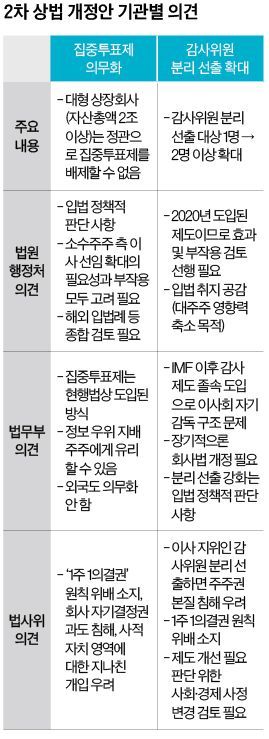
The amendment to the Commercial Act, which passed the National Assembly Legislation and Judiciary Committee (Legislation and Judiciary Committee) on August 1, was proposed by Lee Jungmoon (age 52, 33rd class of the Judicial Research and Training Institute), a lawmaker from the Democratic Party of Korea, with the aim of strengthening the rights of minority shareholders. For large listed companies with total assets of 2 trillion won or more, it includes provisions that △prohibit the exclusion of cumulative voting from the articles of incorporation, and △expand the scope of separate election of audit committee members to two or more members.
Regarding cumulative voting, the National Court Administration stated in its review report to the National Assembly Legislation and Judiciary Committee that while this is a matter of legislative policy decision, it is also "a question of how broadly to recognize the possibility for minority shareholders to appoint board members." The administration emphasized that "a decision should be made after comprehensively considering the shareholder composition of Korean companies, the necessity of minority shareholder board members, the degree of potential side effects, and overseas legislative examples."
On the issue of separate election of audit committee members, the National Court Administration pointed out that "given the criticisms of the separate election method and the fact that it was first introduced in December 2020, a comprehensive review of the effects and side effects of the newly established separate election system is necessary before expanding it to all audit committee members and further restricting the voting rights of major shareholders for outside directors who serve as audit committee members." However, the administration also stated, "Compared to the collective election method, we agree with the legislative intent in that restricting the voting rights of major shareholders allows for the appointment of audit committee members independent from the influence of major shareholders."
The Ministry of Justice, which is the main government agency in charge, also expressed the view that a cautious approach is necessary. Regarding cumulative voting, the Ministry of Justice noted that "when cumulative voting is implemented, not only the share ratio but also voting strategies can determine the outcome of board member appointments, and there are opinions that this ultimately benefits controlling shareholders who have an informational advantage, so this should be considered." The ministry also pointed out that "most states in the United States, as well as the United Kingdom, Germany, France, and Japan, do not make cumulative voting mandatory." However, the ministry added, "Cumulative voting is already a voting method introduced under current law, and making it mandatory to expand the possibility for minority shareholders to appoint board members is a matter of legislative policy decision."
Regarding the expansion of separate election of audit committee members, the Ministry of Justice stated that "since the audit committee system was hastily introduced during the IMF (financial crisis) in 1997-1998, the board of directors has become a self-monitoring structure that serves as both the executive and supervisory body, which is considered a key reason for the weakening of the board's oversight function." The ministry added, "In the long term, it is necessary to consider measures to strengthen the board's function through systematic and comprehensive amendments to corporate law." However, the ministry also stated, "Strengthening separate election to ensure the independence of audit committee members is fundamentally a matter of legislative policy decision."
The expert advisor to the Legislation and Judiciary Committee also took a somewhat negative stance on the introduction of mandatory cumulative voting, stating that "making cumulative voting mandatory, as in the amendment, raises controversy over violation of the 'one share, one vote' principle, excessively infringes on the company's right to self-determination, and may conflict with the principle of majority rule in capital." The advisor particularly emphasized that "since there are concerns about excessive intervention in the private autonomy of the company, this should be taken into account."
Regarding the separate election of audit committee members, the expert advisor to the Legislation and Judiciary Committee expressed concerns, stating that "since audit committee members hold the status of directors, expanding separate election may infringe on the essential content of shareholder rights, which are a type of property right, and is highly likely to violate the 'one share, one vote' principle." The advisor further explained, "The current requirement to separately elect at least one audit committee member was the result of discussions in 2020 that took into account increased burdens on companies and concerns from the business community," and added, "It is necessary to examine whether there have been any social or economic changes since the introduction of the separate election system that would warrant institutional improvements."
The amendment to the Commercial Act, which passed the National Assembly Legislation and Judiciary Committee on August 1, was proposed by Lee Jungmoon (age 52, 33rd class of the Judicial Research and Training Institute), a lawmaker from the Democratic Party of Korea, with the aim of strengthening the rights of minority shareholders. For large listed companies with total assets of 2 trillion won or more, it includes provisions that △prohibit the exclusion of cumulative voting from the articles of incorporation, and △expand the scope of separate election of audit committee members to two or more members.
Regarding cumulative voting, the National Court Administration stated in its review report to the National Assembly Legislation and Judiciary Committee that while this is a matter of legislative policy decision, it is also "a question of how broadly to recognize the possibility for minority shareholders to appoint board members." The administration emphasized that "a decision should be made after comprehensively considering the shareholder composition of Korean companies, the necessity of minority shareholder board members, the degree of potential side effects, and overseas legislative examples."
On the issue of separate election of audit committee members, the National Court Administration pointed out that "given the criticisms of the separate election method and the fact that it was first introduced in December 2020, a comprehensive review of the effects and side effects of the newly established separate election system is necessary before expanding it to all audit committee members and further restricting the voting rights of major shareholders for outside directors who serve as audit committee members." However, the administration also stated, "Compared to the collective election method, we agree with the legislative intent in that restricting the voting rights of major shareholders allows for the appointment of audit committee members independent from the influence of major shareholders."
The Ministry of Justice, which is the main government agency in charge, also expressed the view that a cautious approach is necessary. Regarding cumulative voting, the Ministry of Justice noted that "when cumulative voting is implemented, not only the share ratio but also voting strategies can determine the outcome of board member appointments, and there are opinions that this ultimately benefits controlling shareholders who have an informational advantage, so this should be considered." The ministry also pointed out that "most states in the United States, as well as the United Kingdom, Germany, France, and Japan, do not make cumulative voting mandatory." However, the ministry added, "Cumulative voting is already a voting method introduced under current law, and making it mandatory to expand the possibility for minority shareholders to appoint board members is a matter of legislative policy decision."
Regarding the expansion of separate election of audit committee members, the Ministry of Justice stated that "since the audit committee system was hastily introduced during the IMF (financial crisis) in 1997-1998, the board of directors has become a self-monitoring structure that serves as both the executive and supervisory body, which is considered a key reason for the weakening of the board's oversight function." The ministry added, "In the long term, it is necessary to consider measures to strengthen the board's function through systematic and comprehensive amendments to corporate law." However, the ministry also stated, "Strengthening separate election to ensure the independence of audit committee members is fundamentally a matter of legislative policy decision."
The expert advisor to the Legislation and Judiciary Committee also took a somewhat negative stance on the introduction of mandatory cumulative voting, stating that "making cumulative voting mandatory, as in the amendment, raises controversy over violation of the 'one share, one vote' principle, excessively infringes on the company's right to self-determination, and may conflict with the principle of majority rule in capital." The advisor particularly emphasized that "since there are concerns about excessive intervention in the private autonomy of the company, this should be taken into account."
Regarding the separate election of audit committee members, the expert advisor to the Legislation and Judiciary Committee expressed concerns, stating that "since audit committee members hold the status of directors, expanding separate election may infringe on the essential content of shareholder rights, which are a type of property right, and is highly likely to violate the 'one share, one vote' principle." The advisor further explained, "The current requirement to separately elect at least one audit committee member was the result of discussions in 2020 that took into account increased burdens on companies and concerns from the business community," and added, "It is necessary to examine whether there have been any social or economic changes since the introduction of the separate election system that would warrant institutional improvements."
Kim Jihyun, Law Times Reporter
※This article is based on content supplied by Law Times.
© The Asia Business Daily(www.asiae.co.kr). All rights reserved.
















