Estimated as "Administrative Report After Punishment" from the Mid-6th Century
Accuracy Enhanced with Hyperspectral Imaging Technology
The specific aspects of administrative practices during the Silla period have been revealed through wooden tablets (mokgan, wooden slips used for writing before the advent of paper) excavated from Seongsan Mountain Fortress in Haman.
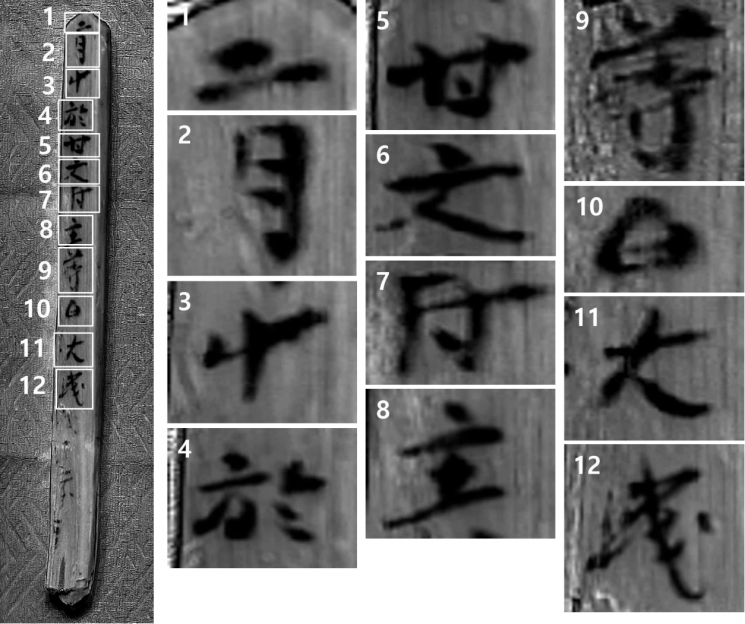 Hyperspectral image of one side of a multi-faced wooden tablet excavated from Seongsan Mountain Fortress in Haman
The National Research Institute of Cultural Heritage and the National Gaya Cultural Heritage Research Institute announced on August 7 that they have completed the decipherment of two wooden tablets unearthed from Seongsan Mountain Fortress last year.
Seongsan Mountain Fortress is an ancient Silla fortress site that underwent seventeen excavations between 1991 and 2016. To date, about 245 wooden tablets have been discovered there, making it a key site for the study of ancient Korean history.
During the eighteenth excavation conducted last year, two additional wooden tablets were found in the fortress wall’s buyup facility. The buyup facility refers to a structure built to compensate for the fortress’s topographical vulnerabilities.
The newly discovered tablets consist of one multi-faced wooden tablet and one double-sided wooden tablet. Both are estimated to have been produced in the mid-6th century.
On three of the four sides of the multi-faced tablet, ink inscriptions detailing administrative actions involving the punishment of individuals were identified. In particular, on one side, the inscription reads, “In the middle of the second month, to the head of Gammun Village and others, report to the Great Fortress...” (二月中於甘文村主等白大城...).
The research institute explained, “Given the unique script and usage of the characters ‘eo’ (於) and ‘baek’ (白), it appears to be an early document in the form of an oral report, in which a subordinate reports the results of their work to a superior.”
The institute utilized hyperspectral imaging technology for the first time in the decipherment process. This technology allowed for clearer restoration of characters that are difficult to identify with the naked eye or standard photography, and it provided greater accuracy than conventional infrared (IR) analysis.
However, the purpose or nature of the double-sided tablet could not be determined. The institute stated, “Because the distinction between the upper and lower sides is unclear and only a small number of characters are legible, there were limitations in interpreting the overall content.”
© The Asia Business Daily(www.asiae.co.kr). All rights reserved.

















