Amid ongoing controversy over the discharge of wastewater from North Korea's uranium plant, it has been found that there are currently no abnormal levels of radioactivity in the Incheon sea area.
The Incheon Institute of Health and Environment announced on August 7 that a comprehensive uranium survey conducted at 45 major locations, including the coastal areas of Ganghwado and the vicinity of Yeongjongdo, confirmed safety as of early this month.
The survey found that the uranium concentration in seawater at the 45 sites averaged 2.0 ㎍/L, with the lowest at 1.0 ㎍/L and the highest at 2.3 ㎍/L. This is lower than the average concentration of natural seawater, which is 3.3 ㎍/L, and is similar to the results of a recent government special joint investigation, which found uranium concentrations ranging from 0.087 to 3.211 ㎍/L.
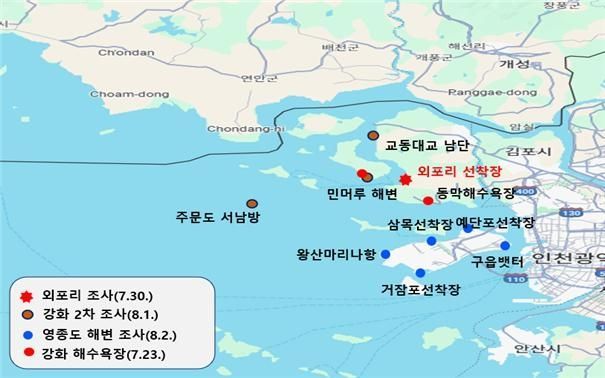
This survey was conducted in response to ongoing claims that untreated radioactive wastewater from the uranium refinery in Pyongsan, North Korea, is flowing into the West Sea and causing contamination.
In particular, Ganghwa County in Incheon, which borders North Korea, has seen a sharp decline in visitors, resulting in a blow to the tourism and fisheries industries. As the controversy spread, the Incheon Fisheries Technology Support Center collected and tested four types of seafood?white clams, marsh clams, gizzard shad, and butterfish?directly from the coastal areas of Samsan-myeon, Hajeom-myeon, and Seonwon-myeon in Ganghwa County on July 7 and 10. No radioactive substances were detected in any of the samples.
Previously, the government also announced last month that a joint investigation by the Nuclear Safety and Security Commission, the Ministry of Oceans and Fisheries, and the Ministry of Environment collected and analyzed samples from 10 sites, including Ganghwado and the Han River estuary, and confirmed that there were no abnormalities.
Kwak Wansoon, director of the Incheon Institute of Health and Environment, stated, "The detailed investigations conducted by both Incheon City and the government have not confirmed any inflow of North Korean uranium wastewater," adding, "The uranium concentration throughout Incheon's sea area is within the normal range and is not at a level of concern."
Meanwhile, Incheon City has decided to strengthen radiation testing of seafood from Ganghwado to address public anxiety over the alleged discharge of wastewater from North Korea's uranium plant. Until November, seafood scheduled for sale at fishing villages and wholesale markets in Ganghwa County will be subject to radiation testing.
The tests will be conducted regularly at least twice a month for substances such as iodine (I-131) and cesium (Cs-137, 134). These are the radioactive nuclides most commonly released during nuclear accidents. They are particularly well absorbed by seafood and tend to accumulate in the muscles of fish and shellfish, which is why they are measured in seafood radiation inspections.
© The Asia Business Daily(www.asiae.co.kr). All rights reserved.
![Clutching a Stolen Dior Bag, Saying "I Hate Being Poor but Real"... The Grotesque Con of a "Human Knockoff" [Slate]](https://cwcontent.asiae.co.kr/asiaresize/183/2026021902243444107_1771435474.jpg)















