The Presidential National Policy Planning Committee announced on August 6 that it had held a meeting of its Regulatory Rationalization Task Force (TF) and selected the "Tourism Regulatory Rationalization Plan for Revitalizing Domestic Demand" as a fast-track initiative, which it plans to propose to the government.
Recently, the tourism industry has projected that the number of foreign tourists visiting South Korea this year will reach an all-time high. In 2019, just before the COVID-19 pandemic, the number of foreign tourists reached a record 17.5 million. Last year, the number of foreign tourists was 16.37 million, recovering to about 94% of the 2019 level, and so far this year, the figure has already surpassed the 2019 level.
According to tourism statistics released by the Korea Tourism Organization on July 31, the number of foreign tourists in the first half of this year was 8,825,967, an increase of 14.6% compared to the same period last year (7,701,407). This figure is also 4.6% higher than the 8,439,214 recorded in the first half of 2019, which was the previous record high. Considering that the peak season usually falls in September and October and that the number of foreign tourists typically increases in the second half of the year, there is growing expectation that the number of foreign tourists this year will surpass the government's initial target of 18.5 million and, for the first time ever, exceed 20 million.
In a recent report, the Hyundai Research Institute predicted that the number of foreign tourists this year would exceed 20 million, with an expected 2.5 percentage point increase in domestic consumption.
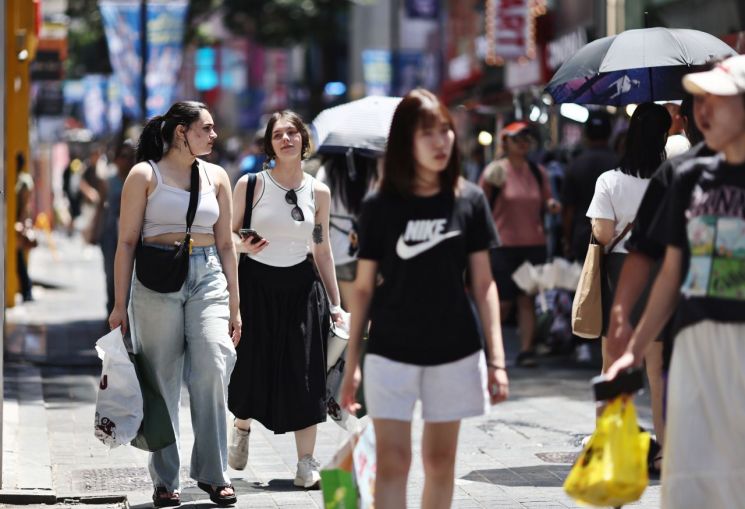
The Lee Jaemyung administration has set a goal of ushering in an era of 30 million foreign tourists.
Accordingly, the National Policy Planning Committee stated that, in order to achieve the goal of attracting 30 million foreign tourists to South Korea, it is necessary to address inconveniences faced by inbound tourists and to improve unreasonable regulations to better reflect current realities. Through meetings with relevant ministries and experts, the committee discussed key issues and selected the "Three Major Tasks for Tourism Regulatory Rationalization" as fast-track initiatives.
The first of these three major fast-track tasks is the implementation of visa-free entry for Chinese group tourists. Chinese tourists account for the largest share of inbound foreign tourists (about 28%), and since November last year, China has already allowed South Korean citizens to visit for tourism without a visa. In response, the committee proposed that the government quickly establish a management system to accommodate the expected surge in Chinese tourists and promptly allow visa-free entry for Chinese group tourists recruited by designated travel agencies.
The second task is to relax the fast-track entry requirements for international conference participants. Currently, a simplified entry screening system is being piloted for certain foreign participants attending international conferences with more than 500 foreign attendees. To boost the MICE (Meetings, Incentives, Conventions, and Exhibitions) industry and enhance competitiveness in attracting international conferences, the committee proposed that the government quickly relax the requirements for foreign participants eligible for expedited entry screening lanes.
The final task is to make the application criteria for "excellent medical tourism attracting institutions" more realistic. To apply for this status, which grants benefits such as electronic visa application authority, an institution must have handled at least 30 medical tourism visas or provided medical treatment to at least 500 foreign patients in the past year. However, attracting agencies that are not hospitals often do not have records of providing medical treatment to foreigners, making it difficult to meet the requirements. The committee therefore proposed that the government revise the system to allow agencies with a record of attracting at least 500 foreign clients to apply.
Oh Gihyung, Planning Commissioner of the National Policy Planning Committee and head of the Regulatory Rationalization TF, stated, "It is necessary to swiftly pursue regulatory innovation in order to provide institutional support for revitalizing the tourism industry and to drive increases in foreign tourist arrivals and spending. We will work closely with the government to ensure that the tasks proposed today are implemented quickly and deliver immediate results."
© The Asia Business Daily(www.asiae.co.kr). All rights reserved.

















