Operation of Consultation Centers with District Offices and Architects Association
Proposal to Ministry of Land for Building Act Amendments to Address Unreasonable Regulations
The Seoul Metropolitan Government is taking steps to address the issue of "small-scale residential building violations," such as stepped veranda window frames (sash), roofs installed to block sunlight or rain, and parking lot canopies. The city plans to extend the period for reduced compulsory compliance fines to a maximum of three years and will also propose legislative amendments.
On August 6, the city announced that it had confirmed that most violations occur in low-rise housing such as multi-family and multiplex homes. To address this, Seoul has prepared three support measures: administrative assistance, ordinance revisions, and institutional improvements.
According to the Seoul Metropolitan Government, residential building violations account for 77,000 cases (77%) out of all building violations. Of these, 65% involve multi-family and row houses, 14% are multiplex homes, 12% are single-family houses, and 5% are apartments. By floor area, violations involving small buildings under 20 square meters account for 72% of cases. Among residential building violations, unauthorized extensions or violations of sunlight angle regulations total 44,000 cases (58%).
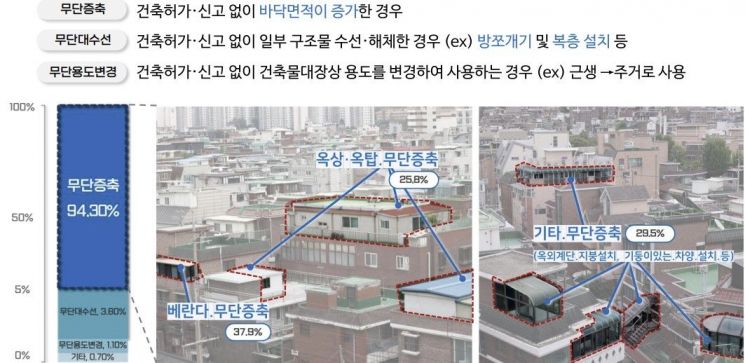
Currently, even small-scale facilities such as sashes or roofs installed by residents for daily convenience are identified as "building violations." Compliance fines are imposed on the current owner, even if the previous owner installed the facility. In 2019, an amendment to the Enforcement Decree of the Building Act abolished the five-time limit for imposing compliance fines, significantly increasing the burden on citizens.
A Seoul city official explained, "If there are walls or roofs, the increased floor area results in a building violation, or if the building exceeds the sunlight angle, it is also considered a violation. Since the Building Act was amended in 2019, compliance fines are now imposed continuously until the violation is rectified, not just five times, which can cause financial hardship. There are limitations as we must act within the boundaries of the current law."
The city will first pursue an ordinance amendment to extend the period for reduced compliance fines from one year to three years. A 75% reduction in compliance fines will apply in cases of: small-scale violations involving less than 30 square meters (or less than 5 square meters for collective buildings); a change in ownership after the violation occurred; or when immediate rectification is impossible due to lease contracts. The city aims to announce the revised ordinance in September after discussions with the city council this month. Additionally, since last year's amendment to the Enforcement Decree of the Building Act increased the reduction rate from 50% to 75%, the city will also revise ordinance language to address the unfairness faced by citizens who were already subject to compliance fines and could not benefit from the new reduction.
The city will also operate a "Building Violation Consultation Center" in cooperation with the 25 district offices and the Seoul Association of Architects. Although some building violations can now be legalized through post-construction reporting due to the temporary relaxation of floor area ratio regulations in Type 2 and 3 general residential areas (Regulatory Reform No. 33), the city will provide consultations to assist citizens who may find it difficult to determine eligibility. In May, the city revised the urban planning ordinance to temporarily relax the floor area ratio from 200% to 250% for Type 2 general residential areas and from 250% to 300% for Type 3 general residential areas, implementing Regulatory Reform No. 33.
Believing that the current Building Act leads to an increase in building violations, the city will also recommend legislative amendments to the Ministry of Land, Infrastructure and Transport to address unreasonable daily life regulations. These proposals include excluding the floor area of certain facilities?such as canopies above external stairs in low-rise homes and small-scale pergolas (gazebos) for living and pedestrian convenience?from floor area calculations within a specified range, and revising the "sunlight angle regulation," which is a major cause of illegal extensions. The sunlight angle regulation restricts the distance between buildings based on their height to ensure sunlight rights for neighboring homes.
The city has already made several proposals to the Ministry of Land, Infrastructure and Transport regarding these regulation improvements and will continue to consult with the ministry. A Seoul city official stated, "The Enforcement Decree contains a provision that allows certain areas to be excluded from floor area calculations, so we are requesting the ministry to exclude them. In some cases, even if the floor area ratio is relaxed, legalization is impossible due to combined violations such as unauthorized extensions and sunlight rights."
Choi Jinseok, Director of Housing at the Seoul Metropolitan Government, said, "We have prepared support measures for citizens who have had to pay compliance fines every year due to the installation of small-scale facilities in essential living spaces such as stairs and verandas. We will continue to identify and improve regulations and systems that are tailored to real-life needs, in order to support the safety and convenience of citizens' housing and to reduce their financial burden."
© The Asia Business Daily(www.asiae.co.kr). All rights reserved.
![Clutching a Stolen Dior Bag, Saying "I Hate Being Poor but Real"... The Grotesque Con of a "Human Knockoff" [Slate]](https://cwcontent.asiae.co.kr/asiaresize/183/2026021902243444107_1771435474.jpg)















