Overall Employment Rises, but Manufacturing Jobs Decline
Share of Manufacturing Employment Falls to 15% Range
Cyclical Factors Added 827,000 Jobs
Structural Factors Reduced Employment by 899,000
While employment in the manufacturing sector has remained sluggish over the long term, structural factors such as automation and industrial transformation have continued to exert an impact. In particular, there has been a notable structural decline in large-scale manufacturing industries such as computers, electronics, and optical equipment, where employment has not increased in proportion to production growth. Experts have assessed that government support, such as reemployment assistance for workers, is necessary for declining manufacturing sectors undergoing industrial restructuring.
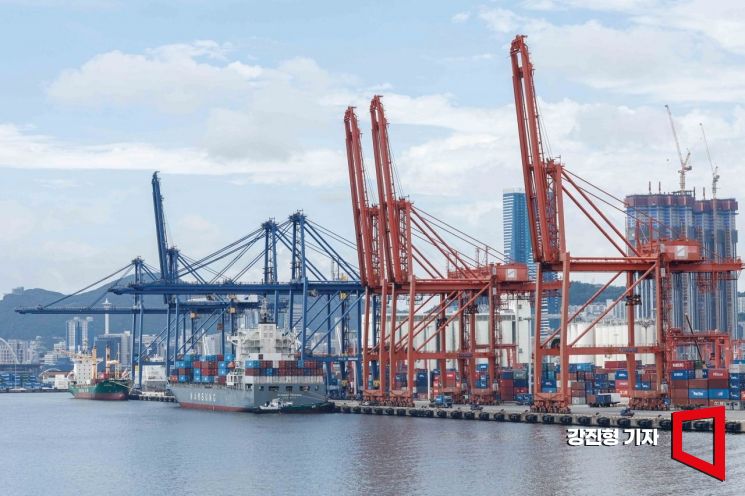
According to the "Recent Decline in Manufacturing Employment and Leading Industries" section of the "Employment Trend Brief, Issue 5, 2025," recently published by the Korea Employment Information Service, the manufacturing sector's ability to create jobs has shown a long-term decline, with the downward trend becoming particularly pronounced since last year.
The number of people employed in manufacturing steadily increased after 2014, reaching a peak in the fourth quarter of 2015 at 4,664,000. Since 2016, the trend reversed and employment began to decline. After rebounding due to economic recovery and base effects in the second half of 2021, the number of manufacturing employees entered a downward phase again after the first quarter of 2023. Last year, there were only slight increases in the first quarter (36,000) and the second quarter (49,000), followed by a continued year-on-year decline from the third quarter onward. In the second quarter of this year, the number of people employed in manufacturing was 4,415,000, marking a 2.0% decrease.
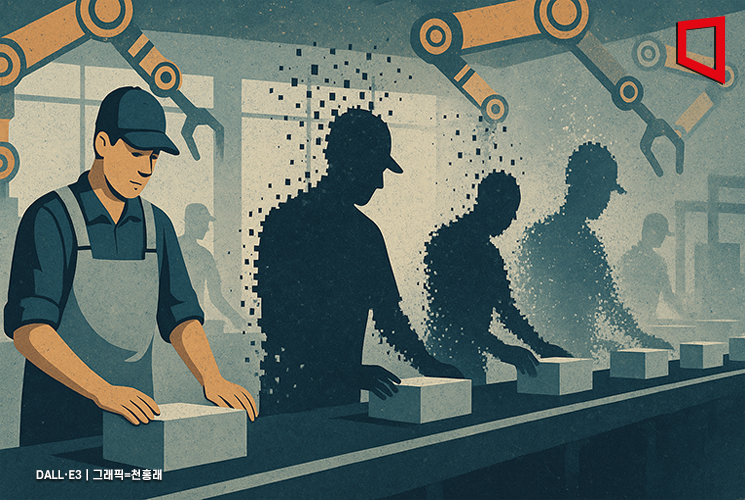
This is in contrast to the overall employment trend, which has continued to rise. Except for a 0.8% decrease in 2020 during the COVID-19 pandemic, the total number of employed people has continued to increase each year, although the growth rate has slowed. In contrast, manufacturing employment has declined, resulting in a shrinking share of manufacturing jobs within total employment. The proportion of manufacturing employees remained in the 16% range until 2022 (16.0%), but dropped to 15.7% in 2023 and 15.6% last year. In the second quarter of this year, the figure fell further to 15.2%.
The decline in manufacturing employment has been driven not only by cyclical factors such as changes in output, but also by structural factors such as industrial transformation and automation. According to the report, structural factors have consistently contributed to the decrease in employment, while cyclical factors have caused fluctuations in the trend. From the second quarter of 2018 to the second quarter of this year, manufacturing employment decreased by a total of 72,000. This was the result of a reduction of 899,000 due to structural factors, which outweighed an increase of 827,000 due to cyclical factors.
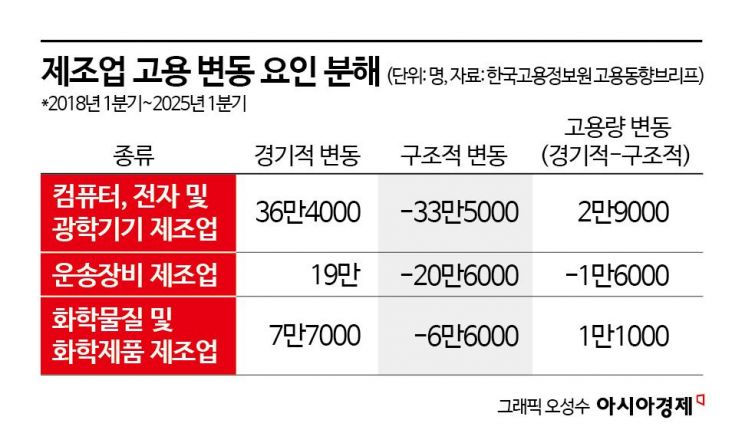
Breaking down the manufacturing sector, industries with large employment such as computers, electronics and optical equipment manufacturing, transportation equipment manufacturing, and chemicals and chemical products manufacturing, all experienced pronounced structural declines, as employment did not keep pace with production increases. In the computers, electronics, and optical equipment manufacturing sector, employment rose by 364,000 due to cyclical changes from the first quarter of 2018 to the first quarter of this year, but fell by 334,000 due to structural changes, resulting in only a modest net increase. Industries with large employment declines, such as textiles and leather products manufacturing, were affected by ongoing restructuring and worsening economic conditions.
Jang Sarang, Senior Researcher at the Employment Trend Analysis Team of the Korea Employment Information Service, explained, "Structural causes can include a variety of factors such as technological advancement due to investment or automation, and productivity improvements. While it may be viewed negatively that employment did not increase in proportion to production, it can also be interpreted as an indication that more output was achieved with fewer workers." She added, "Since there are sectors undergoing industrial transformation as production declines, the government should continue to seek reemployment support and other assistance for workers in these fields."
© The Asia Business Daily(www.asiae.co.kr). All rights reserved.



















