A "foldable robot sheet technology" that allows the folding structure of a robot to be reprogrammed in real time according to on-site conditions has been developed in South Korea.
In robot design, folding structures enable efficient shape transformation and are being explored in a variety of applications, including space and aerospace robots, soft robots, and foldable grippers (robotic hands). However, conventional folding mechanisms have limitations because the folding positions and directions are pre-set, requiring the robot structure to be redesigned and rebuilt every time the surrounding environment or the type of task changes.
In contrast, the foldable robot sheet technology dramatically improves the robot’s ability to change shape, overcoming previous limitations and opening up new possibilities for the field of robotics.
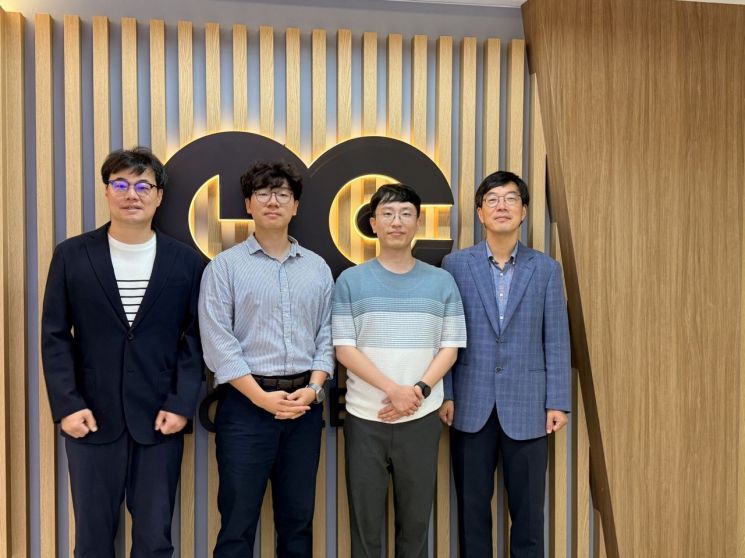 (From left) Professor Inkyu Park, Department of Mechanical Engineering, KAIST; Professor Yongrok Jung, Department of Mechanical Engineering, Kyungpook National University; Dr. Hyungyu Park, Department of Mechanical Engineering, KAIST; Professor Jung Kim, Department of Mechanical Engineering, KAIST. Provided by KAIST
KAIST announced on August 6 that a joint research team led by Professors Kim Jung and Park Inkyu of the Department of Mechanical Engineering has developed a "field-programmable robotic folding sheet" technology that allows the folding structure to be programmed in real time.
This technology, developed by the joint research team, is a successful example of applying the concept of "field programmability" to foldable structures. It enables the user to determine "where, in which direction, and how much to fold," and to reflect these decisions on the material’s shape in real time based on the user’s commands and judgments.
The robotic sheet consists of a thin and flexible polymer substrate embedded with a micro metal resistor network. Each metal resistor simultaneously functions as both a heater and a temperature sensor, enabling real-time detection and control of the sheet’s folding state without the need for separate external devices.
In addition, by combining a genetic algorithm with a deep neural network, the software allows users to input desired folding positions, directions, and intensities. The system then autonomously repeats heating and cooling cycles to achieve the precise shape.
Notably, the joint research team applied closed-loop control for temperature distribution, improving real-time folding accuracy, compensating for environmental changes, and addressing the slow response speed characteristic of heat-based folding technologies.
Real-time programming is significant because it enables diverse robot functionalities to be implemented on the spot without complex hardware redesign.
In practice, the joint research team implemented an "adaptive robotic hand (gripper)" that can change its grasping strategy to match various object shapes using a single material.
They also demonstrated bio-inspired locomotion strategies, such as walking or crawling, by placing the same "robotic sheet" (a thin and flexible robot) on the ground. This suggests the potential for expansion into environment-adaptive autonomous robots that can change their shape in response to environmental changes.
Professor Kim Jung said, "This research represents a step closer to realizing 'morphological intelligence,' where the shape itself becomes the intelligence, enabling robots to move intelligently by changing their own bodies. The joint research team plans to further develop the field-programmable robotic sheet technology as a 'next-generation physical AI platform' that can be applied in various fields, including disaster response robots, customized medical assistive devices, and space exploration equipment."
This research was supported by the National Research Foundation of Korea and was conducted with Dr. Park Hyunkyu (currently at Samsung Electronics Samsung Advanced Institute of Technology) and Professor Chung Yongrok (currently at Kyungpook National University) as co-first authors. The research results (paper) were recently published online in the international journal Nature Communications.
© The Asia Business Daily(www.asiae.co.kr). All rights reserved.
![Clutching a Stolen Dior Bag, Saying "I Hate Being Poor but Real"... The Grotesque Con of a "Human Knockoff" [Slate]](https://cwcontent.asiae.co.kr/asiaresize/183/2026021902243444107_1771435474.jpg)















