Trump in CNBC Interview
"Wants Semiconductors and Chips Manufactured in the U.S."
Pharmaceutical Tariffs Could Reach Up to 250%
"Investments in the U.S. by the EU and Others Are Gifts, Not Loans"
On August 5 (local time), U.S. President Donald Trump announced that he would unveil new tariffs on semiconductors and pharmaceuticals next week. Regarding the recent trade agreement with South Korea, he assessed, "We have opened up a closed country," expressing expectations for increased sales of American automobiles. He also warned that the investment pledges made by major countries such as South Korea, Japan, and the European Union (EU) are "gifts, not loans," and threatened to impose heavy tariffs if these investment promises are not fulfilled.
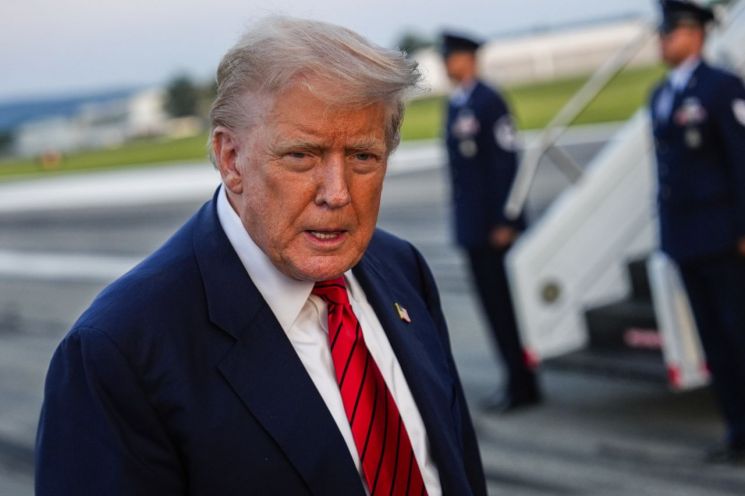
In an interview with CNBC's "Squawk Box" that day, President Trump said, "We are going to announce a separate (tariff) category for semiconductors and chips." He added, "We want them to be manufactured in the United States," and explained that the announcement would come "next week or around then."
He also reaffirmed his plan to impose tariffs on pharmaceuticals. President Trump stated that tariffs on pharmaceuticals would "start with a small amount" and increase to as much as 150% within one to one and a half years, and then to 250% thereafter. This is even higher than the previously announced 200%. This stepwise increase is interpreted as giving pharmaceutical companies time to relocate their manufacturing facilities to the United States.
Separate from the reciprocal tariffs set to take effect on August 7, the United States has already implemented itemized tariffs. Currently, a 25% tariff is imposed on automobiles and auto parts, and a 50% tariff on steel and aluminum. Now, semiconductor tariffs are also expected to be added. Since semiconductors, along with automobiles, are key export items for South Korea, the implementation of tariffs is expected to inevitably worsen the export environment to the United States.
President Trump highlighted trade agreements with major countries as achievements, specifically mentioning South Korea.
He said, "South Korea has opened itself up," and added, "This will go beyond simple (market) opening and become a tremendous business." He emphasized, "South Korea used to be a closed country, but now we can suddenly sell cars, trucks, and sport utility vehicles (SUVs) there. We are truly opening up South Korea."
Although South Korea has consistently imported American automobiles, the United States has pointed out that South Korea's domestic automotive safety and environmental standards have acted as non-tariff barriers. In response, the South Korean government agreed in this deal to recognize vehicles that meet U.S. safety standards as also satisfying Korean standards.
President Trump also stressed that the investments promised to the United States by other countries to lower tariffs are "gifts" that do not need to be repaid.
Regarding the EU's investment pledge, he said, "That's not a loan, it's a gift," and added, "We don't have to pay anything back. They have offered $600 billion that can be invested in any sector we want." He warned that if the EU fails to fulfill its investment promise, "they will have to pay a 35% tariff." In response to criticism that the trade agreement lacks details, he claimed, "The fact that we can invest $600 billion in any sector I want is the detail."
South Korea also agreed to a 15% tariff in exchange for investing $350 billion in the United States. While the South Korean government has explained that this investment is mainly in the form of loans and guarantees, minimizing the actual burden, considering President Trump's remarks, significant differences between the two countries' positions may arise in future follow-up negotiations.
Additionally, President Trump announced that he has narrowed down the candidates for the next Federal Reserve (Fed) Chair to four people. The current term of Fed Chair Jerome Powell ends in May 2026.
He mentioned, "Both Kevins are excellent, and the others are also outstanding," referring to Kevin Warsh, former Fed governor, and Kevin Hassett, chairman of the White House National Economic Council (NEC), both of whom are considered candidates for the next Fed Chair. President Trump is expected to appoint a successor to recently resigned Fed governor Adriana Kugler within a few days and may also announce the next Fed Chair.
President Trump also said that Scott Besant, U.S. Secretary of the Treasury, who had been mentioned as a possible candidate for Fed Chair, expressed his desire to remain in his current position the previous day.
He also suggested the possibility of a summit meeting with Chinese President Xi Jinping within the year. President Trump said, "He requested a meeting, and if we conclude (trade) negotiations, there is a high possibility we will meet before the end of the year. If we do not reach an agreement, we will not meet, but we are very close to a deal and I believe it will be a good one."
Regarding the possibility of running for a third term, he said, "Probably not," but left open the possibility by adding, "I would like to run."
© The Asia Business Daily(www.asiae.co.kr). All rights reserved.
![Clutching a Stolen Dior Bag, Saying "I Hate Being Poor but Real"... The Grotesque Con of a "Human Knockoff" [Slate]](https://cwcontent.asiae.co.kr/asiaresize/183/2026021902243444107_1771435474.jpg)
















