83% of Homes Are Semi-Basement in Aging Neighborhood
Overlapping Regional Housing Association and Redevelopment Projects
Integrated Road Network Plan Established in Connection with Surrounding Areas
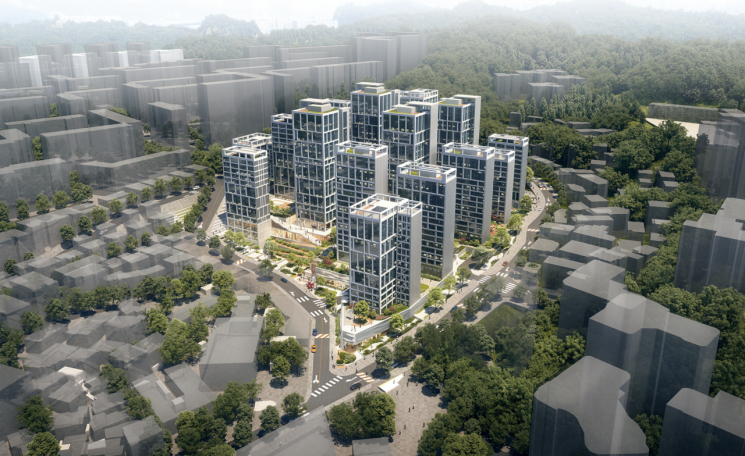
The rapid integrated planning for the dense semi-basement area in Sadang-dong, Dongjak-gu, located at the edge of the Seoul National Cemetery, has been finalized.
On August 6, the Seoul Metropolitan Government announced its plan to redevelop the area around 63-1 Sadang-dong into a residential complex with up to 23 floors and 850 households.
This area is a cluster of old buildings where semi-basement homes account for 83% of the housing. It has faced significant challenges due to issues securing access roads, as well as overlapping efforts between an ongoing regional housing association project and a redevelopment project.
Although the area is a transportation hub connected to Dongjak-daero and adjacent to Isu Station, an interchange station for subway lines 4·7, it has been considered in urgent need of redevelopment due to its classification as a Type 1 and Type 2 (7-story) residential zone and its sloped terrain, which features a ground elevation difference of up to 30 meters. Additionally, in the nearby Sadang 2·3-dong area, 12 apartment complexes totaling 8,000 households have been created through individual development projects, leading to a strong sense of relative deprivation among local residents who have been excluded from such developments.
The city plans to pursue the project based on three main principles: integrated road maintenance to improve the transportation environment, the creation of a safe street environment for local residents, and the formation of an urban landscape that harmonizes with the Seoul National Cemetery area.
Taking into account the ongoing regional housing association project to the east and the apartment remodeling project to the south, the city will comprehensively improve the roads. Initially, the current 4-6 meter wide roads will be widened to 12-15 meters. In addition, the northern Dongjak-daero 35-gil (entrance) will be constructed as a three-lane road (15 meters wide), while the northern and western Dongjak-daero 29-gil and 35-gil will be constructed as two-lane roads (12 meters wide), to ensure smooth traffic flow.
Furthermore, the city will create a safe pedestrian environment by connecting the sidewalks secured through road improvements with open spaces within the site. By linking everyday spaces, such as citizen facilities, with sidewalks, spatial efficiency will also be enhanced. To achieve this, neighborhood living and community facilities will be concentrated along school routes, such as Dongjak Elementary School, and along the main street on the north side, Dongjak-daero 25-gil.
Taking into consideration the highest point of Hyeonchung Neighborhood Park (elevation 124 meters) and the ridgeline (around 105 meters), apartment buildings of varying heights, mostly around 105 meters, will be arranged to create a harmonious skyline. On Dongjak-daero 35-gil, which has the highest pedestrian usage, spaces will be created to offer views of Hyeonchung Park and other landmarks.
The city will apply flexible urban planning measures, such as upgrading the zoning classification (from Type 1 and Type 2 (7-story) to Type 2 residential area), to enhance the feasibility of the project.
Cho Namjun, head of the Urban Space Headquarters of Seoul Metropolitan Government, stated, "We focused our planning on improving the deteriorated residential environment in neglected areas and expanding local infrastructure. This is an example of the city, district, and residents coming together as a team to quickly complete the planning, and we will also expedite follow-up procedures such as designation of the redevelopment zone."
Meanwhile, with the finalization of this rapid integrated plan, planning has been completed for 127 out of 205 target sites across Seoul, covering approximately 225,000 households. Among these, follow-up procedures are underway, with 53 sites currently establishing redevelopment plans, 46 sites designated as redevelopment zones, 23 sites approved for association establishment, and 5 sites with project implementation approval or other procedures in progress.
© The Asia Business Daily(www.asiae.co.kr). All rights reserved.
![Clutching a Stolen Dior Bag, Saying "I Hate Being Poor but Real"... The Grotesque Con of a "Human Knockoff" [Slate]](https://cwcontent.asiae.co.kr/asiaresize/183/2026021902243444107_1771435474.jpg)















