Expansion of U.S. Investment Emerges as an Alternative for Domestic Construction
"Tariff Impact Minimal, Opportunities Are Significant"
U.S. Orders on the Rise, Proven During 2023 Reshoring Boom
Samsung, Hyundai, and SK Accelerate Entry with Affiliate Projects
Key to Further Growth: Joint Entry of Mid-Sized and Small Construction Firms
Following the conclusion of the Korea-U.S. tariff negotiations, the construction industry is encountering an unexpected opportunity. While the direct impact of tariffs is minimal, the core of the negotiations?a $350 billion (approximately 485 trillion won) U.S. investment package?has flung open the doors to large-scale construction projects in the United States. Expectations are rising that this could become a new growth engine to offset the domestic market, which has been mired in its worst slump due to the project financing (PF) crisis.
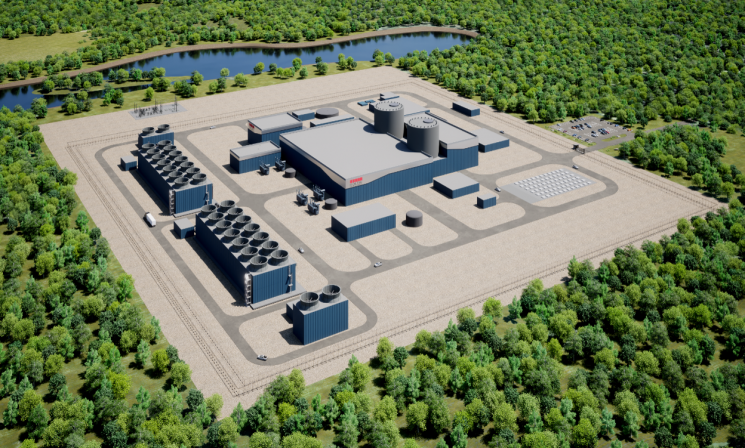 Hyundai Engineering & Construction is advancing the Holtec SMR-300 project with the American energy company Holtec. As part of the U.S. investment package, Hyundai Engineering & Construction is expected to secure additional orders in nuclear power plants and SMRs. Hyundai Engineering & Construction.
Tariff Shock Avoided... Opportunities Emerge in Large-Scale U.S. Infrastructure
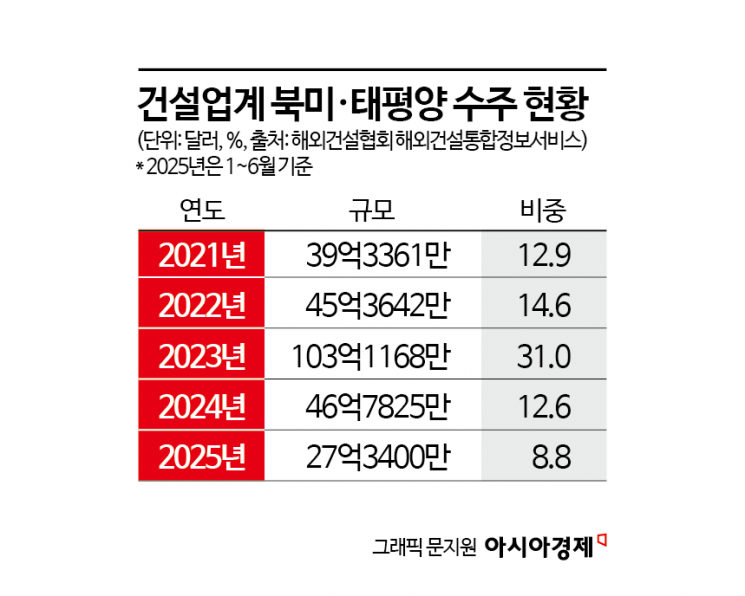
The potential for Korean construction companies to expand orders in the United States has already been demonstrated statistically. According to data from the International Contractors Association of Korea on August 11, the total overseas construction orders secured by Korean companies in 2023 reached $33.31 billion, with the United States accounting for $10 billion, ranking first among single countries for the first time. This represents 30% of all overseas orders. In the same year, the total orders in the North America and Pacific region amounted to $10.3 billion (31.0%), making it one of the two main pillars alongside the Middle East ($11.4 billion, 34.3%).
This is interpreted as the result of a surge in local investments in the United States by major Korean manufacturing companies in semiconductors, batteries, and automobiles, encouraged by the U.S. government's reshoring policy at the time. Last year, orders in North America and the Pacific totaled $4.67825 billion (12.6%), and in the first half of this year (January to June), orders reached $2.734 billion, accounting for 8.8% of the total ($31.01334 billion). After a temporary surge in 2023, the figures have since returned to normal levels.
The securities industry is expressing hope that the order boom seen during the reshoring period will be repeated. Kim Seungjun and Ha Minho, analysts at Hana Securities, commented, "Samsung E&A is likely to secure orders in semiconductors and biopharmaceuticals, Hyundai Engineering in secondary batteries and automobiles, and Hyundai Engineering & Construction in nuclear power plants and related fields." They added, "HanmiGlobal is expected to win contracts for data centers and battery-related projects in the U.S. through its subsidiary OTEC."
The construction industry is responding with "quiet cheers." Fundamentally, construction is a service industry focused on the domestic market. The impact of cost increases or export restrictions due to tariff hikes is relatively limited. Instead, the industry is pinning its hopes on the surge in large-scale construction demand accompanying the expansion of industrial infrastructure within the United States. A representative from Hyundai Engineering & Construction, considered a beneficiary of the U.S.-driven "construction boom," stated, "We will proactively secure various new energy business opportunities in the global market, starting with the United States, and continue to strengthen our competitiveness."
Large Corporations Already in the U.S.... The Key Is Joint Entry by Mid-Sized and Small Construction Firms
Large construction affiliates of conglomerates are already rapidly entering the U.S. market, leveraging their stable captive markets (internal markets among affiliates). Samsung C&T's construction division built an advanced semiconductor fab in Taylor, Texas, with an investment of over $37 billion by Samsung Electronics. Based on its experience constructing the first plant, it now has a competitive edge in the expansion project. Hyundai Engineering led the construction of Hyundai Motor Group's Metaplant America (HMGMA) in Georgia and SK On's battery joint venture plant. SK Ecoplant is proactively responding to eco-friendly infrastructure projects in the U.S., such as solar power plants, fuel cells, and battery recycling facilities.
Kim Hwarang, associate research fellow at the Korea Institute of Construction Industry, stated, "Currently, opportunities for mid-sized and specialized construction companies remain limited within the conglomerate-dominated captive market structure. However, if the U.S.-centered construction boom intensifies, there is ample room for expansion." He added, "Due to local labor shortages and construction capacity constraints, the technological and quality competitiveness of Korean companies could become more prominent." He emphasized, "The key issue is how quickly companies can adapt to American regulations, systems, and fair trade culture. If small construction firms also follow large corporations into the U.S. market, the ripple effect will be significant."
© The Asia Business Daily(www.asiae.co.kr). All rights reserved.
![Clutching a Stolen Dior Bag, Saying "I Hate Being Poor but Real"... The Grotesque Con of a "Human Knockoff" [Slate]](https://cwcontent.asiae.co.kr/asiaresize/183/2026021902243444107_1771435474.jpg)
















