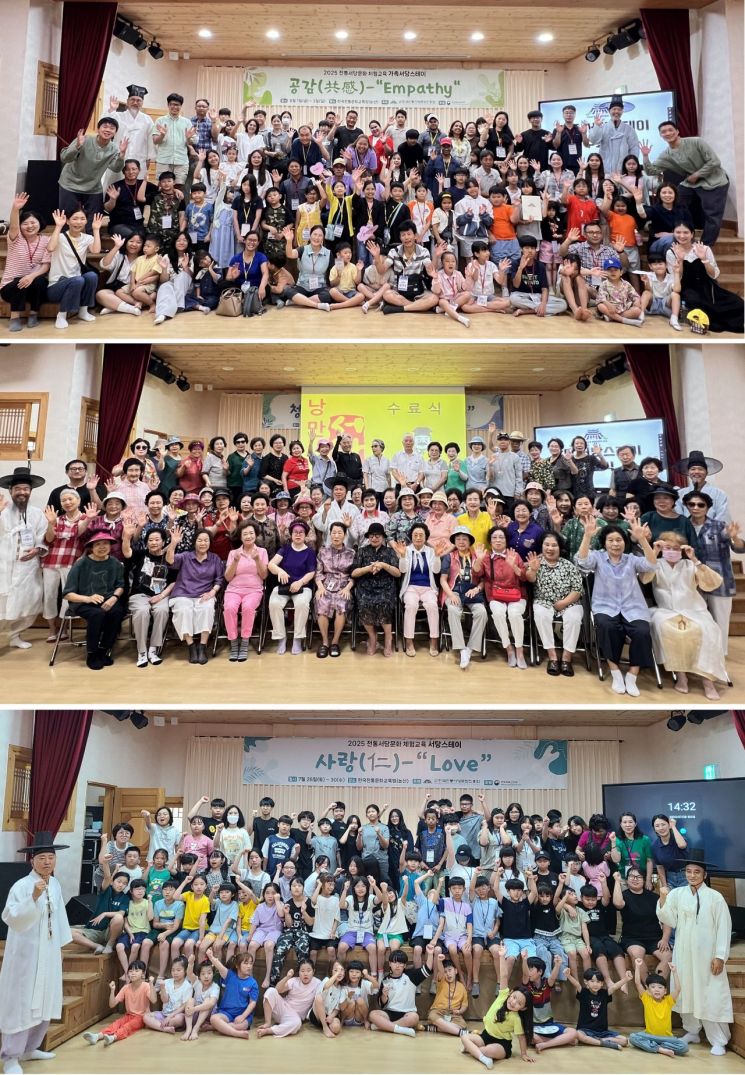
The Korean Traditional Seodang Culture Promotion Association (Chairman Park Seonggi) successfully concluded the Seodang Stay, a seodang culture experience program, which took place over nine days from Saturday, July 26 to Sunday, August 3. The program was held at the Korean Traditional Culture Education Center in Nonsan, Chungcheongnam-do. It was attended by approximately 320 participants from 14 regional children's centers in Gyeonggi, Chungcheong, Gyeongsang, and Jeolla, about 160 participants from three family centers in Ansan, Gwangju Seo-gu, and Gimje, and around 160 participants from three senior welfare centers in Cheonan, Daegu Dalseo-gu, and Jeungpyeong-gun.
This program, based on seodang education which has traditionally provided holistic education, offered a comprehensive experience program. It featured three concepts tailored to the needs and demands of different generations: the experience-oriented "Seodang Stay" for youth, the learning-oriented "Family Seodang Stay" for family participants, and the healing-oriented "Romantic Seodang Stay" for seniors. Alongside traditional culture experiences, the program provided practical character education through reinterpretation of the classics.
In particular, in Gimje, the Foreigners & Multicultural Association and the Family Sharing Volunteer Group participated. The program was specially designed with the hope that, as multicultural families have rapidly increased in recent years, they could resolve family or social conflicts through traditional culture and become new members of Korean society.
During the "Seodang Stay" program themed on "Love (仁)," youth participants discussed the importance of loving oneself and others and learned practical ways of communication. During the traditional crafts session, they wrote the phrase "Injainja (仁者人也)" on wooden nameplates they made themselves, taking time for spiritual cultivation. A representative from a regional children's center in Gyeongbuk said, "These days, children have little time to talk with each other due to the use of smartphones and other electronic devices, and they do not get enough physical activity. Their vocabulary for smooth communication is lacking, and their ability to empathize is also insufficient. Through this Seodang Stay, our children had time to play and communicate with their peers, and by learning and writing classical texts, they had the opportunity to improve their vocabulary and expressive skills," expressing gratitude.
The "Family Seodang Stay," themed on "Empathy (共感)," was a time for families to learn about etiquette to be observed within the family and to strengthen trust and understanding within the family community. Participating families shared activities such as writing a family motto and creating a "One Page of Our Family's Dream." A parent, Mr. A from Ansan, said, "Although our family is always together, we rarely have time to talk seriously and share feelings of gratitude and love. Through the Family Seodang Stay, we had a wonderful opportunity, for which I am very grateful."
Senior participants gathered under the theme of "Youth (靑春)" spent time gaining new motivation and vitality for life through the seodang program. Mr. B, a participant from the Cheonan Senior Welfare Center, said, "By participating in the Romantic Stay, I was able to reflect on my life and think about the direction of my future. I am grateful to have spent such a valuable time."
Han Jaewoo, Secretary General of the Korean Traditional Seodang Culture Promotion Association, who organized the event, said, "The satisfaction level of participants in this Seodang Stay, which was prepared to provide customized education according to the life cycle of each generation and to resolve generational conflicts and strengthen bonds, was very high. It was also a time to confirm that seodang education, which has traditionally been responsible for humanities education in Korea, is still necessary and effective in modern society. We will continue to do our best so that traditional seodang not only promotes intellectual improvement but also helps people become truly humane individuals (人), providing essential education for the mind from youth to old age."
© The Asia Business Daily(www.asiae.co.kr). All rights reserved.
![Clutching a Stolen Dior Bag, Saying "I Hate Being Poor but Real"... The Grotesque Con of a "Human Knockoff" [Slate]](https://cwcontent.asiae.co.kr/asiaresize/183/2026021902243444107_1771435474.jpg)















