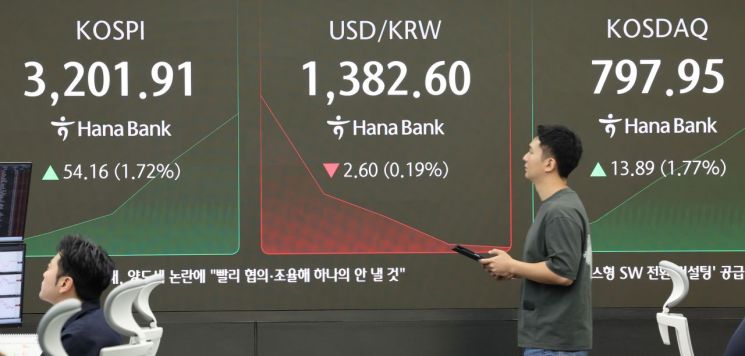
As of 9:25 a.m. on August 5, the KOSPI was up 64.56 points (2.05%) at 3,212.31 compared to the previous day. The KOSDAQ rose 16.31 points (2.08%) to 800.37.
All of the top market capitalization stocks were showing gains. Samsung Electronics rose 1.72%, recovering the 70,000 won level. SK Hynix gained 1.94%, LG Energy Solution 4.13%, Samsung Biologics 1.43%, Hanwha Aerospace 0.43%, Hyundai Motor 1.18%, and KB Financial Group 3.69%. Among the top 10 KOSDAQ stocks by market capitalization, all were up except for HLB. Alteogen was up 3.47%, EcoPro BM 15.46%, and EcoPro 9.38%.
Foreign investors and institutions led the recovery of the 3,200 level. In the KOSPI market, foreign investors recorded a net purchase of 111.4 billion won, and institutions net bought 112.0 billion won. Both foreign investors and institutions have continued their net buying streak for two consecutive days.
Jung Haechang, a researcher at Daishin Securities, said, "The KOSPI is showing an upward trend as both institutions and foreign investors have started bargain hunting after confirming support at the 3,100 level."
On the previous day, the New York stock market surged significantly as weaker employment data fueled expectations that interest rate cuts could come sooner. The Dow Jones Industrial Average rose 1.34%, the S&P 500 gained 1.47%, and the Nasdaq climbed 1.95%, with all three indices posting gains of over 1%.
Han Jiyeong, a researcher at Kiwoom Securities, explained, "Following this employment shock, a September rate cut by the US Federal Reserve (Fed) has become a foregone conclusion, and the consensus (the average forecast of securities firms) for the total number of cuts this year has shifted from the previous 1-2 times to 3 times. The market is now interpreting the Fed's rate cuts this year not as a 'post-recession response (a negative for the stock market)' but as an 'insurance cut to prevent economic cooling (a positive for the stock market).'"
Although the stock market managed to rebound after the sharp drop on the 1st, caution over the tax reform plan?which had been the cause of the decline?is expected to persist for some time. Han added, "The tax reform plan, which has become a unique domestic noise factor, will remain at the center of stock market news flow for the time being. Not only domestically but also foreign investment banks (IBs) are raising concerns about the lack of policy consistency and the potential for diminished expectations of domestic undervaluation due to the tax reform. Since no resolution has been found yet, various possibilities will be discussed this week, and a clearer outline is expected to emerge after the 7th."
Jung also noted, "The tax reform plan will inevitably impact the market until it passes the National Assembly. However, it is unlikely to change in a more negative direction than the current proposal, so once the worst-case scenario is confirmed, the anxiety in the market should peak and then subside."
© The Asia Business Daily(www.asiae.co.kr). All rights reserved.
![Clutching a Stolen Dior Bag, Saying "I Hate Being Poor but Real"... The Grotesque Con of a "Human Knockoff" [Slate]](https://cwcontent.asiae.co.kr/asiaresize/183/2026021902243444107_1771435474.jpg)















