"Trump Showed Great Interest in MASGA"
"15% Auto Tariff Avoided Worst-Case, but Still Regrettable"
"Chairman Chung Euisun Expressed Gratitude"
"Used 'Mad Cow Disease Protest Photos' to Persuade in Agricultural Talks"
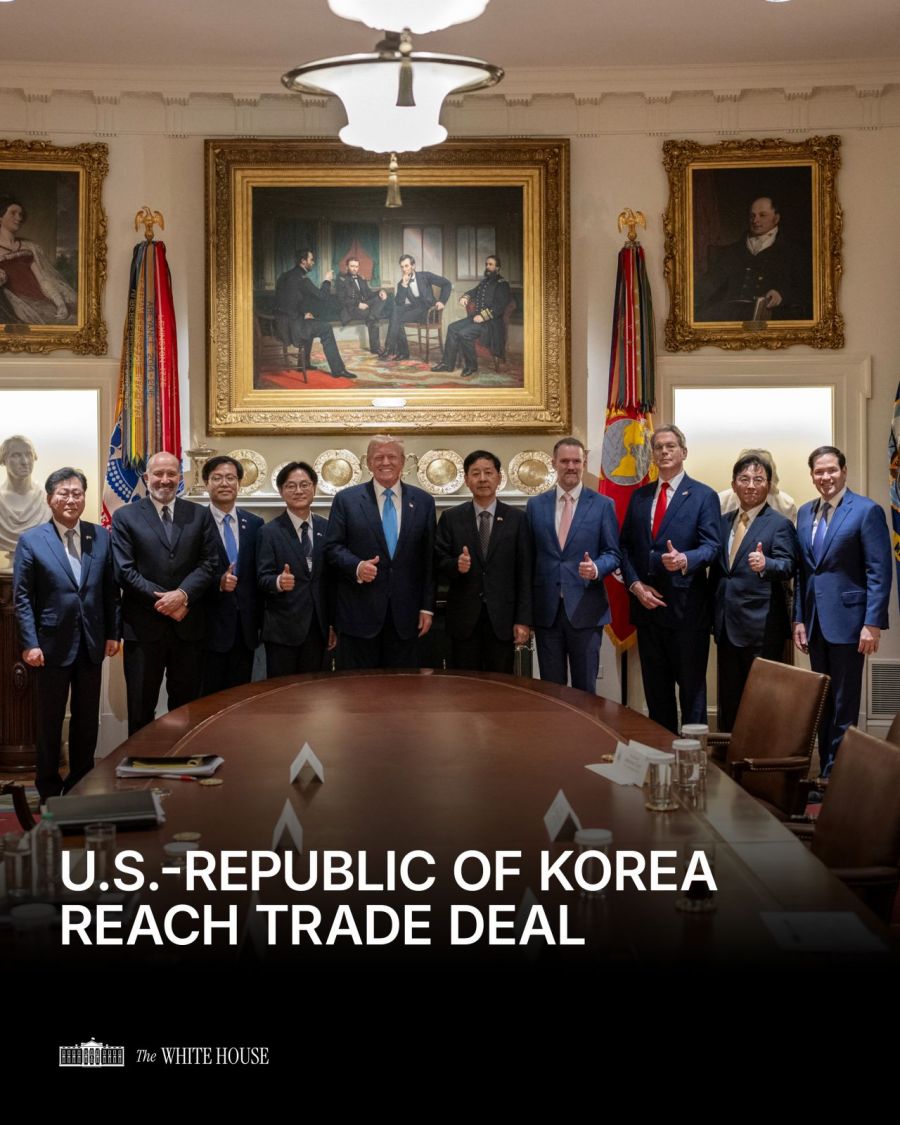
On August 5, Minister of Trade, Industry and Energy Kim Jungkwan made a surprise disclosure of the behind-the-scenes story of the Korea-US tariff negotiations. Minister Kim shared detailed anecdotes from his first encounter with US President Donald Trump, stating that he strongly felt Trump's commitment to improving Korea-US relations.
Appearing on MBC Radio's 'Kim Jongbae's Focus' that morning, Minister Kim explained, "Usually, in the Cabinet Room at the White House, the counterpart waits first and the President enters later, but President Trump was already seated and waiting for us." He added, "He greeted us warmly, not only with a handshake but also a hug." Minister Kim assessed that this experience made him feel that "President Trump had a strong will to improve relations with Korea."
Minister Kim especially noted that President Trump showed considerable interest in the Korean-proposed shipbuilding cooperation project, 'Make American Shipbuilding Great Again (MASGA).' He explained, "We prepared a detailed program and proposed the modernization of US shipyards, naval maintenance (MRO) projects, and worker training plans, which left a strong impression on President Trump."
Regarding the origin of the name 'MASGA,' Minister Kim said, "It was first suggested by a staff member at the Ministry of Industry. Initially, it had the plain name 'Korea-US Shipbuilding Cooperation Project,' but a member of the negotiation team proposed the unique name 'MASGA,' and after internal discussions, it was adopted."
He continued, "When we first chose this name, there were internal concerns that benchmarking President Trump's political slogan 'MAGA' might offend the US, but in the end, it led to better-than-expected results." He added, "We plan to award a commendation to the staff member who proposed the idea."
Regarding the automobile tariff issue, Minister Kim expressed the difficulties faced during the negotiations. He stated, "The US maintained a tough stance on automobiles, and in the end, the tariff rate was set at 15%, the same as for Japan and the EU. Our negotiation team insisted on 12.5% until the end, but it was not accepted, which is regrettable." However, he emphasized, "Since we avoided the worst-case scenario of a 25% tariff, the government will actively support measures to maintain the competitiveness of the automotive industry."
Regarding the reaction of Hyundai Motor Group Chairman Chung Euisun, who visited the US at the time, Minister Kim said, "Chairman Chung expressed his gratitude for the negotiation results," adding, "It was probably because we avoided the 'worst-case scenario' of a 25% tariff."
In the agricultural sector negotiations, Minister Kim explained that they blocked US demands for further market opening by presenting 'photos of the mad cow disease candlelight protests' as a strategy. He said, "Simply explaining was not effective enough, so we presented photos illustrating Korea's sensitivity, and the US side did not raise the issue any further. The issues of additional market opening for rice and beef were effectively taken off the negotiation table." However, he added that issues such as genetically modified potatoes and fruit quarantine would require ongoing management.
Minister Kim also provided specific directions for the use of the $200 billion investment fund. He explained, "The fund will be operated by designating specific sectors such as semiconductors, batteries, bio, critical minerals, and energy, connecting US weaknesses with Korea's strengths." He firmly denied some claims that the investment profit distribution would be as extreme as 9 to 1, saying, "Such conditions are completely untrue."
Addressing some claims that "the Korea-US FTA is over," Minister Kim said, "I do not think the effect of the Korea-US FTA has disappeared because of these tariff measures." He explained, "When exporting to the US, Japanese ramen will be subject to a total tariff of 21.4%, which combines the existing 6.4% and the newly added 15% from this negotiation. In contrast, since Korea previously had a 0% tariff under the Korea-US FTA, only the new 15% tariff will be applied. In other words, thanks to the Korea-US FTA, Korea still enjoys a 6.4% lower tariff benefit compared to Japan."
Minister Kim added, "Of course, for products like automobiles that are subject to item-specific tariffs, the effect of the FTA has essentially disappeared due to the new tariffs. However, chemical products such as ramen, polypropylene, and plastics still benefit from tariff reductions. Korea exports hundreds of millions of dollars worth of ramen annually, so in these sectors, the positive effects of the Korea-US FTA remain."
© The Asia Business Daily(www.asiae.co.kr). All rights reserved.

















