Colombia Records 1,136 Square Kilometers of Forest Loss in 2024
Government Struggles to Curb Illegal Development Activities
In 2024 alone, approximately 1,136 square kilometers of forest disappeared across Colombia. This is about twice the total area of Seoul, which measures 605 square kilometers.
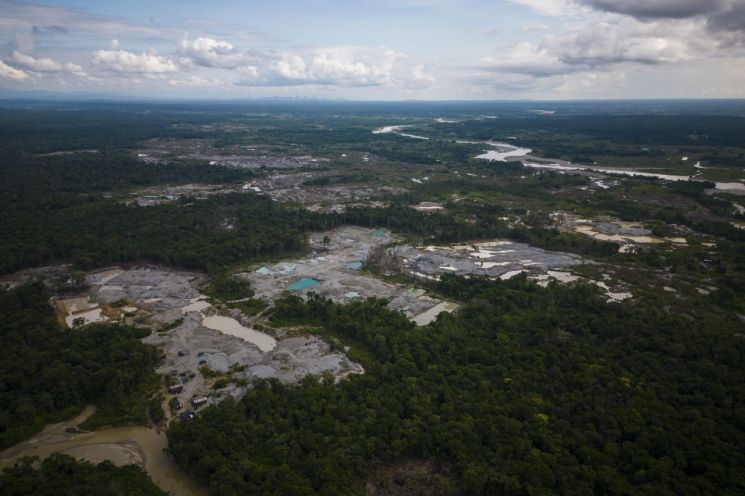 On September 23, 2024, clear signs of forest destruction caused by illegal mining are visible around the Quito River near Paimado, Colombia. Photo by AP Yonhap News
According to the Associated Press on August 4, the Colombian government announced on August 1 that deforestation in its Amazon rainforest region increased sharply last year. This figure represents a 43% increase compared to 2023, marking a significant rebound from the lowest level recorded in over 20 years at that time.
The Colombian National Meteorological Institute (IDEAM) identified the main causes of this increase in deforestation as the expansion of pasture for livestock, illegal crop cultivation, illegal mining, and indiscriminate infrastructure development. Each of these factors contributed independently to the overall rise in forest loss.
A joint report released by Minister of Environment Lena Estrada Anyocazi and IDEAM revealed that the greatest damage occurred in the Amazon rainforest. Of the total forest loss, 770 square kilometers, or 65%, took place in the Amazon region. This is approximately 1.3 times the size of Seoul.
The Colombian Ministry of Environment announced that forest destruction decreased in the first quarter of this year thanks to strengthened cooperation with local communities and crackdowns on environmental crimes. However, the annual figures showed results contrary to this trend.
Minister Estrada stated, "These numbers show how much effort the government has put into protecting forests and biodiversity, but they also reveal that these efforts are still insufficient." She also pointed out that droughts and wildfires caused by climate change were major independent contributors to the increase in deforestation.
In particular, illegal livestock farming, land grabbing, and road construction have been actively taking place in high-risk forest destruction zones known as the 'Amazon Arc,' which includes Meta, Caqueta, Guaviare, and Putumayo.
Deforestation has also been on the rise within national park protected areas. This trend has raised concerns as it includes UNESCO World Heritage sites such as Tinigua, La Macarena, and Chiribiquete. While the government is focusing on crackdowns and cooperation with local communities, analysts say that illegal development activities remain strong.
© The Asia Business Daily(www.asiae.co.kr). All rights reserved.
![Clutching a Stolen Dior Bag, Saying "I Hate Being Poor but Real"... The Grotesque Con of a "Human Knockoff" [Slate]](https://cwcontent.asiae.co.kr/asiaresize/183/2026021902243444107_1771435474.jpg)















