Production Delays and Soaring Prices
Difficulties in Securing Alternative Suppliers
The Wall Street Journal (WSJ) reported on the 3rd (local time) that China is restricting the supply of critical minerals to Western defense industry companies, resulting in production delays and rising prices.
Earlier this year, as trade tensions between the United States and China intensified, China tightened export controls on rare earth elements. After the second round of high-level US-China talks held in London, UK, in June, China allowed rare earth exports, but it continues to restrict exports of critical minerals for military purposes. China supplies about 90% of the world's rare earth elements and monopolizes the production of several other key minerals.
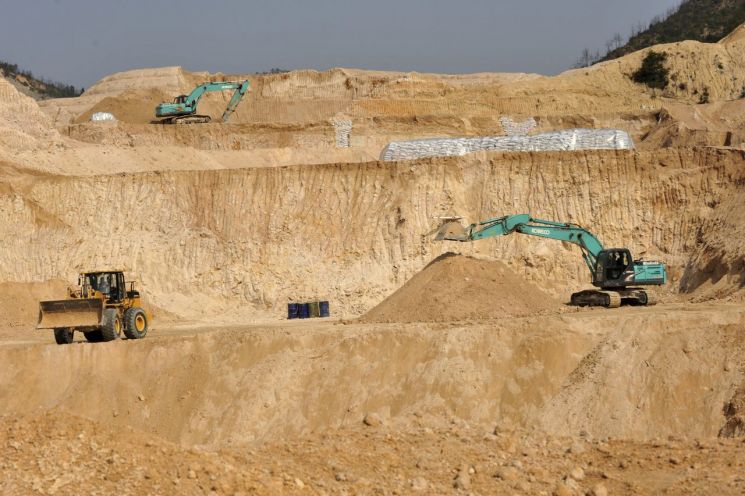
As a result, Western defense companies are experiencing production delays and price increases. According to WSJ, a drone parts manufacturer supplying components to the US military had to delay orders by two months while searching for non-Chinese sources for rare earth-containing parts. Industry sources stated that the price of certain raw materials has increased more than fivefold. One company revealed that it obtained samarium, a mineral needed to make magnets that can withstand the extreme temperatures of fighter jet engines, at 60 times the standard price.
Efforts are being made to find alternative suppliers to China, but this is proving difficult. Bill Lynn, CEO of Leonardo DRS, the American subsidiary of Italian defense giant Leonardo, recently stated that only safety stock of germanium remains. He said the company is working to diversify its supply chain and seeking alternatives to germanium. Since December last year, China has banned the sale of germanium, gallium, and antimony to the United States. These minerals are used in bullets, projectiles, and night vision devices.
Western companies have tried to find alternative sources for critical minerals in recent years, but industry insiders report that some elements are so rare that profitable production in the West is impossible.
According to defense software company Govini, more than 80,000 components used in US Department of Defense weapon systems are currently made with critical minerals subject to China's export controls.
The US Department of Defense has required defense contractors to stop purchasing rare earth magnets containing Chinese minerals by 2027. In response, some companies have stockpiled significant quantities, but in many cases, the reserves are only sufficient for a few months. According to industry sources, drone manufacturers, most of which are small startups, are the most vulnerable.
Although China has allowed rare earth exports since the June trade talks, imports remain difficult. Western defense industry officials report that Chinese authorities are demanding sensitive documents, including information on which rare earth elements and magnets are being imported, how they will be used, product images, and production line photographs. A manufacturer of propulsion motors for drones said they were asked to provide product drawings, photographs, a list of buyers, and guarantees that rare earth magnets would not be used for military purposes.
WSJ stated, "Pressure over critical minerals shows how much the US military relies on China for significant portions of its supply chain," and added, "This gives China a means of exerting influence as US-China tensions rise and trade negotiations intensify."
Meanwhile, Jamieson Greer, a representative of the US Trade Representative (USTR), expressed optimism regarding negotiations with China over rare earth supplies. Appearing on CBS's 'Face the Nation' on this day, he said, "We are focused on ensuring that (rare earth) magnets can move as freely as before from China to the US and through adjacent supply chains," and added, "We can say that we are about halfway there at this point."
© The Asia Business Daily(www.asiae.co.kr). All rights reserved.
![Clutching a Stolen Dior Bag, Saying "I Hate Being Poor but Real"... The Grotesque Con of a "Human Knockoff" [Slate]](https://cwcontent.asiae.co.kr/asiaresize/183/2026021902243444107_1771435474.jpg)















