Large Supermarkets and SSMs See Sales Hit from Consumption Coupons
Up to 10% Drop Year-on-Year... Smaller Decline Than Emergency Relief Fund Period
Support Funds Distributed in Two Rounds... Dispersed Usage Eases Impact
Expanded Discount Events Absorb Some Indoor Shopping Demand
As the government-issued "Livelihood Recovery Consumption Coupons," which have been distributed since July 21 to boost domestic demand, enter their second week, concerns over declining sales at large supermarkets and corporate supermarkets (SSMs), which were excluded from the list of eligible merchants, have become a reality.
However, these retail companies have experienced a smaller decrease in sales compared to the period when emergency relief funds were issued during the COVID-19 pandemic. This is attributed to two factors: first, the number of offline locations where the coupons can be used has significantly increased compared to when "social distancing" restrictions were in place; and second, large retail stores have implemented counter-discount events to help defend their performance.
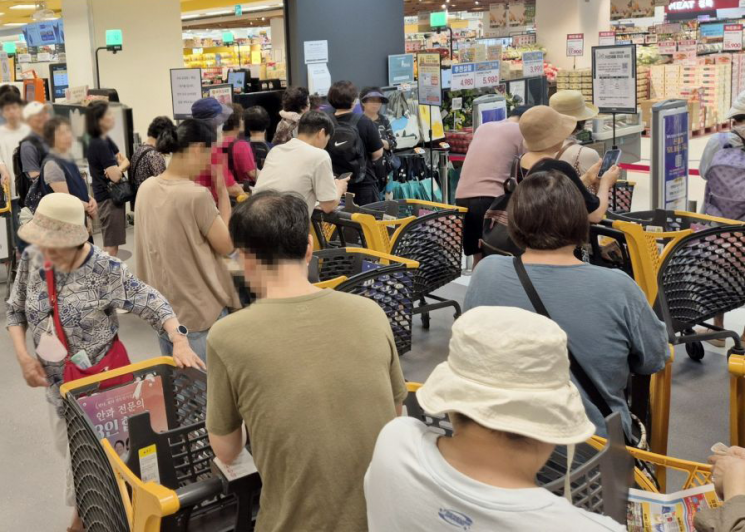
Large Supermarket Sales Drop 10% in First Week of Coupon Distribution
According to industry sources on August 5, major offline channels?including large supermarkets such as Emart, Homeplus, and Lotte Mart, warehouse discount stores, and SSMs under major retail corporations?saw their sales decrease by up to 10% in the first week after the consumption coupons were distributed, compared to the same period last year.
This decline is less severe than during the COVID-19 period, when the first round of nationwide emergency relief funds of 400,000 to 1 million KRW per household in 2020, and the fifth round of national mutual aid funds of 250,000 KRW per person for the bottom 88% income bracket in September 2021, led to sales at large supermarkets dropping by up to 20% after distribution.
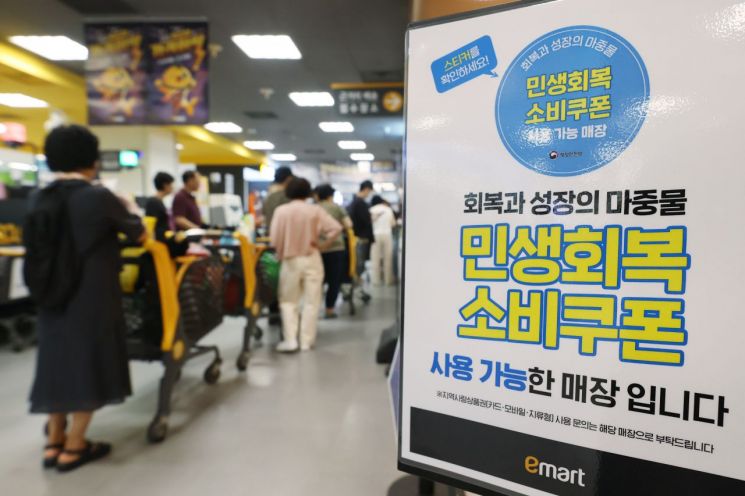 A notice about the use of the Livelihood Recovery Consumption Coupon is posted in front of a rental store inside an Emart in Seoul. Yonhap News
Industry experts attribute this to the fact that, unlike during the COVID-19 period when social distancing was enforced, consumers now have a wider range of options for spending their support funds, resulting in more dispersed usage. One industry insider commented, "During the COVID-19 pandemic, face-to-face consumption was limited, so there was a clear increase in sales at nearby convenience stores and grocery stores. This time, however, spending has spread across dining, beauty, and household goods." The insider also noted, "Some small business tenant stores within large supermarkets are included among the places where consumption coupons can be used, which seems to have mitigated the decline in sales compared to the past."
Coupon Usage Diversifies... 11% Spent at Convenience Stores
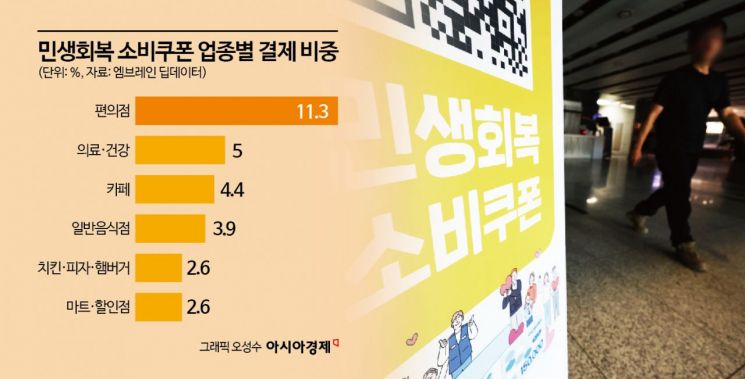
According to market research firm Embrain Deepdata, during the week of July 22 to 28, the sector where consumption coupons were most frequently used was convenience stores (11.3%). This was followed by medical and health (5%), cafes (4.4%), general restaurants (3.9%), chicken, pizza, and hamburger outlets (2.6%), and supermarkets and discount stores (2.6%), among others.
Unlike previous support funds, which were distributed as a lump sum, this time the funds are divided into two rounds. In the first round, between 150,000 and 450,000 KRW per person is distributed selectively based on income level, region, and status as a near-poverty household. From August 22, a second round of 100,000 KRW per person will be provided to the remaining 90% of the population, excluding the top 10% by income.
An industry insider stated, "The 150,000 KRW that most people will receive is an amount that can be mostly spent at a single location, such as for food purchases or dining out, so it is unlikely that sales at any particular merchant will rise or fall dramatically." The insider added, "It will only be possible to fully analyze overall spending patterns after the additional funds are distributed in September."
On online communities, some users have shared, "I paid for my children’s academy fees with the consumption coupon during the summer vacation, and after using the small remaining balance for a family meal, the support funds were quickly used up." In addition, large supermarkets have responded to the consumption coupons by expanding food-centered discount events, which appear to have absorbed some demand from people seeking to shop in these air-conditioned facilities during the heatwave.
Large-Scale Discount Events Help Defend Sales
In fact, large supermarkets excluded from the list of eligible coupon merchants launched discount events from the very first week of the policy to minimize customer attrition. Emart offered five cans of imported beer and ready-to-drink (RTD) highballs, which are in high demand during the summer, for 9,800 KRW, and sold sliced watermelon and melon for 5,000 to 6,000 KRW. On July 29-30, imported pork belly and pork neck (100g, chilled) were sold for 788 KRW, a 60% discount when paid with a promotional card.
Homeplus also began a "Homeplus Run" event from July 31 to August 6, offering 50% off Nonghyup Anshim Hanwoo Grade 1 female sirloin (100g), up to 60% off branded Korean pork belly and pork neck (100g), and 1+1 deals on summer foods. Meanwhile, Lotte Mart has been running its "Direct Price" campaign since July 31, selecting around 10 food items each week to offer at special prices for one week at a time.
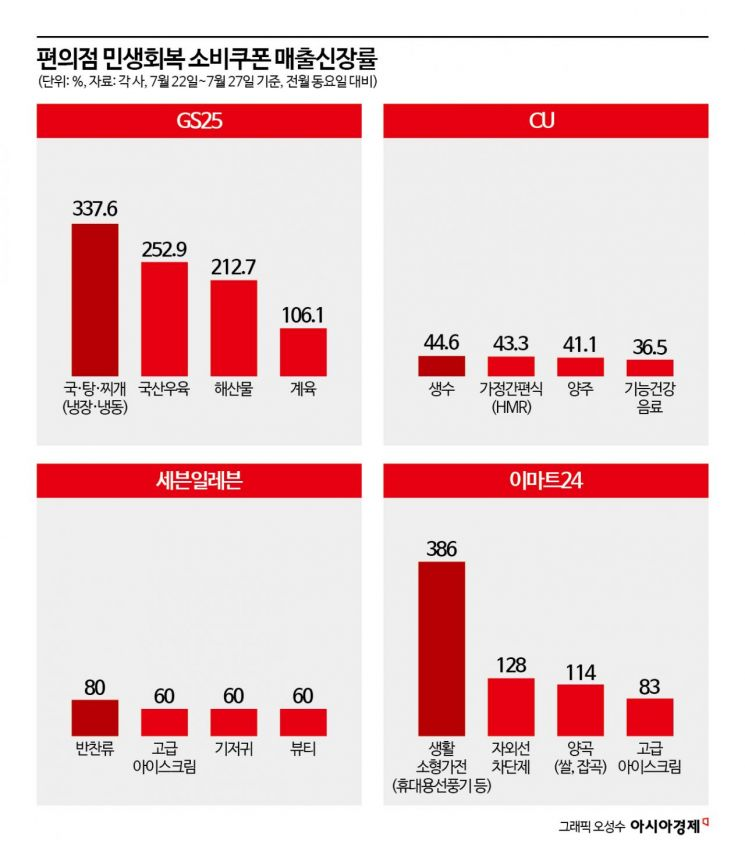
The convenience store industry believes that most of the first-round consumption coupons were used up within the first one to two weeks, and is focusing on boosting performance through its own discount promotions. For example, GS25 is running value-for-money discount events on around 1,700 essential food, daily necessity, and fresh food items this month. CU is offering 1+1 deals and card-linked discount events throughout the month on around 700 beverages, which see increased demand during summer.
Seven-Eleven will launch "Handochoqua Yetnaltongdak" on August 7, and is running a promotion through August 15 where it can be purchased for 5,900 KRW, a 6,000 KRW discount from the original price of 11,900 KRW. During the same period, four cans of eight types of imported beer, including Asahi and Heineken, will be sold for 8,800 KRW. Emart24 is also running 1+1 and 2+1 freebie and discount events on a total of 3,160 products throughout the month.
According to a report published by the Korea Development Institute (KDI) in 2020 titled "Effects and Implications of the First Emergency Relief Fund Policy," after the first week of relief fund distribution in May of that year, sales generated through eight credit card companies rose 6.4% year-on-year in the second week of May, 16.8% in the third week, and 15.2% in the fourth week, indicating a surge in spending in the early stages.
© The Asia Business Daily(www.asiae.co.kr). All rights reserved.
![Clutching a Stolen Dior Bag, Saying "I Hate Being Poor but Real"... The Grotesque Con of a "Human Knockoff" [Slate]](https://cwcontent.asiae.co.kr/asiaresize/183/2026021902243444107_1771435474.jpg)


















