Candidate Pool Stirs Ahead of Next Year's Local Elections
Metropolitan and Basic Local Government Heads Busy Gauging Party Sentiment
Signs of Division Within City and Provincial Councils... Struggle for Leadership
Possibility of Non-Mainstr
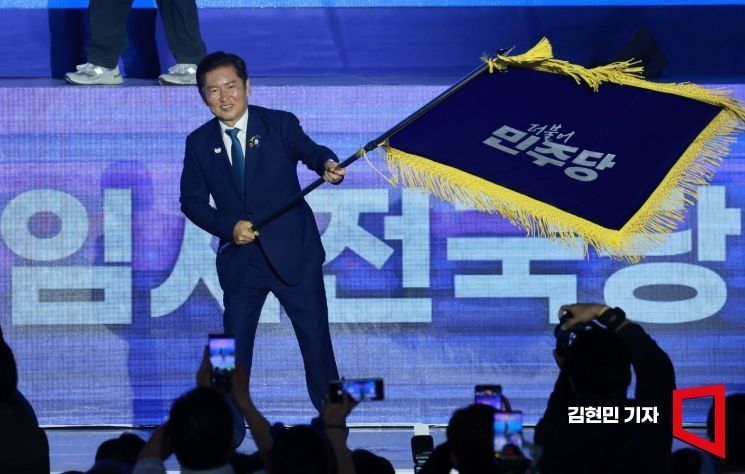 Jeong Chungrae, the newly appointed party leader of the Democratic Party of Korea, is waving the party flag received from Kim Byunggi, the acting party leader and floor leader, at the National Party Members' Convention held on the 2nd at KINTEX in Goyang-si, Gyeonggi-do. Photo by Kim Hyunmin
With Representative Jung Chungrae being elected as the leader of the Democratic Party of Korea on August 2, a reshuffling of the political landscape in the Gwangju and Jeonnam regions is anticipated. As the local elections approach next year, both prospective candidates for each race and local residents are showing increasing interest in the changing dynamics.
In particular, as differences in stance become more pronounced not only among members of the National Assembly but also among incumbent metropolitan and basic local government heads and local council members, there is speculation about the possibility of new political alliances and realignments within the region.
According to the local political scene on August 4, Representative Jung secured a decisive victory at the temporary party convention on August 2, winning 61.7% of the final vote, which reflected the votes of delegates (15%), party members with voting rights (55%), and public opinion (30%). He defeated candidate Park Chan-dae, who received 38.3%, and was elected as party leader.
As a result, those considering running in next year’s local elections are stepping up their preparations. Some prospective candidates with ambitions for local government head positions are already moving to align themselves with influential figures, reacting sensitively to the new developments.
Metropolitan and basic local government heads in Gwangju and Jeonnam, who have so far maintained a neutral stance, are now closely watching the direction of party sentiment under Representative Jung’s leadership. This is because, in these regions, where winning the Democratic Party nomination is virtually equivalent to election, building trust with the new leadership is directly linked to their political survival.
A representative from the office of a district head in Gwangju stated, "Representative Jung Chungrae tends to prioritize a party member-based approach over the vested interests of multi-term lawmakers," and added, "For basic local government heads who have weaker ties with the central party, anxiety over renomination may increase."
Accordingly, some local government heads are working to expand their connections with Representative Jung’s circle while also seeking to coordinate their relationships with local National Assembly members.
Subtle shifts are also being detected within the Democratic Party factions in the Gwangju City Council and the Jeonnam Provincial Council. As the policy differences between younger, reform-minded council members and the traditional mainstream senior members become more evident, there is growing interest in which side Representative Jung’s leadership will support.
A member of the Gwangju City Council explained, "Young council members have high expectations for the 'Jung Chungrae leadership,' while senior and multi-term members are keeping a close watch on the central party’s direction. Within the council, there is also intense strategizing to secure party support, and moves aimed at next year’s local elections are already in full swing."
Since Representative Jung’s election, there has also been cautious talk of possible "behind-the-scenes alliances" between non-mainstream and anti-Lee Jae-myung factions within the party. If Representative Jung appoints hardline pro-Lee Jae-myung figures to key party positions, there is a possibility that incumbent lawmakers who oppose this may respond by organizing themselves in opposition.
Although Representative Jung emphasized immediately after his inauguration that he would "embrace public sentiment beyond factions," there are considerable concerns in the local political community that his emphasis on "reform" and a "hardcore supporter base" could instead spark new conflicts in regional politics.
A local political figure predicted, "While Representative Jung is likely to pursue strong leadership with a party member-centered approach, internal backlash may become more visible in the process. If Gwangju and Jeonnam become the epicenter of such internal strife, it could also affect the party’s overall election strategy."
Meanwhile, as the so-called "Honam marginalization" debate continues within the Democratic Party, Representative Jung’s appointments to party positions are expected to be a decisive factor in determining whether Gwangju and Jeonnam can reclaim their status as the heart of the Democratic Party’s power, or whether they will become a testing ground for political realignment.
© The Asia Business Daily(www.asiae.co.kr). All rights reserved.
![Clutching a Stolen Dior Bag, Saying "I Hate Being Poor but Real"... The Grotesque Con of a "Human Knockoff" [Slate]](https://cwcontent.asiae.co.kr/asiaresize/183/2026021902243444107_1771435474.jpg)















