"Prophecy Fulfilled" Reactions Flood Local Social Media
However, Many Call It a "Far-Fetched Interpretation"
The so-called "July Great Disaster Theory" in Japan, which originated from a Japanese manga artist's prophecy and spread worldwide, is once again stirring controversy. On July 30, just two days before the predicted timeframe mentioned in the prophecy, a magnitude 8.8 earthquake struck the Kamchatka Peninsula in Russia. As a result, a tsunami was observed in Japan, reigniting claims that "the prophecy is coming true."
Kamchatka Earthquake Brings Renewed Focus on "July Great Disaster" Theory
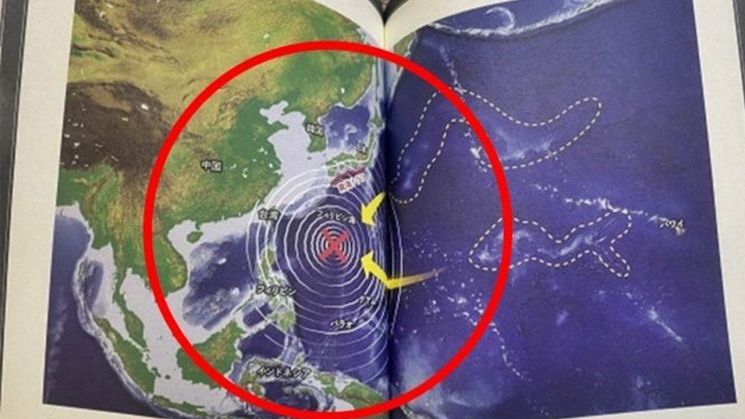 The part predicting a great disaster in Ryoh Tatsuki's manga "The Future I Saw" Complete Edition. X (formerly Twitter)
In fact, at 9:24 a.m. local time on July 30, a powerful earthquake occurred off the eastern coast of Russia's Kamchatka Peninsula. Following this, the Japan Meteorological Agency issued tsunami advisories for most areas along the Pacific coast, and in some regions, even higher-level warnings were announced. The next day, a tsunami with a maximum height of 1.3 meters was observed at Kuji Port in Iwate Prefecture, Honshu, while Hokkaido's Nemuro saw a tsunami of 80 cm and Hamanaka recorded 60 cm.
News of the earthquake quickly spread across local social networking services (SNS), where posts began circulating again about the content of "The Future I Saw: Complete Edition," published in 2021 by manga artist Ryo Tatsuki. In this work, Tatsuki described, "In my dream, I saw water surging up from the southern Pacific Ocean off Japan," and went on to depict, "In July 2025, the seabed between Japan and the Philippines suddenly explodes, and a tsunami three times the size of the Great East Japan Earthquake engulfs Japan and other Pacific coastal countries."
"Ryo Tatsuki's Prophecy Becomes Reality" vs "Far-Fetched Interpretation"
Some internet users argued that the prophecy had come true, citing the timing of the earthquake at the "end of July" and the actual observation of a tsunami. On SNS, reactions included: "Volcano, earthquake, and tsunami?all happened. The prophecy was spot-on," "Absolutely chilling. The prophecy was real," "The magnitude and location are different, but the main point of a 'July tsunami' was accurate," "The circumstances are quite similar," and "Tatsuki has gotten more than one thing right so far. This shouldn't be dismissed as just a rumor." These comments suggested that Tatsuki's prophecy was correct.
On the other hand, many dismissed this as a "far-fetched interpretation." They pointed out that the Kamchatka earthquake differed from the prophecy in both timing and location, and that the actual scale of damage was much smaller. Online, people commented, "Tatsuki's prophecy was that a massive volcanic eruption would occur in the Philippine Sea, causing a tsunami three times the height of the Great East Japan Earthquake to hit Japan, but this (Kamchatka Peninsula) earthquake is nothing like that," "If it was supposed to be the Philippine Sea, why is it Kamchatka, Russia? That doesn't make sense," "Why are people still talking about prophecies?" and "They're ignoring all the parts that were wrong and claiming it was accurate just because a couple of things coincidentally matched."
 A magnitude 8.8 earthquake struck the Kamchatka Peninsula in Russia on the 30th of last month, triggering a tsunami warning and evacuation orders along the Pacific coast of Japan. The photo shows Japanese citizens watching the evacuation alert breaking news. Photo by AFP Yonhap News
Regardless of the prophecy's authenticity, the so-called "July Great Disaster Theory" has dealt a massive economic blow to Japan's travel and tourism sector. On July 5, Japanese media outlet Asahi News reported that baseless rumors of a "major disaster occurring on July 5" spread due to the influence of a certain manga, and that demand for travel to Japan had sharply declined since around May. Citing research by Nobuhide Kiuchi, an economist at Nomura Research Institute, the report estimated that the July Great Disaster Theory would reduce inbound tourism demand, resulting in a loss of approximately 560 billion yen (about 5.3 trillion won) in tourism revenue.
© The Asia Business Daily(www.asiae.co.kr). All rights reserved.
![Clutching a Stolen Dior Bag, Saying "I Hate Being Poor but Real"... The Grotesque Con of a "Human Knockoff" [Slate]](https://cwcontent.asiae.co.kr/asiaresize/183/2026021902243444107_1771435474.jpg)
















