"Yellow Envelope Act Is a Law That Strangles Businesses," Criticism Raised
"Crucial to Elect the Right Party Leader This Time," Calls for Support
On August 4, Ahn Cheolsoo, a candidate for the People Power Party leadership, criticized, "Retail investors have lost all their vacation funds due to the stock market crash, yet President Lee Jaemyung is calmly going on vacation," adding, "He is a president like an anteater." On his social media account that day, Ahn stated, "He tempted the public with the sweet words 'KOSPI 5000,' but what remains is the grim reality where the people's hard-earned money has evaporated."
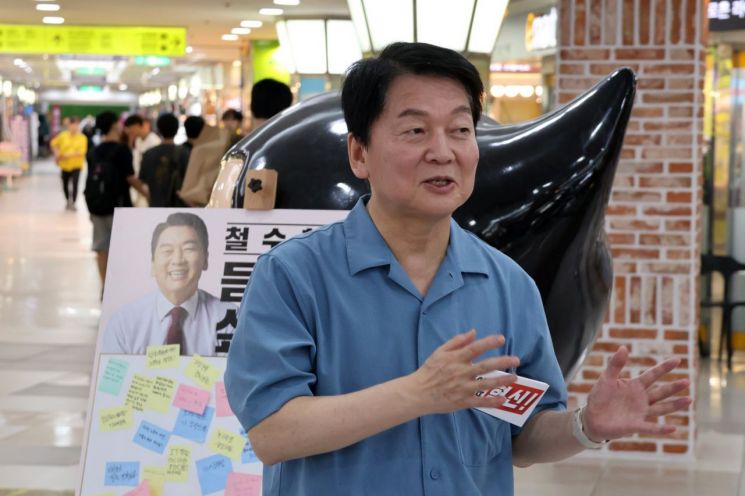 On the 2nd, Ahn Cheolsoo, who visited Daegu, said, "The pride of party members is collapsing," and appealed for support by calling himself "the only person who will no longer embarrass the pride of party members." Ahn Cheolsoo Facebook
Regarding various bills being pushed by the Democratic Party, Ahn commented, "Forcing through the Yellow Envelope Act will suffocate businesses and freeze investment sentiment," and pointed out, "It is a bad law that stifles economic vitality." He went on to say, "The three broadcasting laws will ultimately turn the media into something like Kim Jong Un's Korean Central TV," and added, "The Lee Jaemyung administration's all-out push for tax increases and harmful legislation is undermining South Korea's market economy and liberal democracy." Ahn further appealed for support, saying, "The true nature of the Lee Jaemyung regime is just beginning to reveal itself. The Lee Jaemyung regime is even threatening to dissolve our People Power Party. To stop the reckless actions of the Lee Jaemyung regime, it is crucial to elect the right party leader this time."
Meanwhile, on this day, the Democratic Party plans to present five key contentious bills, including the Yellow Envelope Act, the three broadcasting laws (amendments to the Broadcasting Act, the Foundation for Broadcast Culture Act, and the Korea Educational Broadcasting System Act), and the amendment to the Commercial Act, to the plenary session. To block the passage of these bills, the People Power Party has announced its intention to launch a filibuster (a legal obstruction of proceedings through unlimited debate). The Democratic Party, which holds a majority of seats, can end the filibuster through a vote, but since at least 24 hours must pass, only one contentious bill can be passed during the July extraordinary session, which ends on August 5.
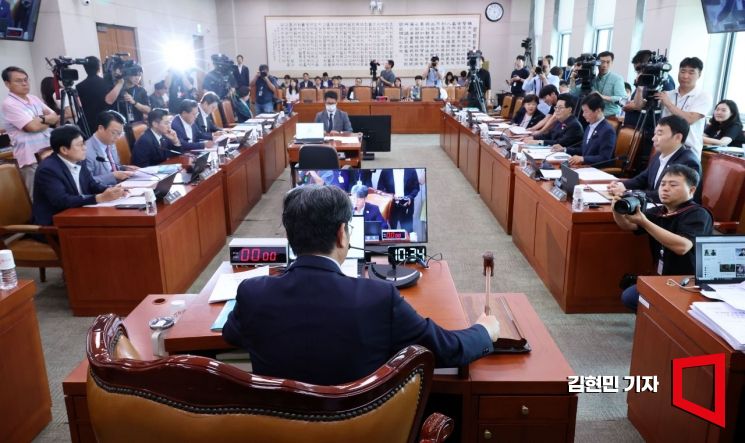 On the 1st, Chairman Lee Chunseok striking the gavel at the plenary session of the Legislation and Judiciary Committee held in the National Assembly to deliberate on the three broadcasting laws, the Yellow Envelope Act, and the Commercial Act. Photo by Kim Hyunmin
According to the National Assembly Act, if debate time, including a filibuster, exceeds 24 hours, the debate can be ended and the process moved to a vote with the approval of three-fifths (180 seats) or more of the total members. Among the bills submitted by the Democratic Party this time, the Yellow Envelope Act mainly seeks to expand the definition of "employer" to include not only parties to a labor contract but also anyone who can substantially and specifically control or determine workers' working conditions. It also seeks to broaden the scope of industrial action and limit employers' claims for damages against unions for legal industrial action.
The three broadcasting laws include provisions to increase the number of KBS board members from 11 to 15, and the number of board members for the Foundation for Broadcast Culture (MBC) and EBS from 9 to 13, respectively. The amendment to the Commercial Act is centered on prohibiting listed companies with total assets of 2 trillion won or more from excluding cumulative voting in their articles of incorporation, and increasing the number of audit committee members elected separately from other directors at the general meeting of shareholders from one to two. Cumulative voting is a system where, when electing company directors at a general meeting, shareholders can exercise as many votes as the number of directors to be elected for each share they own. This system is advantageous for minority shareholders to concentrate their votes on a specific candidate and elect the director they want.
© The Asia Business Daily(www.asiae.co.kr). All rights reserved.
![Clutching a Stolen Dior Bag, Saying "I Hate Being Poor but Real"... The Grotesque Con of a "Human Knockoff" [Slate]](https://cwcontent.asiae.co.kr/asiaresize/183/2026021902243444107_1771435474.jpg)

















