KOSPI Plunges After Government Eases Capital Gains Tax Criteria
Park Sanghyuk: "It Causes Confusion Over the KOSPI 5000 Goal"
"Need to Gather Opinions"... Over 100,000 Sign National Assembly Petition
As the government announced its 2025 tax reform plan, which includes lowering the threshold for major shareholders subject to capital gains tax from 5 billion won to 1 billion won, investors have strongly opposed the move, with the KOSPI plunging nearly 4%. In response, Park Sanghyuk, a lawmaker from the Democratic Party of Korea, stated that the plan "lacked careful consideration."
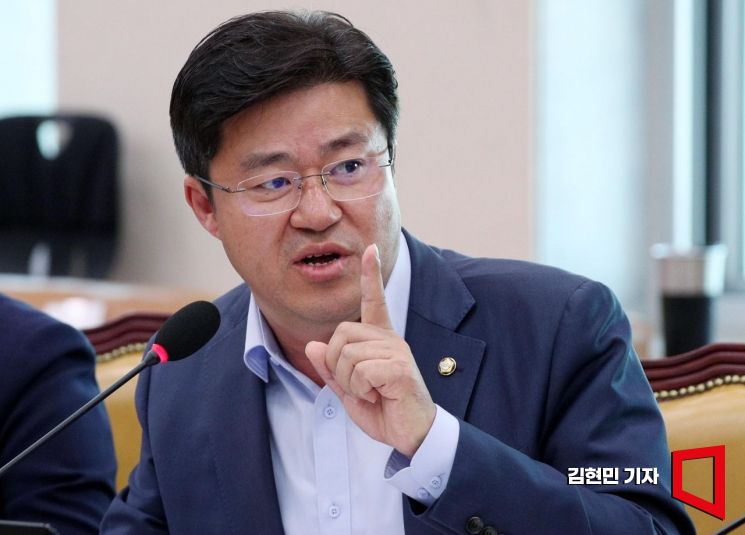
In an interview with YTN Radio's "News Fighting" on the 4th, Park said, "We have set a direction for KOSPI 5000 and have been amending the Commercial Act accordingly. Previously, we even abolished the financial investment income tax. Now, retail investors are criticizing us, saying, 'If you relax the capital gains tax threshold like this, isn't it in conflict with that direction?' While everyone understands the major policy goals, we should have created a detailed roadmap and design for related measures, but we ended up causing confusion in those areas."
He continued, "It is true that Jin Sungjoon, the former chairman of the Policy Committee, was involved in discussions regarding the major shareholder threshold, but not everything was done by Representative Jin. It was coordinated with the Ministry of Economy and Finance. As floor leader Kim Byungki mentioned, there is a need to sufficiently gather opinions within the party, centered around the Special Committee on Tax Normalization."
He added, "I believe the government is closely monitoring the situation. As we aim for the KOSPI 5000 era and seek to shift investment from real estate to the capital market, it is essential to carefully examine which measures align with this direction. I expect the government will pay close attention to these issues."
Regarding the compromise proposal to lower the major shareholder threshold to 3 billion won per stock, he said, "It is not appropriate to specify an exact amount. During the Park Geunhye administration, the threshold was lowered from 10 billion won to 5 billion won and then to 2.5 billion won. Under the Moon Jaein administration, it changed from 2.5 billion won to 1.5 billion won. This is why we need a forum for public discussion, which is the role of the National Assembly."
According to the National Assembly's public petition site on the 4th, as of 8:30 a.m. that day, 115,461 people had agreed to the petition opposing the lowering of the major shareholder capital gains tax threshold. The petition was posted on July 31, and surpassed 100,000 signatures by 7:00 p.m. on August 3, just four days later. The petitioner stated, "I am submitting this petition to prevent the collapse of the KOSPI. The capital gains tax is a law that major shareholders can avoid simply by selling at the end of the year. If tax-avoidance-driven selling increases, stock prices will inevitably fall."
The petitioner added, "If taxes on the US and Korean stock markets are the same, who would choose the Korean market? If there is a flood of tax-avoidance selling at the end of every year, the KOSPI cannot rise steadily like the US market. If the capital gains tax threshold is set at 1 billion won, most people will start selling in advance from 700 million or 800 million won. Offsetting gains and losses is not allowed, making this law even more unfair than the financial investment tax. Should one have to pay the capital gains tax just because they have more money?"
The petitioner also argued, "It is not as if taxes are paid in order of who made the most money in the Korean market, nor is holding a large amount of stock a crime. If that is the case, of course people will sell in Korea and move to the US market. Please do not kick away the ladder at 1 billion won, and instead protect the culture of long-term investment and the dream of 'ten-bagger' returns in the Korean market. If you make money in the Korean market, you should pay taxes, but do not drive everyone away with strange populism by taxing people just because they have more money."
© The Asia Business Daily(www.asiae.co.kr). All rights reserved.

















