WiFi 7 Pilot Service Applied to 100 Buses in Seoul and Gyeonggi
Average Download Speed Increased 1.5 Times Compared to WiFi 6 and 6E
SK Telecom announced on the 30th that it has confirmed improvements in communication quality by providing a pilot service that introduces WiFi-7 based on 5G·LTE communication in city buses for the first time in Korea.
The core of this pilot service is to enhance quality by applying WiFi-7 equipment (AP) based on 5G·LTE backhaul to existing public bus WiFi. This initiative was carried out as part of the public bus WiFi project led by the National Information Society Agency (NIA).
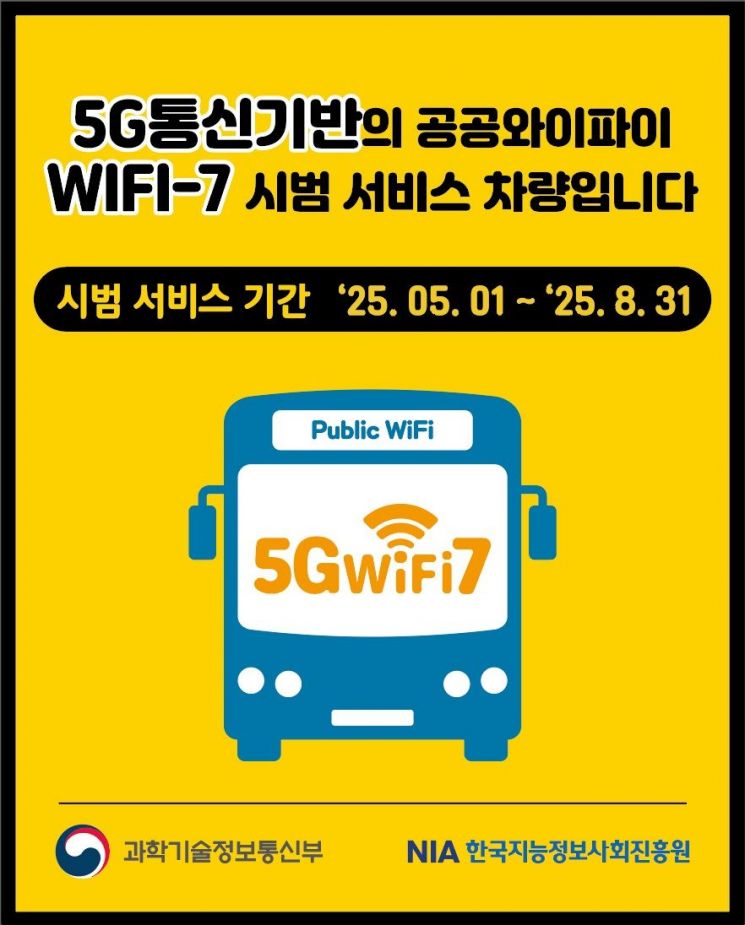 SK Telecom announced on the 30th that it has verified the improvement in communication quality by providing a pilot service introducing WiFi-7 based on 5G and LTE communication in city buses for the first time in Korea. Photo by SK Telecom
SKT began the pilot service in May, targeting a total of 100 buses in Seoul and Gyeonggi regions, including city trunk lines (blue), city branch lines (green), and metropolitan buses (red). The pilot service is scheduled to continue until the end of August.
According to SKT, a mid-term review of the pilot operation showed that average download speeds improved by more than 1.5 times. When WiFi-6·6E equipment, the previous generation, was first applied, the average download speed was 429Mbps, but after the initial deployment of WiFi-7 equipment, speeds of 715 to 1003Mbps were recorded depending on the route.
The average usage per device also increased by 20 to 30 percent. A comparison conducted in May, where both WiFi-6·6E and WiFi-7 equipment were installed on the same bus routes, showed that the average monthly usage per bus was 272,979 megabytes (MB) for WiFi-6·6E and 365,211MB for WiFi-7.
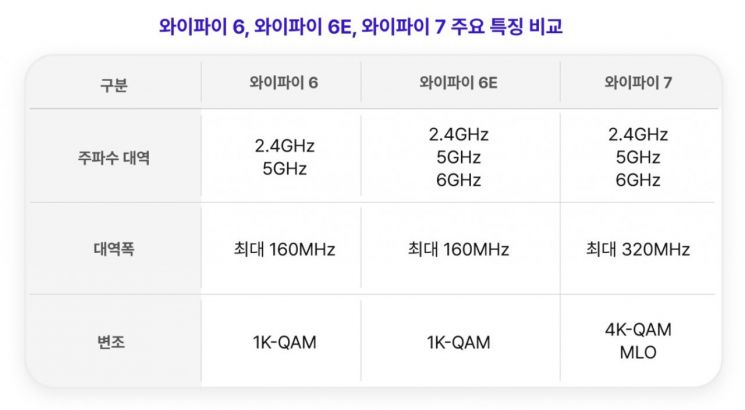
WiFi-7 offers faster transmission speeds and reduced latency compared to WiFi-6·6E. WiFi-7 supports a variety of frequency bands simultaneously, including 2.4GHz, 5GHz, and 6GHz, allowing many devices to communicate without interference. The bandwidth (channel width) is also doubled to 320MHz compared to WiFi-6·6E, increasing the amount of data that can be processed at once.
The QAM (Quadrature Amplitude Modulation) value, a technology that converts digital packets into analog signals for wireless data transmission, is also higher. A higher QAM value allows more information to be packed into the wireless signal. Through Multi-Link Operation (MLO), a core technology of WiFi-7, uploads and downloads across multiple frequency bands can be processed simultaneously, further enhancing stability.
Security has also been strengthened. OWE technology has been introduced to encrypt user data in the free public WiFi band. In the secure public WiFi band, 'WPA2/3 Enterprise' security technology, commonly used by businesses and institutions, has been adopted.
SKT plans to continue advancing public WiFi services based on this pilot. Kim Ilyoung, Head of Connectivity Business at SKT, stated, "By piloting WiFi-7 based on commercial 5G·LTE networks in the public bus WiFi project, people will experience better WiFi services," adding, "We will continue to take the lead in providing stable and improved communication services."
© The Asia Business Daily(www.asiae.co.kr). All rights reserved.
![Clutching a Stolen Dior Bag, Saying "I Hate Being Poor but Real"... The Grotesque Con of a "Human Knockoff" [Slate]](https://cwcontent.asiae.co.kr/asiaresize/183/2026021902243444107_1771435474.jpg)
















