Trump-Modi Relationship, Once a 'Bromance,' Now Worsens
Clashes Over Agricultural Market, Russian Oil, and Pakistan Ceasefire
Conflicts on Every Issue... WSJ: "Trump Feels Deep Frustration"
There are assessments that the relationship between U.S. President Donald Trump and Indian Prime Minister Narendra Modi is rapidly deteriorating. On the 3rd (local time), Yonhap News cited the Wall Street Journal (WSJ), reporting, "India is refusing to yield to U.S. demands in trade negotiations and on the issue of purchasing Russian energy. Furthermore, President Trump has grown cold toward Prime Minister Modi as India does not acknowledge his role in mediating the India-Pakistan ceasefire."
On the 30th of last month, President Trump stated on social media, "(India), along with China, is becoming the largest buyer of Russian energy," and warned, "If India does not stop importing Russian crude oil, additional sanctions will be imposed." The following day, he said, "I don't care what India does with Russia," adding, "They can ruin their already failed economy together."
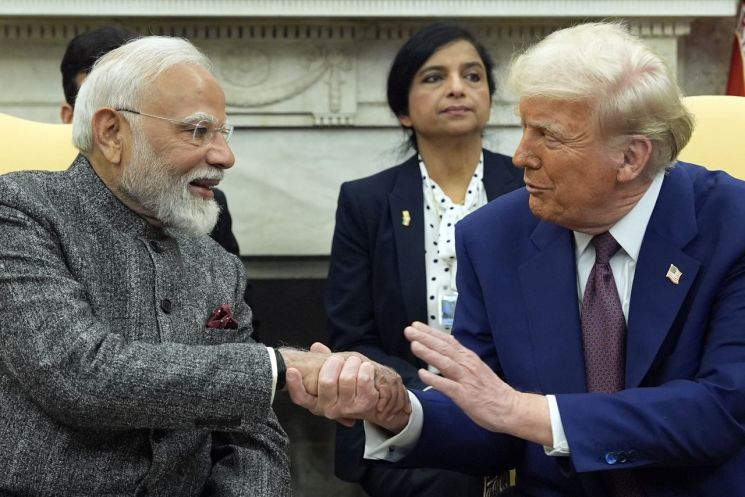
The two leaders once enjoyed a close relationship, often referred to as a 'bromance.' In February, President Trump praised Prime Minister Modi, who visited the White House, saying, "He is a much stronger negotiator than I am." In response, Prime Minister Modi cited President Trump's slogan 'MAGA (Make America Great Again)' and said, "I want to make India great again."
However, as President Trump's tariff pressure intensified and India's response remained minimal, their relationship began to sour. On the 1st, the Trump administration released the mutual tariff rates of various countries and announced a 25% tariff on Indian goods. As a result, India's exports to the U.S. now face a more disadvantageous situation compared to South Korea and Japan (15%) and even compared to most Southeast Asian countries such as Vietnam, Thailand, and Indonesia (19-20%).
The main issue in U.S.-India trade negotiations is the opening of India's agricultural market, which accounts for more than 40% of domestic employment. The Trump administration has strongly pressured India to lower tariffs on American agricultural products and dairy imports. However, the Modi administration has resisted, mindful of backlash from farmers, who are a powerful voting bloc. According to the WSJ, "Former and current officials say President Trump feels a deep sense of frustration over the lack of progress in trade negotiations with India."
The ceasefire following the armed clash between India and Pakistan in May also appears to have contributed to the deterioration of their relationship. President Trump emphasized that the U.S. had mediated the ceasefire negotiations, but in a phone call with President Trump in mid-last month, Prime Minister Modi stated, "The ceasefire was not achieved through mediation by the U.S. or any other third party." It was also reported that Prime Minister Modi declined President Trump's invitation to visit the United States.
India's import of Russian crude oil remains a contentious issue. Previously, President Trump had announced sanctions against Russian President Vladimir Putin for ignoring pressure to end the war in Ukraine. However, as India continues to import Russian oil, criticism has arisen from President Trump's side that "India is effectively funding Russia's war effort."
Randhir Jaiswal, spokesperson for India's Ministry of External Affairs, stated on the 1st, "The relationship between the two countries has weathered many transitions and challenges," adding, "We continue to focus on a substantive agenda and are confident that the relationship will continue to progress."
© The Asia Business Daily(www.asiae.co.kr). All rights reserved.

















