Petitioner: "A Surge of Tax-Avoidance Selling Will Occur Every Year-End"
A petition opposing the tax reform plan to lower the capital gains tax threshold for listed stocks from 5 billion won to 1 billion won received support from about 90,000 people on August 3.
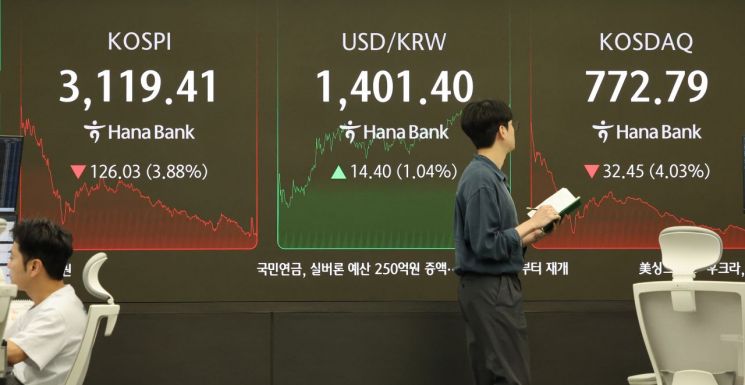 On the 1st, employees are working in the dealing room at the Hana Bank headquarters in Jung-gu, Seoul. On this day, the KOSPI closed at 3,119.41, down 126.03 points (3.88%) from the previous session. Photo by Yonhap News
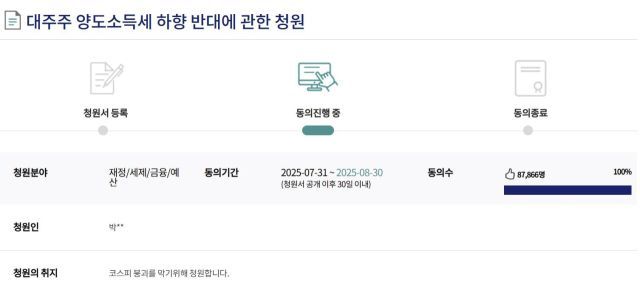
As of 1:40 p.m. on this day, more than 90,000 people had participated in the National Assembly e-petition regarding the tax reform plan that began on July 31. This already meets the requirements for the petition to be discussed in the National Assembly. According to the National Assembly Act, if a petition receives the consent of 100 people within 30 days of registration, it is made public to everyone. If it receives the consent of more than 50,000 people within 30 days, it is formally referred to the relevant standing committee of the National Assembly.
The petitioner, identified as Mr. A, argued, "The capital gains tax is a law that can be avoided by major shareholders simply selling at the end of the year. If a large volume of stocks is sold for tax avoidance, prices will inevitably fall."
Mr. A claimed that if the threshold for the capital gains tax is set at 1 billion won, people holding stocks worth 700 million to 800 million won will begin selling. He added, "Do we have to diversify into more than 20 stocks just to avoid the capital gains tax? This law is even more unfair than the financial investment income tax, and it does not allow for offsetting gains and losses."
"The market will become a place for only themes to remain"
He continued, "If the tax is the same for the US stock market and the Korean stock market, who would choose the Korean market? If there is a surge of tax-avoidance selling at the end of every year, KOSPI will never be able to rise steadily like the US market. The market will regress to the old days, becoming a 'boxpi' where only themes remain."
He also said, "It is not as if those who make the most money in the Korean market pay the tax first, nor is it a crime to simply hold a lot of stocks. If that's the case, of course people will sell their Korean stocks and move to the US market."
The government announced in its tax reform plan on July 31 this year that it would lower the threshold for major shareholders subject to capital gains tax from those holding 5 billion won or more in a single stock to those holding 1 billion won or more.
Since then, some investors have claimed that people holding more than 1 billion won in stocks are selling to avoid being classified as major shareholders, leading to a decline in stock prices. In fact, on August 1, the KOSPI closed at 3,119.41, down 126.03 points (3.88%) from the previous trading day. This was the largest drop in about four months, since April 7, when it fell by 5.57%.
The Korea Stock Investors Association (Hantuyon), a union of individual investors, announced plans for collective action against the tax reform. They stated, "For foreigners, the threshold for major shareholders subject to the capital gains tax is a 25% stake, which means they could own over 100 trillion won of Samsung Electronics. If the 1 billion won threshold is enforced, we are prepared to take collective action, even to the point of a people's uprising."
Meanwhile, Kim Byungki, floor leader of the Democratic Party of Korea, responded to the rising opposition by acknowledging, "There are significant concerns and worries about the tax reform plan." He added, "We will review the possibility of raising the 1 billion won major shareholder threshold, focusing on the party's special committees on tax normalization and KOSPI 5000."
© The Asia Business Daily(www.asiae.co.kr). All rights reserved.


















