Private Rental Housing Accounts for 11% of All Homes in Seoul
Clear Guidelines Established for Succession of Landlord Status Upon Inheritance
The Seoul Metropolitan Government announced on the 3rd that it will publish and distribute the "2025 Registered Private Rental Housing Business Manual" to protect the rights and interests of both private rental housing operators and tenants.
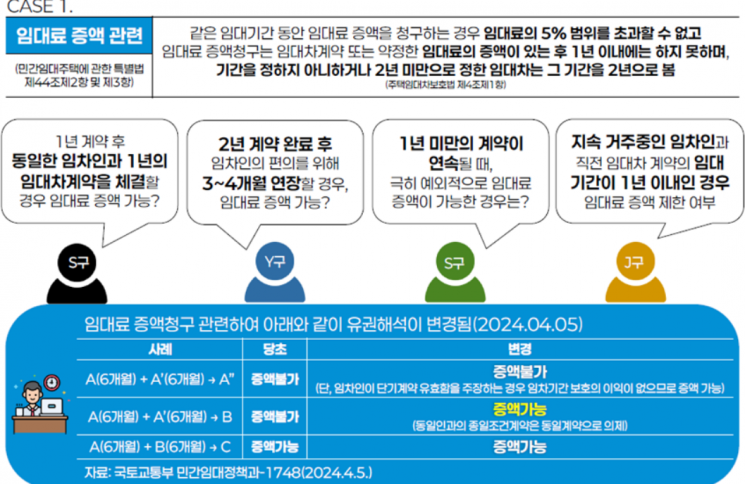 Questions and answers regarding rent increase from the Private Rental Housing Manual. Provided by Seoul City.
Private rental housing refers to properties owned by landlords for rental purposes and registered with local districts in accordance with the Special Act on Private Rental Housing. Landlords must comply with 16 obligations to protect tenant rights and can receive tax benefits for national and local taxes.
Tenants residing in private rental housing are protected during the mandatory rental period (4, 6, 8, or 10 years), including a 5% cap on rent increases and mandatory subscription to deposit return guarantees.
Currently in Seoul, there are 97,233 private rental business operators providing 415,460 rental housing units. This accounts for approximately 11% of Seoul's total housing stock (3,879,000 units) and about 20% of all tenant households. By housing type, apartments make up the largest share (44.2%), followed by multi-family houses (22.4%), officetels (14.6%), and multi-household dwellings (8.6%).
This manual reflects the amendments made to the Special Act on Private Rental Housing in June and focuses on resolving confusion and improving the speed of civil complaint responses.
The "2025 Registered Private Rental Housing Business Manual" consists of six chapters, covering an introduction to the private rental housing system, benefits and obligations for landlords, registration and deregistration procedures, frequently asked questions (FAQ), case studies of inquiries and responses from local district officials, and examples of administrative fines.
To protect tenant rights, the city has published the manual by establishing consistent standards, considering the lack of clear regulations on administrative actions for landlord violations or succession of landlord status upon inheritance, which can vary by district.
One representative administrative case is whether a property is subject to deregistration if an heir files a transfer report after inheritance registration when the landlord dies. The Private Rental Housing Act does not specify this. The city has included unified guidelines in the manual based on inquiries to the Ministry of Land, Infrastructure and Transport and legal interpretations from the Ministry of Government Legislation.
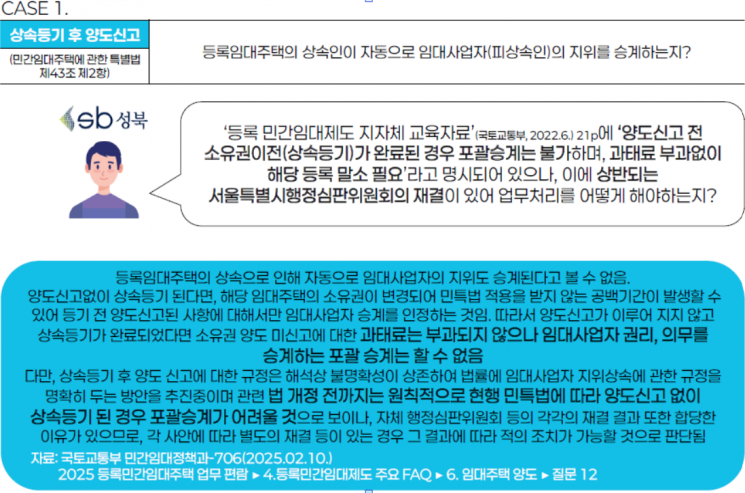 Inquiry and response regarding transfer report after inheritance registration in the Private Rental Housing Manual. Provided by Seoul City.
The authority to impose administrative fines for landlord violations has been delegated from the Minister of Land, Infrastructure and Transport to local district mayors. The city has published the manual to implement system improvements and ensure that administrative actions do not differ across districts, going beyond simple mediation.
Along with the publication of the manual, the city will hold three training sessions and meetings for local district officials in charge of the private rental housing system during August. The manual will be distributed to the Seoul Metropolitan Government, each local district, the National Assembly Library, and the Seoul Metropolitan Library.
Choi Jinseok, Director of Housing at the Seoul Metropolitan Government, stated, "We expect that this Registered Private Rental Housing Business Manual will reduce confusion in legal interpretation and increase public trust in the system," and added, "We will continue to promote public-supported private rental housing to help alleviate citizens' concerns about rent and deposit instability and contribute to housing stability."
© The Asia Business Daily(www.asiae.co.kr). All rights reserved.
![Clutching a Stolen Dior Bag, Saying "I Hate Being Poor but Real"... The Grotesque Con of a "Human Knockoff" [Slate]](https://cwcontent.asiae.co.kr/asiaresize/183/2026021902243444107_1771435474.jpg)
















