801 Cases Last Year, Up from 585 in 2021
A man in his 50s who verbally abused and assaulted medical staff while intoxicated in a hospital emergency room was sentenced to prison last month.
According to the Criminal Division of the Pyeongtaek Branch of the Suwon District Court, the man recently became agitated and shouted profanities when a nurse rolled up his socks and jeans during his examination in the emergency room. He then threw the neck brace he was wearing at the nurse and also threatened and verbally abused the doctor who tried to intervene.
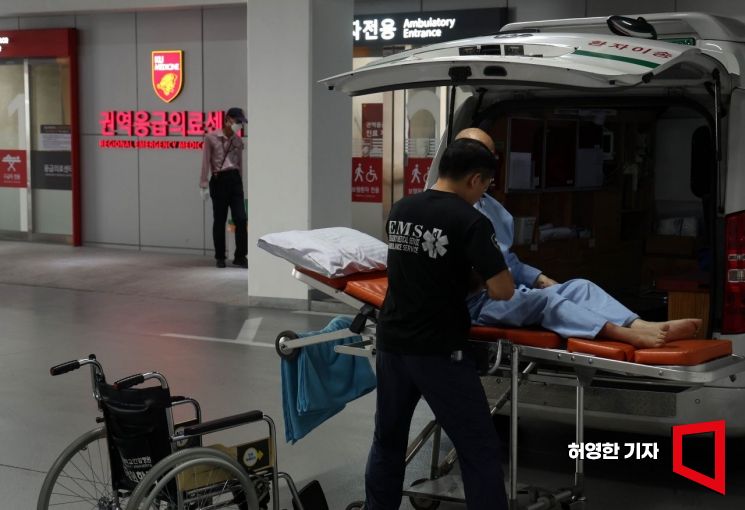 A patient is being transported by ambulance in front of the Regional Emergency Medical Center at Korea University Anam Hospital in Seoul. Photo by Heo Younghan younghan@
Cases of assault and threats against medical staff in emergency rooms have surged by nearly 40% over the past three years.
On August 3, Yonhap News reported, citing data from the Ministry of Health and Welfare obtained by National Assembly Health and Welfare Committee member Kim Mi-ae, that there were a total of 801 reports of interference with emergency medical care last year. This represents an increase of about 37% compared to 585 cases in 2021.
By reason for report last year, verbal abuse and insults against emergency medical staff accounted for 587 cases (73.3%), making it the most common incident. Physical assault occurred 123 times. There were also 36 cases of threats against medical staff and 28 cases of property damage.
Violent acts in emergency rooms were mostly committed by intoxicated individuals. In 2023, there were 444 cases (55.4%) where the perpetrator was under the influence of alcohol, accounting for more than half of all reports. Drunken disturbances also made up the majority of reports in 2023 (51.9%), 2022 (53.8%), and 2021 (52.6%).
Article 12 of the current Emergency Medical Services Act stipulates that no one shall obstruct the treatment of emergency medical workers by means of assault, threats, fraud, or force, nor destroy, damage, or occupy emergency medical facilities or property.
Currently, Article 6 of the same law states that emergency medical workers may not refuse treatment without just cause when emergency medical care is requested. However, government guidelines allow medical professionals to refuse or avoid treatment if violence or threats against them occur or are likely to occur.
Nevertheless, as violent disturbances threatening medical staff in emergency rooms continue, the Korean Medical Association (KMA) has decided to operate its own "Rapid Counseling Response Team" to provide legal and psychological counseling in response to violent incidents.
© The Asia Business Daily(www.asiae.co.kr). All rights reserved.
![Clutching a Stolen Dior Bag, Saying "I Hate Being Poor but Real"... The Grotesque Con of a "Human Knockoff" [Slate]](https://cwcontent.asiae.co.kr/asiaresize/183/2026021902243444107_1771435474.jpg)















