PwC "Global A&D Industry Annual Report"
"Space Industry Market Expected to Triple Within 10 Years"
An analysis has found that the aerospace and defense (A&D) industry must respond swiftly to tariffs, supply chain instability, technological changes, and other challenges.
On August 1, Samil PwC announced the publication of its 'Global A&D Industry Annual Report,' which contains this analysis. This report highlights the A&D sector as the industry most affected by the 'shifting world order,' one of the five megatrends defined by PwC. The report emphasizes that the A&D industry is not merely a manufacturing sector but a strategic business influenced by global order, requiring proactive measures.
Global A&D Industry Achieves Record-High Revenue and Profit
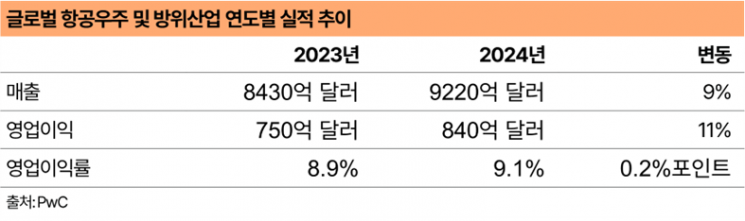
According to the report, the global A&D industry continues to grow, setting new records for both revenue and profit despite complex situations such as heightened geopolitical tensions, technological innovation, and supply chain instability. Last year, the total revenue of the A&D industry reached $922 billion (approximately KRW 1,286 trillion), a 9% increase from the previous year, while operating profit rose by 11% to $84 billion.
In particular, the space industry is expected to more than triple in size over the next decade, reaching a market value of $1.5 trillion. The defense sector is also experiencing a trend where global defense spending has reached an all-time high of $2.178 trillion, with demand consistently outpacing production capacity.
The report states, "Although demand for the A&D sector is breaking records, supply-demand imbalances caused by unstable supply chains are resulting in low operating profit margins. However, the fundamental underpinnings of the industry remain relatively robust, so the medium- to long-term outlook is positive."
Domestic A&D Companies Need Proactive Strategies
In light of these trends, the report emphasizes that domestic companies must establish response strategies to changes in tariff policies under the Trump administration. Currently, tariffs of up to 50% are being imposed on key materials such as steel, aluminum, and copper, while export controls on semiconductors and artificial intelligence (AI) chips are being strengthened. The report advises, "This could lead to increased aircraft manufacturing costs and reduced profitability, so scenario-based response strategies are necessary."
The report also suggests that companies should leverage civilian technologies and mergers and acquisitions (M&A) to shorten procurement lead times. "In emerging technology sectors such as space, drones, and AI, venture capital (VC)-driven transactions are expected to become more active," the report states, recommending that Korean companies expand A&D-focused funds and enhance competitiveness through technology partnerships with global firms.
Additionally, the report points out the need to strengthen strategies for entering the U.S. defense procurement market. The United States, as the world's largest military procurement market, continues to face production constraints due to supply chain disruptions and labor shortages, while weapon stockpiles are decreasing as a result of arms support to Israel and Ukraine. The report stresses, "To prepare for entry into the U.S. market, Korean defense companies must enhance not only their strengths in quality and delivery but also their management capabilities in internal controls, cost verification, and compliance with security and ethics."
The report also calls for the strategic development of the space industry. Following the war in Ukraine, the importance of drone, AI, and satellite-based technologies has increased, and the space industry has become a core area of the defense sector. The report assesses, "Korea has the potential to lead the transition to eco-friendly aviation and space industries in Asia, based on its advanced recycling infrastructure and technological capabilities."
Kim Taeseong, leader (partner) of Samil PwC's Defense Industry Center, stated, "The A&D industry is not simply a manufacturing sector, but a strategic industry shaped by the complex interplay of geopolitics, technology, and supply chains. Korean companies must proactively develop response strategies amid the global realignment of supply chains and the trend toward technological self-sufficiency."
Further details of the report can be found on the Samil PwC website.
© The Asia Business Daily(www.asiae.co.kr). All rights reserved.
![Clutching a Stolen Dior Bag, Saying "I Hate Being Poor but Real"... The Grotesque Con of a "Human Knockoff" [Slate]](https://cwcontent.asiae.co.kr/asiaresize/183/2026021902243444107_1771435474.jpg)















