Hong Joonpyo Criticizes Korea-US Tariff Negotiation Results
"They Incited Mad Cow Disease Fears and Called Me a Traitor During the FTA"
Government Negotiation Team Uses Photos from Mad Cow Disease Protests
Regarding the results of the tariff negotiations between South Korea and the United States, former Daegu Mayor Hong Joonpyo criticized, "They opposed the Korea-US FTA (Free Trade Agreement), but now they are praising themselves for negotiating a 15% tariff." On July 31, Hong posted on his social networking service (SNS), "The whole country is suffering from Trump's tariff policy," and shared these comments.
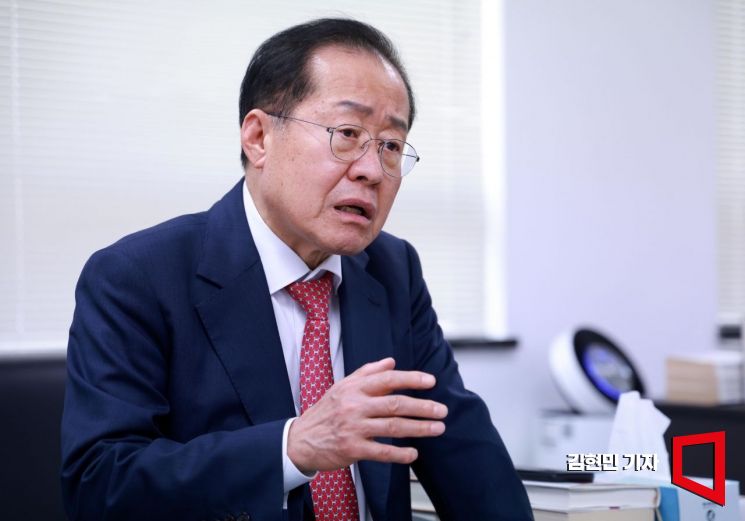
Hong said, "Back in October 2011, when I was the ruling party leader and was pushing for the Korea-US FTA, they incited the entire nation with mad cow disease rumors and called me a traitor. At that time, they opposed the Korea-US FTA, which had a zero-tariff policy, but now they are praising themselves for negotiating a 15% tariff." He continued, "Doesn't the US eat beef from cattle older than 30 months? Where is the so-called principled celebrity who once said they'd rather eat cyanide than American beef?" He added, "Despite all the commotion, South Korea has become the country that imports the most American beef."
Hong also commented on last year's controversy over the ocean discharge of contaminated water from the Fukushima nuclear plant in Japan, saying, "No politician took responsibility after throwing the country into chaos with mad cow disease rumors. The celebrity who said they'd rather eat cyanide than American beef has changed their name and is still actively working." The celebrity he referred to is presumed to be actress Kim Gyuri.
According to the presidential office's announcement that day, the United States and South Korea agreed to set mutual tariffs at 15%, and the US will also lower tariffs on South Korean automobiles to 15%. For items such as semiconductors and pharmaceuticals, which will be announced later, South Korea will receive most-favored-nation treatment. It was also stated that there will be no further opening of the domestic rice and beef markets, which were core issues.
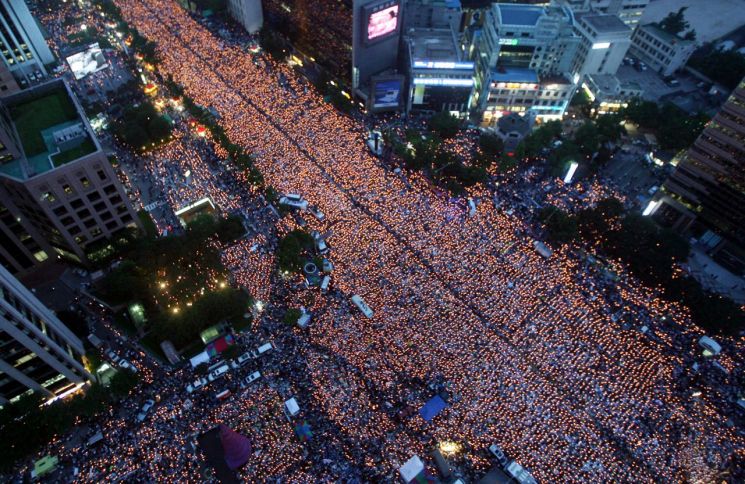 The government negotiation team reportedly presented photos of the mad cow disease protests to the U.S. side to highlight South Korea's sensitivity to the opening of the agricultural and livestock products market. The photo shows a candlelight vigil in June 2008. Photo by Yonhap News Joint Coverage Team
The government negotiation team also shared behind-the-scenes stories about agricultural and livestock market opening at a press briefing held at the Korean Embassy in Washington, DC, on July 30 (local time). Yeo Han-koo, head of trade negotiations at the Ministry of Trade, Industry and Energy, said, "The US side's demand for further opening of agricultural and livestock products was extremely strong. About two weeks ago, the issue of opening Korea's agricultural market started being reported in the media, and as the US saw what was actually happening in Korea, I think it made them realize Korea's sensitivities and that helped us."
It was also reported that photos from the mad cow disease protests during the 2008 Korea-US FTA signing were used. Minister of Trade, Industry and Energy Kim Jeonggwan said, "There is a photo from the last mad cow disease incident showing more than 1 million protesters. Yeo prepared that photo and showed it to the US side. I think such things greatly helped them understand the situation in Korea."
Regarding the results of this tariff negotiation, the Democratic Party of Korea evaluated, "By prioritizing the national interest, the negotiations resolved the uncertainty that was looming over our economy." In contrast, the opposition People Power Party pointed out, "It is appropriate since we are bearing the same tariff rates as Japan and the European Union (EU), but it feels like we made many concessions due to the negotiation deadline."
© The Asia Business Daily(www.asiae.co.kr). All rights reserved.
![Clutching a Stolen Dior Bag, Saying "I Hate Being Poor but Real"... The Grotesque Con of a "Human Knockoff" [Slate]](https://cwcontent.asiae.co.kr/asiaresize/183/2026021902243444107_1771435474.jpg)
















