Demonstration of Personalized Colorectal Cancer Treatment Efficacy
Published in an International Scientific Journal
The Catholic University of Korea announced on August 1 that a research team led by Professor Nam Jaehwan from the Department of Biomedical Science, in collaboration with the biotech company SML Biopharm, has developed Korea's first personalized mRNA cancer vaccine (PCV) and successfully demonstrated its strong anticancer effects in animal models.
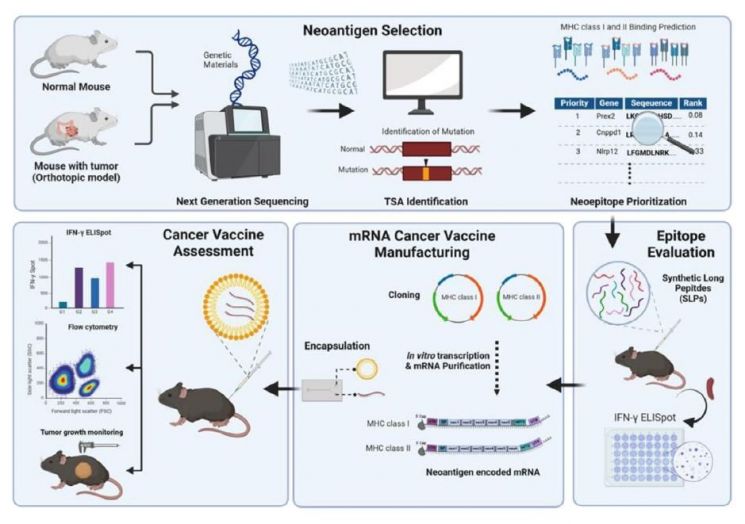 By transplanting colon cancer into mice, the genes of established cancer and normal mice were compared to identify cancer-specific neoantigens (Neoantigen Selection). After analyzing the characteristics of the identified neoantigens (Epitope Evaluation), they were produced to express neoantigens on a proprietary mRNA platform (mRNA Cancer Vaccine Manufacturing), and anticancer effects were confirmed in mice (Cancer Vaccine Assessment). Catholic University
Recently, there has been growing global interest in personalized cancer vaccines for the prevention and treatment of cancer. In particular, following the COVID-19 pandemic, the safety and rapid manufacturing capabilities of mRNA vaccine technology have been proven, accelerating the development of 'personalized therapeutic vaccines' tailored to the tumor characteristics of individual cancer patients. Notably, BioNTech and Moderna in the United States are actively conducting clinical trials targeting melanoma, lung cancer, and other cancers, and some vaccines have shown meaningful results as adjuvant therapies to prevent recurrence after surgery.
Against this backdrop, Professor Nam Jaehwan's research team has, for the first time in Korea, directly produced a therapeutic vaccine based on an individual's cancer genetic information using an mRNA platform and demonstrated its anticancer efficacy through animal experiments. Using a colorectal cancer mouse model, the team identified neoantigens?antigens present only in cancer cells?through next-generation sequencing (NGS), produced an mRNA vaccine targeting these neoantigens, encapsulated it in lipid nanoparticles (LNP), and administered it via injection. The results showed activation of tumor-specific immune cells (CD8+ T cells and CD4+ T cells), suppression of tumor growth, prevention of post-surgical recurrence, and the formation of long-term immune memory.
Of particular note is the finding that neoantigens presented via the MHC-II pathway induced a stronger anticancer immune response than those presented via the MHC-I pathway, which had been the primary focus of previous research. When neoantigens from both pathways were administered simultaneously, a synergistic effect was observed, further enhancing anticancer efficacy. The effect was also significantly improved when combined with immune checkpoint inhibitors such as PD-1 and Tim-3. Additionally, administering the vaccine after surgery reduced the recurrence rate, and its effectiveness as a preventive vaccine was also demonstrated in animal models.
This research was supported by the Ministry of Food and Drug Safety's projects for 'the development of toxicity evaluation technology for mRNA vaccines' and 'the establishment of a safety evaluation platform and international cooperation for mRNA-based neoantigen cancer vaccines.' Doctoral candidate Cho Seongje from the Catholic University of Korea served as the first author, and research teams led by Professors Yoon Hyeonho and Kwak Woori from the Catholic University of Korea, Professor Kim Kwonil from Kyung Hee University, Professor Kim Kitae from Seoul National University, Professor Jang Jun from Ewha Womans University, and the SML Biopharm research team participated as co-researchers.
Professor Nam Jaehwan stated, "This study is significant as it is the first case in Korea where a personalized mRNA-based cancer vaccine was directly produced and its anticancer efficacy verified," adding, "The fact that the vaccine can induce immune cells capable of directly attacking cancer cells and maintain long-term immune memory provides important clues for strategies to prevent cancer recurrence and manage chronic cancer."
Meanwhile, the results of this study were published online last month in the internationally renowned journal Advanced Science.
© The Asia Business Daily(www.asiae.co.kr). All rights reserved.
![Clutching a Stolen Dior Bag, Saying "I Hate Being Poor but Real"... The Grotesque Con of a "Human Knockoff" [Slate]](https://cwcontent.asiae.co.kr/asiaresize/183/2026021902243444107_1771435474.jpg)















