"Avoided the Worst" - Industry Breathes a Sigh of Relief
Shipbuilding Sector Sees Foundation for Growth
Automotive Industry Regrets Loss of Tariff Advantage
Attention on US Reference to "Fully Open" Market
Potential Easing of Regulations to Domestic Industry Levels
Semiconductor Association: "Limited Impact Due to Irreplaceability"
Shipbuilding Industry: "Full-Scale Korea-US Cooperation Begins"
Steel Industry: "Forced to Sell at a Loss,
Support Measures Like Special Operating Funds Needed"
The industry has welcomed the news that the governments of South Korea and the United States have reached a swift agreement on tariffs, stating that the uncertainty that had overshadowed the entire industrial sector has now been resolved. The automotive industry expressed relief, noting that it had avoided the worst-case scenario of having to pay higher tariffs than competitor countries. However, there are also concerns that the tariff-free advantage previously enjoyed under the Korea-US Free Trade Agreement (FTA) has now disappeared. In the shipbuilding sector, where the two countries agreed to expand cooperation, the agreement is seen as an opportunity to lay the foundation for medium- to long-term growth.
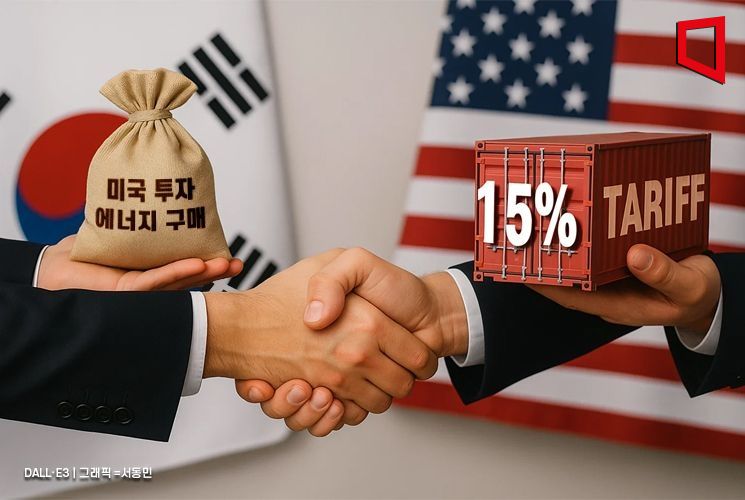
Jang Sangshik, President of the International Trade and Commerce Research Institute at the Korea International Trade Association, commented on July 31 regarding the conclusion of the Korea-US tariff negotiations, stating, "Considering the overall fund size, purchase details, and tariff rates, South Korea has secured a more advantageous position than the European Union (EU) or Japan." South Korea and the United States have agreed to invest a total of $350 billion, including a $150 billion shipbuilding cooperation fund and a $200 billion investment fund for sectors such as semiconductors, nuclear power, secondary batteries, and biotechnology.
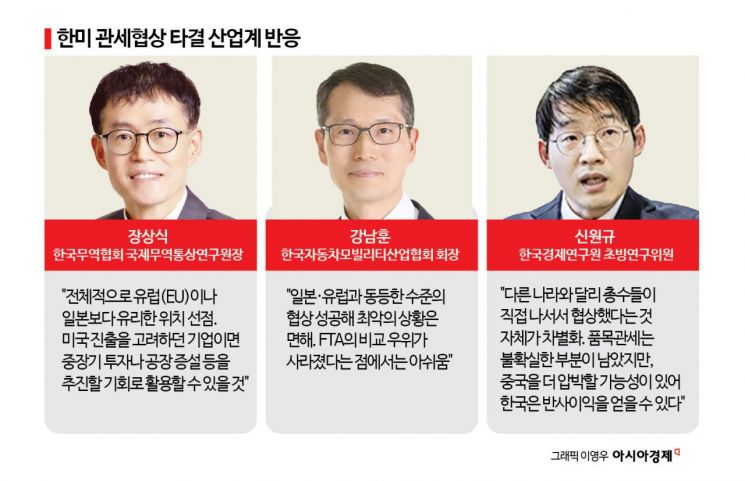
President Jang further explained, "Even for sectors where tariffs are scheduled, such as semiconductors and pharmaceuticals, South Korea has a competitive edge over the United States, so as long as we do not face a disadvantageous tariff rate compared to other countries, the impact will not be significant." He added, "For companies considering entry into the US market, this could be an opportunity to leverage US federal tax benefits or state-level incentives, aiming for additional medium- to long-term investments and plant expansions."
Shin Wonkyu, Visiting Research Fellow at the Korea Economic Research Institute, stated, "South Korea maintained a consistent stance in negotiations with the United States and emphasized economic security centered on shipbuilding, achieving its objectives." He continued, "By strengthening manufacturing alliance and industrial cooperation, South Korea has conveyed its willingness to play a role in relation to China." Shin added, "If the United States increases pressure on China in the future, South Korea could benefit as a result. In sectors such as semiconductors and batteries, US companies are likely to view South Korea as a cooperative partner, minimizing the impact of tariffs and gaining greater benefits."
The automotive industry assessed that the agreement to set tariffs at the same 15% level as competitor countries like Japan and the EU has created an environment for fair competition. Kang Namhoon, Chairman of the Korea Automobile and Mobility Industry Association (KAMA), stated, "We have avoided the worst-case scenario by securing tariff negotiations at a level equivalent to Japan and Europe. However, it is regrettable that the comparative advantage we previously enjoyed under the FTA has disappeared." Before this tariff agreement, Japan and the EU paid a basic tariff of 2.5% on cars exported to the United States, while South Korea, as an FTA signatory, benefited from zero tariffs, enjoying a 2.5 percentage point tariff advantage.
The automotive industry is also paying attention to the US mention of a "fully open" market as a result of this negotiation. The United States has consistently cited non-tariff barriers as the reason for the low market share of US brands in South Korea. There is now a possibility that regulations such as environmental and safety certifications, emission standards, automobile taxes, and customs procedures may be eased to the same level as those applied to domestic companies.
Lee Changhan, former Vice Chairman of the Korea Semiconductor Industry Association, commented, "General tariff increases pose a short-term burden on price competitiveness, but for semiconductors such as DRAM and foundry (semiconductor contract manufacturing), the supply structure makes it difficult for US companies to replace Korean suppliers, so the overall impact will be limited." He added, "Since foundry contracts are long-term, the likelihood of rapid price adjustments is low." He further explained, "Tariffs on semiconductor items are merely a bargaining chip in negotiations. With more than 30 trillion won invested annually in semiconductor facilities, a demand for $10 billion in investment is not likely to have a significant practical impact."
The shipbuilding industry expects that the creation of a dedicated shipbuilding cooperation fund will serve as a turning point, accelerating entry into the North American market and expanding global influence. An industry official stated, "Currently, the only substantial example of Korea-US shipbuilding cooperation is the acquisition of Philly Shipyard in the United States by Hanwha Group. The establishment of the fund will provide the spatial and financial resources needed to lay the groundwork for full-scale Korea-US shipbuilding cooperation."
The steel industry, where the existing 50% tariff remains unchanged, expressed disappointment with the outcome and called for additional support measures. An industry representative said, "With a 50% tariff in place, we are forced to sell at a loss. Policy measures such as special operating funds for exporters to the United States are needed to alleviate the burden of tariffs."
The business community has suggested that the resolution of external uncertainties should be used as an opportunity to create a more favorable business environment. A representative of the Korea Chamber of Commerce and Industry stated, "We welcome and value the resolution of uncertainties in external trade. However, since the agreed tariff levels still pose a considerable burden on our economy and industry, we hope that both governments will continue to negotiate for further reductions or elimination of tariffs. We also urge the government to actively work on creating a business-friendly environment domestically by abolishing legislation and regulations that could negatively affect corporate management."
© The Asia Business Daily(www.asiae.co.kr). All rights reserved.


















