Last year, the accumulated reserves in personal pension savings reached 179 trillion won. The increase in reserves was led by funds, and both the rate of return and the amount of contributions significantly outperformed other products.
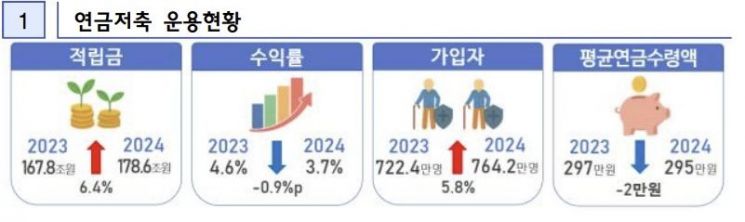
According to the “2024 Status of Personal Pension Savings Management” released by the Financial Supervisory Service on July 31, as of the end of 2024, the total accumulated reserves in personal pension savings amounted to 178.6 trillion won, up by 10.8 trillion won (6.4%) from the previous year's 167.8 trillion won.
By product, personal pension insurance accounted for the largest portion at 115.5 trillion won (64.7%). This was followed by personal pension funds with 40.4 trillion won, personal pension trusts with 14.7 trillion won, and personal pension mutual aid insurance with 8 trillion won. Among these, personal pension funds showed particularly rapid growth, increasing by 43.7% compared to the previous year and recording over 30% growth for the second consecutive year.
By distributor, insurance companies held the largest amount at 115.6 trillion won, followed by financial investment firms with 35.9 trillion won, banks with 19.1 trillion won, and mutual aid institutions with 8 trillion won. Among these, financial investment firms showed the steepest growth, increasing by 43.7% compared to the previous year.
The overall rate of return for personal pension savings in 2024 was 3.7%, a decrease of 0.9 percentage points from 4.6% the previous year. This figure slightly exceeds the inflation rate. By product, personal pension funds recorded a 7.6% return, personal pension trusts 5.6%, and personal pension insurance 2.6%. The fund return was more than double the overall average.
The Financial Supervisory Service explained that the difference in returns stems from the structure of the products. The agency stated, “Personal pension insurance deducts fees (operating expenses) from the paid premiums and then applies the declared interest rate set by each insurance company. In contrast, personal pension funds are managed through funds directly selected by the subscriber, so their returns are linked to the stock market.”
As of last year, there were 7,642,000 personal pension subscribers, an increase of 418,000 (5.8%) from the previous year. Among these, the number of subscribers under the age of 20 rose by 66% compared to the previous year. This is interpreted as resulting from an increase in cases where parents subscribed on behalf of their children for investment education and long-term asset formation.
The data showed that the higher the income, the higher the proportion of personal pension subscribers. The subscription rate for workers with annual earned income of 40 million won or less was only 1.5%. For those earning between 40 million and 60 million won, the rate was 10.1%. In addition, the rate was 22.6% for those earning between 60 million and 80 million won, 34.6% for those earning between 80 million and 100 million won, and 50.7% for those earning more than 100 million won.
Last year, 1,902,000 accounts began receiving personal pension payments (for those aged 55 and over). The average annual pension payment per contract was 2.95 million won, 20,000 won less than the previous year's 2.97 million won. Additionally, contracts receiving 5 million won or less annually accounted for 84.1% of the total.
© The Asia Business Daily(www.asiae.co.kr). All rights reserved.

















