US GDP Surges in Q2, Eurozone Plunges
Clear Slowdown in US Private Sector Demand
Price Pressures Likely to Rise Amid Reduced Government Support
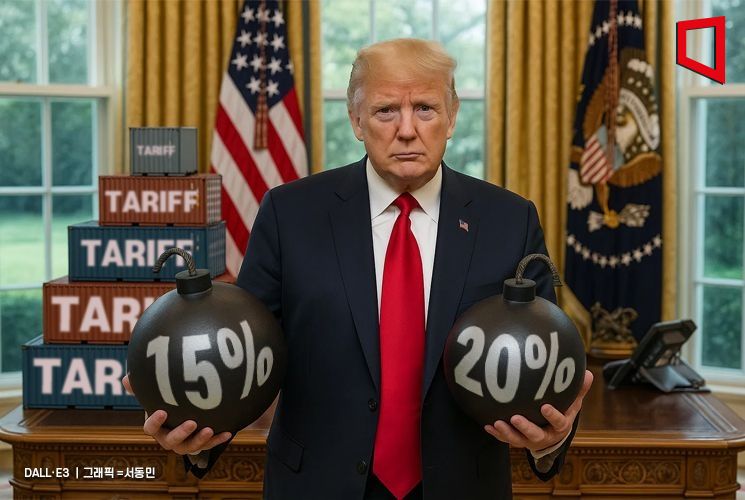
The impact of Trump-initiated tariffs has begun to appear in the GDP figures of major countries. As expected, the United States saw an increase, while the Eurozone experienced a decline. However, a closer look at the US GDP reveals that the quality of growth itself was not strong. On July 31, Daishin Securities analyzed in its report, "The Impact of Tariffs Shown by GDP," that "the major advanced economies showed somewhat different results in the second quarter, which began with President Trump's large-scale tariff announcements."
Trump Tariffs Also Negatively Affect the Quality of US Growth
In the second quarter, the Eurozone's quarter-on-quarter economic growth rate was 0.1%, slightly exceeding market expectations. However, this was a significant slowdown compared to the 0.6% growth in the first quarter. Given that countries with a high proportion of external exports, such as Germany and Ireland, showed negative growth, it is highly likely that the external sector performed worse than domestic demand. In contrast, the US preliminary GDP for the second quarter showed an average annualized growth rate of 3.0% quarter-on-quarter, surpassing the Bloomberg consensus of 2.6%. This is a strong rebound after the first quarter's GDP contracted by -0.5%.
Lee Hayoun, an economist at Daishin Securities, analyzed, "Even when breaking down US growth, it is difficult to evaluate it positively." The increase in private sector demand slowed from 1.9% to 1.2% quarter-on-quarter. Although private consumption growth expanded, it fell short of market expectations. Investment made a negative contribution to growth as both residential investment and inventory investment decreased. Meanwhile, imports, which had led the US economy's contraction in the first quarter, dropped sharply in the second quarter, contributing 5.2 percentage points to growth. As the US continues to post solid growth rates, President Trump is once again intensifying tariff pressure. There will be no extension of the tariff deadline (August 1), and he mentioned that additional tariffs would be imposed on India, where negotiations have been facing difficulties.
Tariffs Clearly Increase US Price Pressures..."Wage Growth Trend Will Determine Fed Rate Cut"
So far, negative effects from tariffs have not yet become clearly apparent in US price indicators. Economist Lee Hayoun stated, "As tariff rates become clearer, US companies are expected to gradually pass on tariff costs to sales prices," and added, "In fact, some consumer goods companies mentioned plans to raise prices during their second-quarter earnings announcements." Considering the recent tariff negotiation results with Japan and the EU, and the possibility of raising the base tariff to the 15% level, the effective tariff rate is bound to be higher than in the second quarter.
In addition to tariffs, the reduction of government support due to DOGE or OBBBA could also stimulate inflationary pressures in areas such as medical services. For now, the slowdown in service price increases is limiting overall inflationary pressure. However, as the end of the year approaches, the pace of price increases may accelerate. Economist Lee Hayoun analyzed, "Even if US inflation rises, if wage growth remains stable, the Federal Reserve (Fed) is likely to resume rate cuts," and added, "However, given the Fed's economic assessment of prices and the labor market, rate cuts are expected to be challenging, which could trigger market volatility and warrants caution."
© The Asia Business Daily(www.asiae.co.kr). All rights reserved.
![Clutching a Stolen Dior Bag, Saying "I Hate Being Poor but Real"... The Grotesque Con of a "Human Knockoff" [Slate]](https://cwcontent.asiae.co.kr/asiaresize/183/2026021902243444107_1771435474.jpg)















