All Major Earthquakes, Including the 1960 Chile and 2004 Indonesia Disasters,
Occurred in the Pacific 'Ring of Fire'
On July 30 (local time), a magnitude 8.8 earthquake that struck the Kamchatka Peninsula in Russia is expected to be recorded as the most powerful earthquake in the world since the 2011 Great East Japan Earthquake. Based on records since the 20th century, it is the sixth most powerful earthquake.
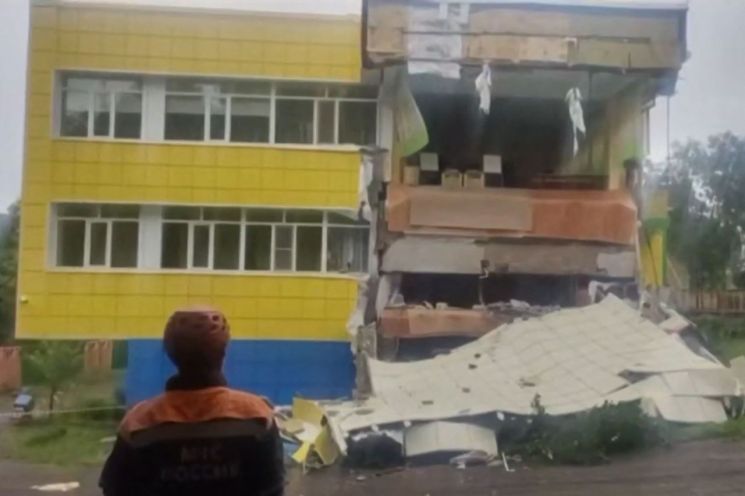 An 8.8 magnitude earthquake occurred on the 30th (local time) in the Kamchatka Peninsula, Russia, causing significant damage. Video capture footage taken by the Russian emergency disaster authorities. Photo by Yonhap News.
The New York Times (NYT), citing data from the United States Geological Survey (USGS), reported that this earthquake was "the most powerful since the 2011 earthquake in Japan that triggered the Fukushima nuclear power plant disaster."
The NYT also noted that unless scientists revise the magnitude downward, this earthquake will be included in the list of the largest earthquakes in history, and it introduced examples of 20th-century earthquakes that were stronger than the one that occurred on this day.
Each time the magnitude of an earthquake increases by one, the amount of energy released increases by a factor of 31.6. This means that a magnitude 8.8 earthquake generates approximately 31.6 times more energy than a magnitude 7.8 earthquake.
According to USGS data, the largest earthquake in the world since the 1900s was the 1960 Chile earthquake, which had a magnitude of 9.5.
The powerful earthquake that struck the Valdivia region of southern Chile on May 22, 1960, resulted in 1,655 deaths and left more than 2 million people displaced.
Four years later, on March 27, 1964, an earthquake with a magnitude of 9.2 occurred in Alaska, United States, and is recorded as the second most powerful earthquake. At that time, the earthquake and the ensuing tsunami caused 100 deaths.
Ten years later, on December 26, 2004, an undersea earthquake with a magnitude of 9.1 occurred near Sumatra Island, Indonesia, resulting in a catastrophe that killed 280,000 people in South Asia and East Africa, including Indonesia.
The magnitude of the 2011 Great East Japan Earthquake was also 9.1, the same as the Indonesia earthquake. During the Great East Japan Earthquake, a 15-meter-high tsunami engulfed the inland, resulting in 15,000 deaths and 130,000 people displaced.
The NYT explained that the magnitude 9.1 earthquakes in Indonesia and Japan were about 2.8 times more powerful than the earthquake that struck the Kamchatka Peninsula on this day.
The Kamchatka Peninsula also experienced a powerful earthquake with a magnitude of 9.0 in 1952. At that time, more than 2,300 people died.
The Kamchatka earthquake on this day had the same magnitude as the earthquakes that struck Ecuador in 1906 and Chile in 2010.
All of these earthquakes share the commonality that they occurred in the so-called "Ring of Fire," the circum-Pacific seismic belt.
The Ring of Fire encompasses a horseshoe-shaped region that starts in New Zealand, passes through parts of Southeast Asia, Japan, the Kamchatka Peninsula, and Alaska in the United States, and extends to the west coasts of North and South America.
Strictly speaking, it is not a scientific term, but after the academic community observed that many earthquakes and volcanic activities occur along the belt surrounding the Pacific Ocean, this term came into use.
Later, as plate tectonics theory developed, it was revealed that the boundary of the Pacific Plate, the largest of the Earth's plates, almost coincides with the Ring of Fire.
Geologists in countries located along the Ring of Fire share relevant information and technology and collaborate on earthquake prediction research.
Meanwhile, the NYT reported that since this earthquake rivals the most powerful ones in history, it is expected to cause economic damage amounting to tens of billions of dollars, just as in the past.
The USGS stated, "In the past, earthquakes that triggered alerts at this level required responses at the national or international level," and added, "Widespread damage is expected, and there is a high possibility that the disaster will spread further."
© The Asia Business Daily(www.asiae.co.kr). All rights reserved.
![Clutching a Stolen Dior Bag, Saying "I Hate Being Poor but Real"... The Grotesque Con of a "Human Knockoff" [Slate]](https://cwcontent.asiae.co.kr/asiaresize/183/2026021902243444107_1771435474.jpg)















