'From Point' Seized During Search
Linked to Politics in 2020 as Well
Mixed Reactions Within and Outside the Art World
"Misused as a Political Tool and Means of Concealing Assets"
"Hope This Becomes an Opportunity to Reevaluate Artistic Value"
The spotlight is currently on a major work by Lee Ufan, a master of contemporary Korean art, as it has been mentioned during a recent special prosecutor's investigation. As the artwork finds itself at the center of political controversy, concerns are mounting within and outside the art world. At the same time, some argue that this is an opportunity to reexamine the artistic value of the piece.
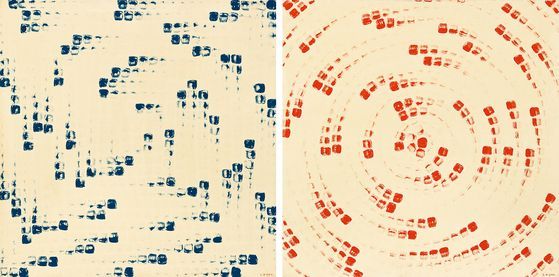
Lee Ufan's "From Point" series is an iconic body of work that represents his artistic vision. Through the repetitive act of marking dots, the series expresses the passage of time, traces of the body, and the accumulation of existence. First introduced in Tokyo in 1972, Lee continued to produce the series steadily until the mid-1980s, earning high acclaim in both the Korean and international art scenes. Positioned at the heart of the Dansaekhwa movement, Lee's philosophy is realized through a unique artistic language that merges Eastern thought and Western minimalism.
This series has long been cherished by major museums and collectors both in Korea and abroad, and it commands high value in the auction market. In 2021, a 1975 "From Point" work fetched 2.2 billion won at Seoul Auction, setting a new record for the artist. The record was broken again in August of the same year when "East Winds" (1984) was sold for 3.1 billion won. Art industry insiders note, "In recent years, both the trading volume and value of Lee Ufan's works have ranked among the highest."
The recent surge in public attention stems from the special prosecutor's investigation related to First Lady Kim Keonhee. During a search of the home of Kim Keonhee's brother Kim Jinwoo's mother-in-law, the special investigation team secured a piece from the "From Point" series and reportedly submitted an appraisal certificate for the work. The artwork is estimated to be worth about 2 billion won. Its provenance and transaction details are currently under investigation.
If it is revealed that the artwork was provided as a bribe, the special prosecutor is closely tracking its ownership structure and movement path, as the possibility of applying bribery charges cannot be ruled out. Accordingly, further summons and judicial action are also being considered.
The art community is responding sensitively to this issue. An anonymous art industry insider commented, "It is not surprising that Kim Keonhee owned a work by Lee Ufan. Among the wealthy, Lee Ufan's works have long been popular collectibles." Another insider expressed concern, saying, "I worry that the true value of the work might be consumed as a side note to a political event. Rather, I hope this serves as an opportunity for a proper reevaluation of its artistic merit."
This is not the first time Lee Ufan's works have been linked to politics. During the 2020 general election, Democratic Party lawmaker Lee Sangsik and his spouse were prosecuted for underreporting 4 billion won worth of art as 1.78 billion won, which included a piece from the "From Point" series. In the first trial, a fine of 3 million won was imposed, but it was reduced to 900,000 won on appeal, allowing Lee to retain his seat in the National Assembly.
This case has once again raised concerns that high-value artworks can be misused for political purposes or as a means of concealing assets. At the same time, there is considerable regret that the works of a leading Korean artist are being viewed as political tools.
Born in 1936 in Haman, Gyeongnam, Lee Ufan is a towering figure in contemporary Korean art who has worked between Japan and France. Well known as a central figure in the Mono-ha movement, he is highly regarded in the international art world for his unique aesthetics that transcend simple forms and blend Eastern philosophy with Western thought.
© The Asia Business Daily(www.asiae.co.kr). All rights reserved.
![Clutching a Stolen Dior Bag, Saying "I Hate Being Poor but Real"... The Grotesque Con of a "Human Knockoff" [Slate]](https://cwcontent.asiae.co.kr/asiaresize/183/2026021902243444107_1771435474.jpg)











