Ministry of Health and Welfare Analyzes "OECD Health Statistics 2025"
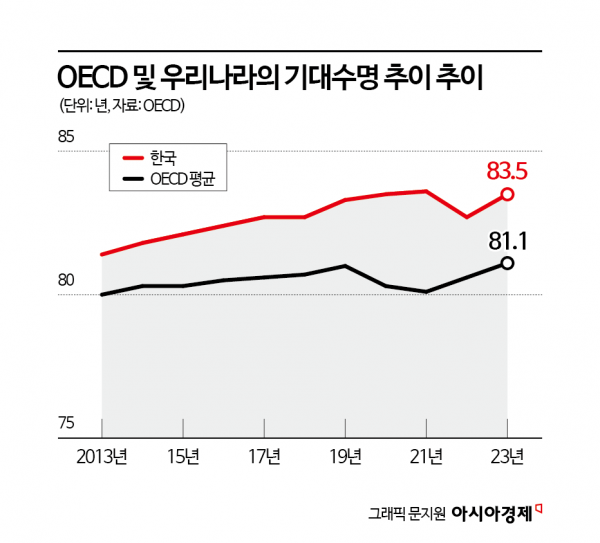
Life Expectancy Ranks Among Highest at 83.5 Years
18 Outpatient Visits Annually, 2.7 Medical Personnel per 1,000 People
Although South Korea has the highest number of outpatient visits per capita and hospital beds among OECD countries, the number of doctors per capita is the second lowest after Japan. The life expectancy of South Koreans is 83.5 years, which is more than two years longer than the OECD average, but the suicide rate is the highest among OECD countries.
The Ministry of Health and Welfare analyzed the detailed sectoral and indicator data from the "OECD Health Statistics 2025," released by the OECD on July 10, and published South Korea's healthcare status and comparisons with other countries on July 30.
Looking at the detailed indicators by sector, the life expectancy of South Koreans is 83.5 years, ranking among the highest in OECD countries (average 81.1 years). The "avoidable mortality rate," which refers to deaths preventable through disease prevention and timely treatment, has been steadily declining, reaching 151.0 per 100,000 people?significantly lower than the OECD average of 228.6. The infant mortality rate in 2023 was 2.5 per 1,000 live births, 1.6 lower than the OECD average of 4.1.
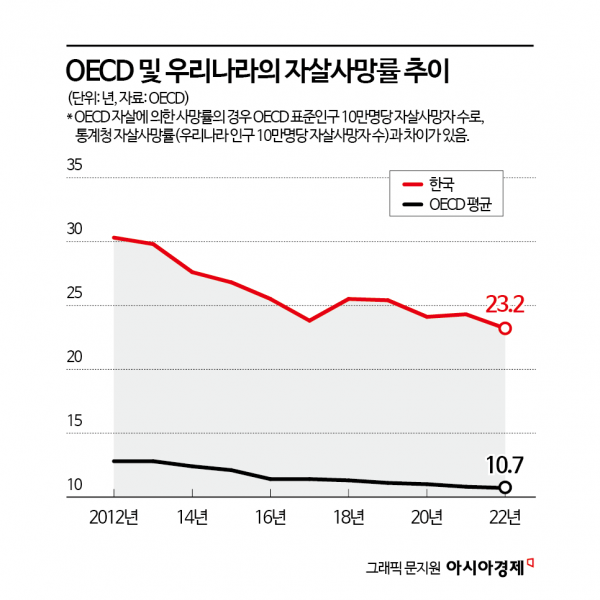
However, despite the high life expectancy and quality of healthcare, South Korea has maintained the highest suicide rate among OECD countries since 2003. According to the latest comparable statistics from 2022, the suicide mortality rate was 23.2 per 100,000 people, more than double the OECD average of 10.7. However, South Korea's suicide rate is decreasing at a faster pace than other OECD countries. The rate dropped by 23.4% from 30.3 in 2012 to 23.2 in 2022, while the OECD average decreased by 16.4% from 12.8 to 10.7 during the same period.
The smoking rate among people aged 15 and older in South Korea is 15.3%, and the annual per capita alcohol consumption is 7.8 liters, both close to the OECD averages (smoking rate 13.2%, alcohol consumption 8.6 liters). The proportion of overweight and obese people, a major cause of chronic diseases, is 36.5% (aged 15 and older), the second lowest among OECD countries (average 56.2%).
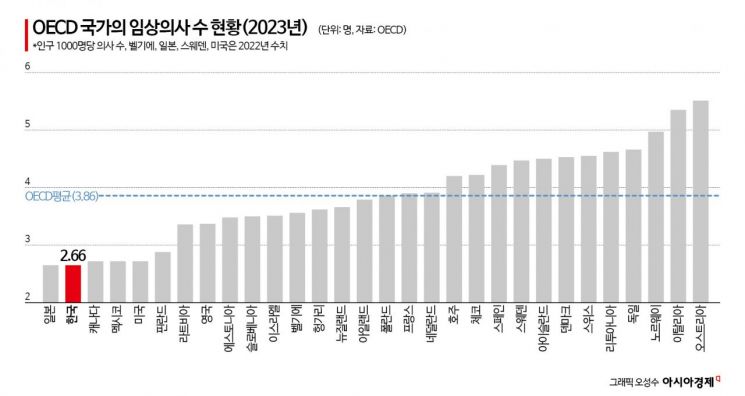
In terms of healthcare personnel, the number of clinical doctors (including Korean medicine doctors) is 2.7 per 1,000 people, the second lowest among OECD countries (average 3.9). The number of clinical nursing staff is also lower than the OECD average, at 9.5 per 1,000 people compared to the OECD average of 9.7. The number of medical graduates (including Korean medicine, excluding dental medicine) in 2023 was 7.4 per 100,000 people, the third lowest among OECD countries (average 14.3), after Israel (7.2) and Canada (7.3).
There are 38.7 MRI machines and 45.3 CT scanners per million people, both higher than the OECD averages (MRI 21.2, CT 31.1). The number of hospital beds is also 12.6 per 1,000 people, three times the OECD average of 4.2.
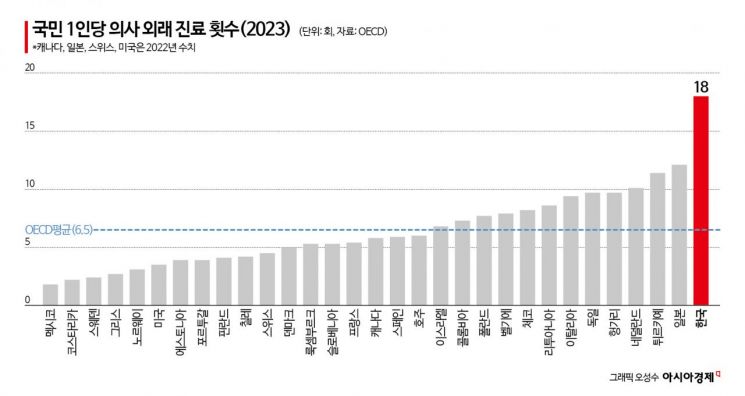
In 2023, the annual number of outpatient visits per capita was 18.0, the highest among OECD countries and 2.8 times the OECD average of 6.5. Japan ranked second with 12.1 visits per capita in 2022, while Mexico (1.8), Costa Rica (2.2), Sweden (2.4), and Greece (2.7) had fewer than three visits per capita.
Current health expenditure accounted for 8.5% of GDP, slightly lower than the OECD average of 9.1%, but has increased rapidly over the past decade. The per capita pharmaceutical sales amounted to $968.9 PPP (purchasing power parity), higher than the OECD average of $658.1 PPP.
Among the population aged 65 and older, the proportion receiving long-term care was 9.0% for home-based care and 2.7% for institutional care, both lower than the OECD averages (home-based 11.2%, institutional 3.5%). However, these rates have been rising rapidly over the past decade due to the increasing elderly population, growing demand for long-term care services, and expanded coverage.
Lim Hoguen, Director of Policy Planning at the Ministry of Health and Welfare, said, "We will continue to expand the production of internationally comparable health statistics for South Korea through ongoing cooperation with international organizations such as the OECD and the World Health Organization (WHO), and we will strive to strengthen statistical quality management so that citizens can utilize these statistics in various policy areas."
© The Asia Business Daily(www.asiae.co.kr). All rights reserved.
![Clutching a Stolen Dior Bag, Saying "I Hate Being Poor but Real"... The Grotesque Con of a "Human Knockoff" [Slate]](https://cwcontent.asiae.co.kr/asiaresize/183/2026021902243444107_1771435474.jpg)


















