Press Release Issued on the 30th Expresses Negative Stance
"Opposed from the Start... Risks for Businesses"
James Kim: "Negative Impact on Investment Willingness of American Companies"
The American Chamber of Commerce in Korea (AMCHAM) announced on the 30th that it "expresses deep concern over the potential negative impact on Korea's business environment and investment appeal" regarding the recent passage of the amendments to Articles 2 and 3 of the Trade Union and Labor Relations Adjustment Act, commonly known as the "Yellow Envelope Act," by the National Assembly's Environment and Labor Committee.
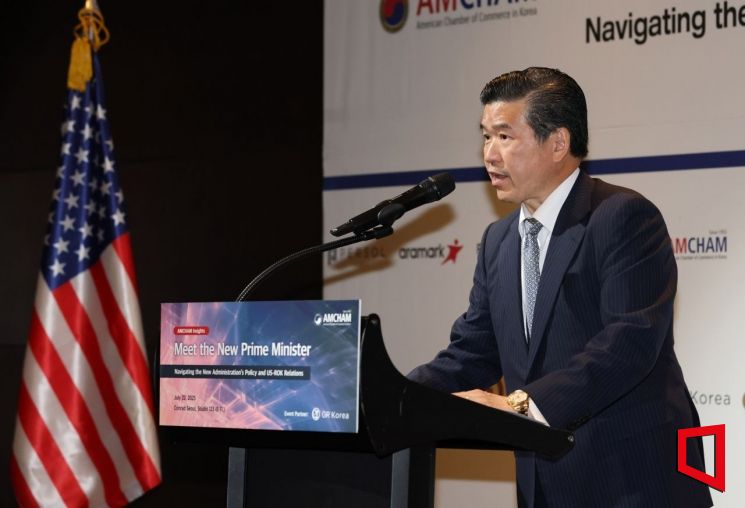 James Kim, chairman of AmCham, is delivering the opening remarks at the American Chamber of Commerce in Korea (AMCHAM KOREA) seminar held at Conrad Seoul Hotel in Yeouido, Seoul on July 22, 2025. Photo by Cheongsa Press Photographers Team
In a press release issued on this day, AMCHAM stated, "We expressed our opposition when the bill was first introduced last year and at that time also emphasized concerns about uncertainty in the business environment and regulatory risks," reiterating its position.
The Yellow Envelope Act is an amendment that expands the definition of employer to strengthen the responsibility of primary contractors for subcontracted workers and limits the scope of damages claims against unions or workers. This amendment was passed at the plenary session of the National Assembly's Environment and Labor Committee on the 28th and is scheduled to be voted on at the National Assembly's plenary session on August 4.
AMCHAM expressed concern, stating, "This amendment expands the scope of protection for subcontracted workers, limits claims for damages resulting from industrial actions, and increases legal liability for management that does not participate in collective bargaining. Such changes could increase legal and operational burdens for global companies, including American firms operating in Korea."
AMCHAM further pointed out that the bill was pushed forward without sufficient collection of opinions despite concerns from the industrial sector, emphasizing the need for procedural improvements. It also suggested that legal and institutional reforms to establish a rational labor-management culture should be prioritized.
James Kim, Chairman and CEO of AMCHAM, warned, "A flexible labor environment is a key factor in strengthening Korea's competitiveness as a business hub in the Asia-Pacific region. If this bill is implemented in its current form, it could affect the willingness of American companies to invest in Korea in the future."
He added, "The 2025 Asia-Pacific Economic Cooperation (APEC) Summit is a very important stage for Korea to demonstrate leadership in innovation and economic policy. At such a time, we should carefully consider what kind of signal this bill might send."
Chairman Kim also emphasized, "In AMCHAM's 2024 Business Environment Survey, the lack of regulatory predictability was cited as a major challenge for foreign companies. This amendment could further increase such uncertainty and, as a result, negatively impact Korea's global competitiveness."
© The Asia Business Daily(www.asiae.co.kr). All rights reserved.
![Clutching a Stolen Dior Bag, Saying "I Hate Being Poor but Real"... The Grotesque Con of a "Human Knockoff" [Slate]](https://cwcontent.asiae.co.kr/asiaresize/183/2026021902243444107_1771435474.jpg)















