No Reports of Human or Material Damage Yet
Japan Meteorological Agency Urges Caution Against Second and Third Tsunami Waves
On July 30, a massive earthquake with a magnitude of 8.8 struck the Kamchatka Peninsula in Russia, prompting tsunami warnings and evacuation orders along Japan's Pacific coast. However, as of now, there have been no significant reports of damage.
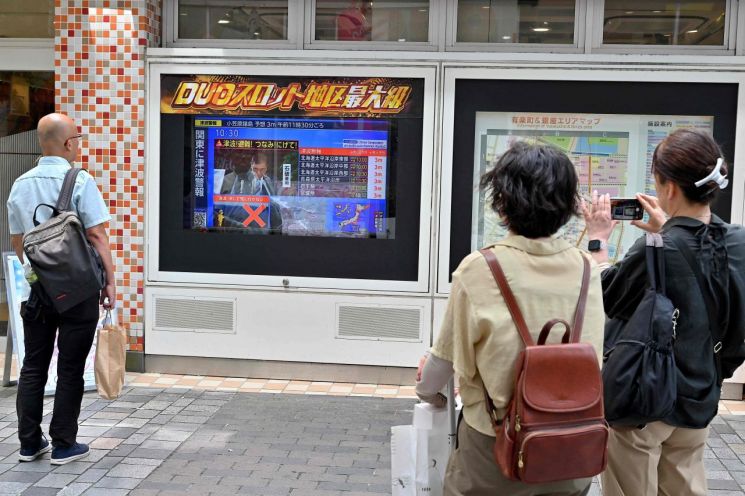
The Japan Meteorological Agency issued tsunami warnings for the Pacific coastal areas of Hokkaido and Honshu at approximately 9:40 a.m. on the same day. Tsunami advisories were also issued separately for the Pacific coastal areas of Kyushu and Shikoku, as well as northern Hokkaido.
According to the European-Mediterranean Seismological Centre (EMSC) and other sources, at around 9:24 a.m. local time, an earthquake with a magnitude of 8.0 occurred in the sea east of the Kamchatka Peninsula. This was followed by another extremely strong earthquake with a magnitude of 8.7 off the eastern coast of the Kamchatka Peninsula. The EMSC later revised the magnitude upward.
After the tsunami warning was issued, the Japanese government set up an information liaison office at the Prime Minister's Office to coordinate the response. Public broadcaster NHK aired emergency disaster coverage. Some expressways and railway lines were temporarily closed. Nuclear power plants also entered emergency response mode. The Higashidori Nuclear Power Plant in Higashidori Village, Aomori Prefecture, which is currently not in operation, suspended all work at its port facilities in preparation for the tsunami's arrival and stated that it was closely monitoring the situation.
However, the height of the tsunami that reached the Japanese coast was lower than expected. The Japan Meteorological Agency had predicted that tsunami waves as high as 1 to 3 meters would hit the Pacific coast starting around 10 a.m., beginning with Hokkaido. In reality, by noon, the observed tsunami heights were only about 30 to 50 centimeters.
Fortunately, it appears that no significant damage has occurred. Japanese government spokesperson Yoshimasa Hayashi stated at a regular morning press briefing, "As of now, there have been no reports of human or material damage."
However, the Japanese government has urged people to remain evacuated, citing the possibility that the second or third waves could be higher. At a press conference held around 1 p.m. that day, the Meteorological Agency warned, "This tsunami has a very long wavelength, with each cycle taking about one hour. There is a risk that the tsunami will continue for an extended period and that higher waves may be observed, so the threat of damage remains."
Currently, the Japan Meteorological Agency is maintaining the tsunami advisories and warnings for each region.
Regarding the reason for upgrading the warnings, the Meteorological Agency explained, "Immediately after the earthquake, we estimated the magnitude to be 8.0 and issued a tsunami advisory at 8:37 a.m. However, after receiving data from the United States Geological Survey (USGS) and the Hawaii Tsunami Warning Center, we revised the magnitude upward and switched to a tsunami warning at 9:40 a.m."
© The Asia Business Daily(www.asiae.co.kr). All rights reserved.
![Clutching a Stolen Dior Bag, Saying "I Hate Being Poor but Real"... The Grotesque Con of a "Human Knockoff" [Slate]](https://cwcontent.asiae.co.kr/asiaresize/183/2026021902243444107_1771435474.jpg)
















