Ministry of Health and Welfare Analyzes "OECD Health Statistics 2025"
Life Expectancy Among the Highest at 83.5 Years
18 Outpatient Visits Per Year, 2.7 Medical Personnel Per 1,000 People
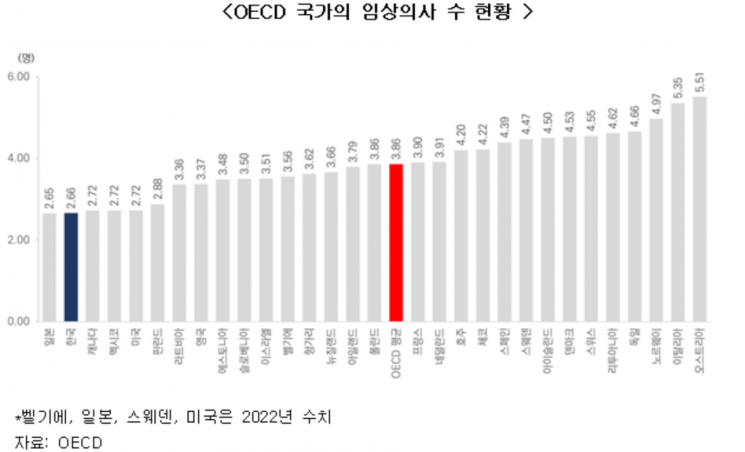
Although South Korea has the highest number of outpatient visits per capita and hospital beds among OECD countries, the number of physicians per capita is the second lowest, following Japan.
The Ministry of Health and Welfare analyzed the detailed contents of the "OECD Health Statistics 2025" by major fields and indicators, which was published by the Organisation for Economic Co-operation and Development (OECD) on July 10, and released the results regarding the level of healthcare in South Korea and the status of each country on July 30.
According to the detailed indicators by field, the life expectancy in South Korea was 83.5 years, ranking among the highest in OECD countries (average 81.1 years). The "avoidable mortality rate," which refers to deaths that can be prevented through disease prevention activities and timely treatment, has shown a long-term downward trend, dropping to 151.0 per 100,000 people, which is significantly lower than the OECD average of 228.6.
The smoking rate among South Koreans aged 15 and older was 15.3%, and the annual per capita alcohol consumption was 7.8 liters, which is similar to the OECD averages (smoking rate 13.2%, alcohol consumption 8.6 liters). The proportion of overweight and obese individuals, a major cause of chronic diseases, was 36.5% (for those aged 15 and older), the second lowest among OECD countries (average 56.2%).
The number of clinical physicians, including doctors of Korean medicine, was 2.7 per 1,000 people, the second lowest among OECD countries (average 3.9 per 1,000). The number of clinical nursing personnel was also lower than the OECD average, at 9.5 per 1,000 people compared to the OECD average of 9.7. The number of magnetic resonance imaging (MRI) machines was 38.7 per million people, and computed tomography (CT) scanners were 45.3 per million, both higher than the OECD averages (MRI 21.2, CT 31.1). The number of hospital beds was also three times higher than the OECD average, at 12.6 per 1,000 people compared to the OECD average of 4.2.
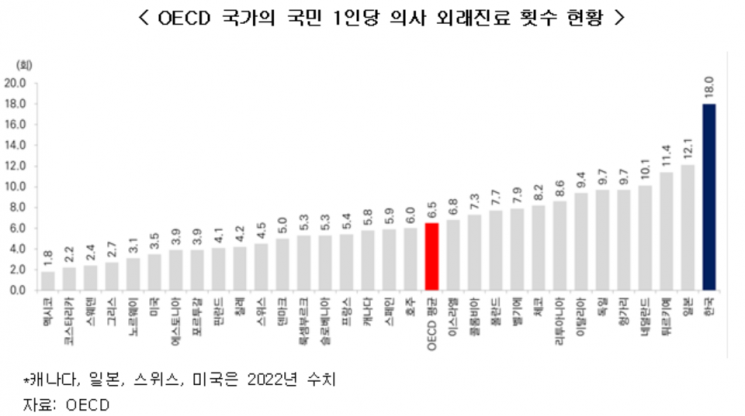
Additionally, South Korea had the highest number of outpatient visits per capita among OECD countries, with 18.0 visits per person annually. Current healthcare expenditure accounted for 8.5% of the gross domestic product (GDP), which is somewhat lower than the OECD average of 9.1%, but it has been rising rapidly over the past decade. The per capita pharmaceutical sales amounted to $968.9 PPP (purchasing power parity), higher than the OECD average of $658.1 PPP.
Among the population aged 65 and older, the proportion of long-term care recipients was 9.0% for home-based care and 2.7% for facility-based care, both lower than the OECD averages (home-based 11.2%, facility-based 3.5%). However, due to the increase in the elderly population, the growing demand for long-term care services, and expanded coverage, these figures have been rising rapidly over the past ten years.
Lim Hoguen, Director of Policy Planning at the Ministry of Health and Welfare, stated, "We will continue to expand the production of internationally comparable health and medical statistics for South Korea through ongoing cooperation with international organizations such as the OECD and the World Health Organization (WHO), and we will strive to strengthen quality control of these statistics so that the public can utilize them in various policy areas."
© The Asia Business Daily(www.asiae.co.kr). All rights reserved.
![Clutching a Stolen Dior Bag, Saying "I Hate Being Poor but Real"... The Grotesque Con of a "Human Knockoff" [Slate]](https://cwcontent.asiae.co.kr/asiaresize/183/2026021902243444107_1771435474.jpg)
















