Bank of Korea Reports June Weighted Average Rates
Mortgage Loan Rate Rises to 3.93% per Annum, Up 0.06 Percentage Points
Five-Year Bank Bond Benchmark Rate Increases by 0.11 Percentage Points
"Additional Interest Rate Shows Little Change in July, Limited Impact on Mortgage Loans"
The interest rates on mortgage loans handled by banks have reversed course and risen for the first time in five months, entering the 3.9% per annum range. This increase is attributed to the rise in the five-year bank bond rate, which serves as the benchmark rate. The impact of additional interest rates resulting from the government's strengthened household debt management measures announced on June 27 will need to be monitored as market conditions evolve.
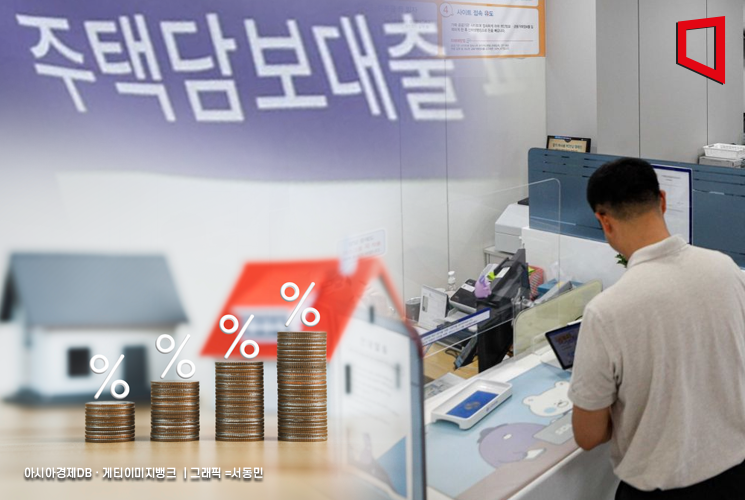
According to the weighted average interest rates of financial institutions for June, released by the Bank of Korea on July 30, the mortgage loan rate (based on new loans) at deposit banks last month was 3.93% per annum, up 0.06 percentage points from the previous month. This marks a reversal to an upward trend for the first time in five months. The mortgage loan rate had climbed to 4.27% per annum in January, then fell for four consecutive months from February, before rising again last month. Specifically, the fixed-rate mortgage rate (3.92% per annum) increased by 0.06 percentage points, while the variable-rate mortgage (3.99% per annum) rose by 0.02 percentage points. Kim Minsu, head of the Financial Statistics Team 1 at the Bank of Korea, explained, "The rise in the mortgage loan rate in June was due to the 0.11 percentage point increase in the five-year benchmark rate," and added, "Since the five-year rate is a long-term rate, it reflects expectations regarding changes in the base rate." He also noted that it is difficult to say that the additional interest rate increased in June, as the rise in mortgage rates was smaller than the increase in the benchmark rate.
The household loan rate, which includes mortgage loans, was 4.21% per annum, down 0.05 percentage points from the previous month. This marks a decline for seven consecutive months. While the mortgage rate rose by 0.06 percentage points and the jeonse loan rate also increased by 0.01 percentage points to 3.71% per annum, marking its first increase in seven months, the general credit loan rate (5.03% per annum) fell by 0.18 percentage points due to the decline in short-term benchmark rates such as short-term bank bonds and COFIX. General credit loan rates have been on a downward trend for seven consecutive months since December last year (6.15% per annum).
The corporate loan rate fell by 0.10 percentage points to 4.06% per annum, reversing to a decline after one month. The cut in the base rate led to a drop in short-term market rates, such as the 91-day certificate of deposit (CD) and short-term bank bonds, resulting in declines for both large corporations and small and medium-sized enterprises (SMEs). The rate for large corporations fell by 0.15 percentage points to 4.00% per annum, while the rate for SMEs dropped by 0.06 percentage points to 4.11% per annum. Kim explained that the larger decline in large corporate loan rates was due not only to the fall in short-term market rates but also to a base effect from a high-interest acquisition financing deal for a specific large corporation in May.
The interest rate on time deposits and other savings deposits (based on new deposits) was 2.55% per annum, down 0.08 percentage points from the previous month. This marks a decline for nine consecutive months since October last year (3.37%). The pure savings deposit rate, mainly for time deposits, fell by 0.10 percentage points to 2.54% per annum. The market-type financial product rate, mainly for CDs, fell by 0.03 percentage points to 2.55% per annum.

The loan-to-deposit interest rate spread (loan rate minus savings deposit rate, based on new transactions) was 1.54 percentage points, unchanged from the previous month. The spread based on outstanding balances was 2.20 percentage points.
It is explained that changes in banks' additional interest rates following the June 27 measures will need to be monitored going forward. The total volume-based regulation of the June 27 measures has so far contributed to stabilizing the real estate market and household loan trends to some extent, so changes in additional interest rates and other rates may also vary depending on future market conditions. Kim stated, "It is difficult to say that banks' additional interest rates increased in June, and there is no significant change in additional interest rates in July either," adding, "The five-year bank bond rate also remained stable in July compared to June, so the mortgage loan rate is unlikely to show significant changes in July."
Meanwhile, the proportion of fixed-rate household loans rose by 2.1 percentage points from the previous month to 61.9%, marking a two-month consecutive increase due to the rise in fixed-rate jeonse loans. The proportion of fixed-rate mortgages among all mortgages fell by 1.0 percentage point to 90.6%.
Among non-bank financial institutions, the deposit interest rate for one-year term deposits, excluding mutual savings banks, fell across the board. Loan rates (based on general loans) also declined for all institutions.
© The Asia Business Daily(www.asiae.co.kr). All rights reserved.
![Clutching a Stolen Dior Bag, Saying "I Hate Being Poor but Real"... The Grotesque Con of a "Human Knockoff" [Slate]](https://cwcontent.asiae.co.kr/asiaresize/183/2026021902243444107_1771435474.jpg)

















